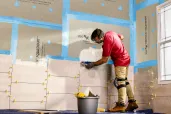
Autofeed screw guns have been around for years. The best-known models have cords and consist of a nosepiece that’s attached to another manufacturer’s screw gun or drill-driver. But in the last year or so, a couple of companies started making cordless versions with a nosepiece that’s integral to the rest of the tool. I wanted to see how well they worked, so I borrowed two to use on a bathroom I was remodeling.
I could have used corded tools, but cords get in the way when you’re working in tight quarters. And cordless tools are reaching the point where they perform about as well as tools with cords. The only limitation is run time, which is not a big issue when you’re remodeling small to medium-size rooms.
Cost vs. Productivity
The idea behind autofeed tools is to speed up the work. But collated screws are a lot more expensive than bulk screws, so the gain in productivity needs to offset the increased material cost. When sold in bulk, 1 1/4-inch screws go for around $4 per thousand, but they cost $14 per thousand when collated. As a result, some trades have been more receptive than others to autofeed guns.
Many carpenters now use screws to fasten subflooring, underlayment, and deck boards. The speed they gain from using an autofeed gun more than makes up for the added cost of collated fasteners. It isn’t faster than using a pneumatic nailer, but it produces a better product. On the other hand, professional drywall hangers have been reluctant to make the switch from bulk to collated screws, because they can drive loose fasteners as quickly as you or I can drive collated ones. However, if you hang board only occasionally, the added fastener cost is insignificant next to the time you save by using an autofeed gun.
Cordless guns are not intended to replace corded models for all tasks. Screwing off vast areas of subfloor means putting in a large number of fasteners as quickly and probably not as accurately as possible. Cordless models are not intended for this task, which is why they aren’t available with extensions that let you work from a standing position.
The cordless autofeed guns I tested were from Makita and Senco. Both tools take the same plastic collated screws, which come 50 to a strip. These fasteners are compatible with guns from Grabber, Hilti, Milwaukee, and PAM.
Senco DS200-14v
The first gun I tested was Senco’s DS200-14v. It’s a general-purpose tool designed for the remodeling market. This gun is powered by a 14.4-volt 1.7-amp-hour battery. It runs at 2,300 rpm and drives fasteners from 1 to 2 inches long. The DS200-14v is part of Senco’s DuraSpin line, which includes a number of corded and cordless models. I did not test the drywall version of this tool, model DS162-14v. It spins at 4,000 rpm and drives screws up to 1 5/8 inches long. The drywall model has less torque than the version I tested but will drive more short screws on a single charge.
I used the DS200-14v to fasten drywall, subflooring, and various pieces of blocking. Besides driving screws rapidly, the best thing about this tool is how comfortable it is in your hand. The contoured handle is very ergonomic. And all the grip surfaces including trigger, handle, top, and back end are covered with a cushioned rubber material. According to the manufacturer, this gun weighs 4.9 pounds. But it feels lighter than that, and I think that’s because it’s so well balanced. Most autofeed guns have pistol grips, which put the weight of the tool out in front of your hand. The DS200-14v has the sort of mid-handle grip found on cordless drill-drivers, so the weight is centered over your hand. This is not the ideal configuration for fastening drywall, but it’s better for everything else.
The Senco DS200-14v shoots screws from 1 to 2 inches long. According to the author, it has excellent balance and precise depth-of-drive adjustment.
Senco’s gun had no trouble driving 1 5/8-inch screws through subflooring into dry Douglas fir joists. It also put 2-inch screws through plywood into solid lumber. Even if it took longer screws, I doubt it would have the power to drive very many of them. If you want to drive the 2 1/2- and 3-inch screws needed to fasten 2-by decking, you’ll need a more powerful corded model. That said, a 2-inch screw is long enough to fasten 4/4 and 5/4 deck boards, and corrosion resistant fasteners are available in that size.
The DS200-14v can do a surprising amount of work on a single charge. According to the manufacturer, it will put 650 1 1/4-inch screws through drywall into wood before it needs to be recharged. I tested this with a fresh battery and managed to drive 610 screws before both the battery and I needed a recharge. (According to Senco, the DS162-14v will drive 975 screws on a charge.)
Strips of screws are easy to load, though switching lengths meant using an Allen key to remove and reinstall a set screw. This is my least favorite feature of the tool, because it’s easy to drop and lose small parts on a job site. To change the depth of drive, you turn a thumbwheel on the side of the housing. You can do this in very fine increments, so it’s easy to get whatever setting you want.
The strips of screws are very floppy, but the shielded guides on Senco’s gun keep them more or less out of the way. Fasteners feed cleanly through the nosepiece, and the only time I had trouble was when I let up before the screw was all the way into the work. A spring-loaded nosepiece similar to the bale on a pneumatic finish nailer advances a new screw each time it’s pressed into the work. The nosepiece is open and doesn’t block your view, which makes it easier to place fasteners exactly where you want them.
The DS200-14v retails for around $200 and comes in a plastic case with a charger, two batteries, extra drive bits, and Allen keys.
Makita 6831DWA
The second cordless autofeed screw gun I tested was Makita’s 6831DWA. It resembles one of the company’s corded models but is powered by a 12-volt 2.0-amp-hour battery. This gun runs at 2,000 rpm and drives fasteners up to 1 5/8 inches long.
The 6831DWA is a general-purpose tool that does a good job of fastening drywall and subflooring. Although it doesn’t shoot the longer screws that Senco’s gun does, 1 5/8-inch fasteners are long enough for the vast majority of tasks I’d want to perform with a small autofeed gun.
I used the Makita gun to refasten the subfloor in a bathroom I was remodeling. It had no trouble driving 1 5/8-inch screws into dry Douglas fir joists. I also used it to fasten drywall and found that its compact size made it easier to get at inside corners and work in tight spaces. Makita’s gun is about the same length as Senco’s but is 3 inches shorter top to bottom.
The Makita 6831DWA drives screws up to 1 5/8 inches long. It comes standard with one battery.
The 6831DWA is configured like a traditional drywall gun with the grip at the back end of the housing. As a result, it doesn’t feel as well balanced as a gun with a mid-handle design. But pushing from the back is a more natural position for driving a large number of fasteners. That’s why drywall hangers grasp the back of the housing instead of the handle of the screw gun. It’s easier on the wrist because it turns the tool into an extension of your arm. The Makita gun is a solid-feeling 4.4-pound tool with a contoured handle and hard-plastic housing. It has a reversible belt hook for left- or right-hand use.
Depth of drive is adjusted by turning an indexed thumbwheel on the housing. The sides of the nosepiece are closed, so it’s hard to see the exact spot the screw will be placed. However, screw placement is not a big issue when you’re fastening drywall and subfloor, and there are index marks on the side of the nose to help line up the fasteners. The only problem I had with this gun was the occasional jam due to the collation strip getting twisted on its way into the guides. This happened only when the nose was pointed down and was easily fixed by twisting the strip back into place.
I was surprised at the amount of work Makita’s gun would do on a single charge. It put 575 1 1/4-inch screws through 1/2-inch drywall and into dry framing before the battery gave out. At 40 to 50 screws per sheet, that’s about 12 full sheets of drywall.
The 6831DWA retails for about $270 and comes in a plastic case with one battery, a charger, and spare screw tips.
Happy Choice
Personally, I’d be happy to own either one of the autofeed guns I tested. Because I do general remodeling and like the versatility of the longer fasteners, I’d probably buy the Senco. If all I wanted to do was fasten subfloor and drywall, I’d prefer the handle configuration of the Makita. David Frane is a finish carpenter and a contributing editor to The Journal of Light Construction