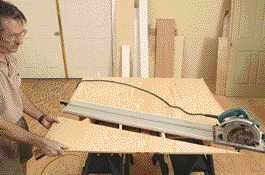
Cabinetmakers are probably more familiar with layup tables than carpenters and remodelers are. Layup tables allow you to make cuts without damaging the underlying surface; they’re also great for assembly work. For example, when assembling a face frame, you can raise it on the layup table so the work surface below doesn’t interfere with the clamps. On site, I use layup tables for edge banding and cutting plywood.
There are many designs, but layup tables generally use evenly spaced supports screwed to a sheet of plywood or some other panel product. I made mine from a 4-foot-by-5-foot piece of plywood with 1×4 cleats screwed to it on edge every 16 inches or so. It’s still not quite big enough for a good-sized face frame, but I didn’t want to build it any bigger — I wouldn’t have room to store it, and it’s already too big for my van. So, when I need a layup table on site, I usually cobble one together from whatever is lying around.
The Smart Table
Now, however, with the expandable layup table from Eurekazone (732/259-9984, www.eurekazone.com), I no longer have to worry about any of that. Called the Smart Table, it’s sold in a kit that includes everything you need to build a sturdy, compact layup table. Unlike the permanently mounted cleats on most layup tables, the Smart Table’s sliding cleats allow you to expand the table to 4 feet by 8 feet and then collapse it for easy storage and transport. The kit includes bolts, bottom tracks, guides, and even the drywall screws you need for assembly.
Simple setup. To assemble the table, you start with a 2-foot-by-4-foot piece of plywood — but rather than screwing cleats directly to it, you bolt the kit’s plastic tracks to the plywood. The tracks receive mating plastic slides that attach to the 1-by support cleats. The sliding supports are the key to the table’s small footprint and large capacity. To improve flexibility, the two end tracks are each secured with a single bolt so they’ll pivot. When the end cleats are perpendicular to the side cleats, the table expands to 4 feet by 8 feet and can support a large face frame or a full sheet of plywood.
I cut my cleats 3 inches tall, but you could make them shorter or taller. The instructions recommend fastening the end tracks so they butt into each other, but with 24-inch cleats, you’d have to remove one set of cleats to store the table. Since I wanted all the cleats on the board at all times, I mounted the end tracks so the cleats would slide by each other for smaller projects and storage. The center supports use similar hardware, but they don’t pivot. You can slide a single cleat into each track or use two cleats per track to widen the table to 4 feet.
My only complaint about the Smart Table is that when the plastic guides are extended to their maximum reach, they tend to flex. This hasn’t been a big problem, but a metal guide would work better. I also wonder what a system like this would be like if it were made with heavy-duty full-extension drawer slides.
The table works well for cutting plywood and assembling face frames. It’s great because I’m able to get my vise-grip clamp into any location. If one cleat is in the way, I just slide it in or pivot it a little, but the frame is always supported.
The Smart Table sells for $55 on the company’s Web site.
EZ Smart Saw Guide
The Smart Table actually wasn’t designed with face frames in mind. The inventor wanted a table that would work well with his saw guide, the EZ Smart Guide System. I’ve used a lot of saw guides, from homemade plywood versions to Festool’s plunge-cut saw and guide rail, and just about everything in between. If you’re reluctant to invest in a Festool saw and guide, this 8-foot guide is a good substitute. The guide I tried is made in two 4-foot aluminum sections, but the company also offers 50-, 150-, and 200-inch versions. Track sections can be joined together or used singly. The sections join with dovetail splines, creating a dependably straight cutting guide — mine was off less than 1/16 inch over 8 feet.
Mounting it.
The manufacturer provides nuts and bolts for mounting the saw to the plastic sled, but I couldn’t bring myself to drill holes in the base of my saw. Instead, I secured it with double-sided high-strength tape. I’ve banged the saw around plenty, and the tape seems to be holding very well. One of the nice things about this guide system is that it prevents tear-out on both sides of the blade. The guide protects one side of the cut, and an insert in the bottom of the sled protects the other side.
Using it. Unlike homemade shooting sticks, which are often held in place with spring clamps, this guide will never move. It clamps quickly and easily, and never interferes with the operation of the saw. Even when you’re using the guide at its maximum length, the cut is always perfectly straight and splinter-free, and the saw balances comfortably. And if you use the guide with the Smart Table, you don’t have to worry about the drop-off breaking loose at the last second and splintering your cut.
For $190, the EZ Smart Guide model 100 includes the two-section track, two clamps, the sled, and four zero-clearance inserts — two that work with the saw guide and two for freehand cutting. A router attachment ($125) can also be used with the guide and provides an accurate way to cut flutes, make tapered columns, and cut curved trim.
Gary Katz, a finish carpenter in Reseda, Calif., moderates the jlconline.com finish-carpentry forum.
Landscape Tools
by Patrick McCombe 
Make the Grade.
With its unique S-shaped tooth pattern, the New England Sifter is the perfect rake for spreading topsoil and removing small rocks before seeding. Like the company’s other aluminum rakes, the Sifter features sturdy construction and a lightweight anodized handle. It comes in five different widths, from 24 to 48 inches; prices range from $45 to $60. The New England Rake Company, 203/933-1230, www.newenglandrake.com

Hole Hog.
Getting excited about digging holes isn’t easy, but maybe a cool new post-hole digger can stir things up a little. The Fiskars Post-Hole Digger is completely different from other models I’ve seen. Steel offset handles eliminate knuckle-smashing and are less likely to break than wooden ones. According to the manufacturer, the new tool can dig down to 48 inches instead of the more typical 36 inches — oh, boy! It sells for $45. Fiskars, 800/500-4849, www.fiskars.com

Single-Track Hauler.
On my old job sites, we’d refer to the wheelbarrow as “the poor man’s dump truck.” It was one of the most widely used and abused vehicles in the fleet. In addition to traditional landscaping tasks, we used it for moving boxes of nails, mountains of old plaster, and acres of stripped roofing. Since the average wheelbarrow turned out to be no match for those materials, we eventually graduated to more robust, steel-framed versions — like the Union 77015. With its 6-cubic-foot capacity, cushioned steel handles, and two-ply tire, this powerhouse is almost as good as a real dump truck. It sells for about $90. Union Tools, 800/888-4196, www.uniontools.com
Measuring Tools


Pocket-Sized Laser Level
To challenge the highly regarded PLS lasers, DeWalt recently introduced its own version of a compact laser tool with both horizontal and vertical beams: the DW087K. According to the manufacturer, the new laser performs better than competitive products because the tool body features a clipped corner that gives the unit greater vertical range, especially when it’s placed close to the wall. The tool’s magnetic mounting bracket swivels, and the controls are designed to be more intuitive than the single-button control on PLS products. DeWalt also offers a model — DW086K — with a horizontal line only. Both units include a case and are accurate to 1/8 inch at 30 feet. The DW087 sells for $250 and the DW086 for $200. DeWalt, 800/433-9258, www.dewalt.com

Low-Cost Laser Measurer.
Don’t have a laser measuring tool? You’re not alone. They’re great for generating estimates and taking difficult measurements, but a $400 price tag has deterred many contractors from getting one. However, with the recent introduction of Stanley’s $100 FatMax TLM 100, expect laser measuring tools to become as ubiquitous as 30-foot tape. With a range of 2 to 100 feet and accuracy of 1/4 inch at 100 feet, the TLM 100 doesn’t offer as many functions as some laser measuring devices — but it does include a square-footage function, measurement storage, and a built-in calculator. Stanley, 800/782-6539, www.stanleyworks.com

Crowning Achievement.
For a long time, the Bosch angle-finder was the only tool designed specifically to measure corners for crown-molding installation. Lately, though, a couple of other angle-finding tools have arrived on the scene. One of the most feature-laden is the The Finisher Angle Calculator. Designed by a professional carpenter, this device incorporates a chart showing the miter and bevel settings for cutting 45- and 38-degree crown molding on the flat, and a slotted measuring arm that allows the tool to function like a T-bevel. The calculator comes in three other models — Framer, Remodeler, and Basic — as well, each with slightly different features designed for different carpentry specialties. The Finisher, Framer, and Remodeler calculators sell for $50; the Basic sells for $40. Mayco Tools, 877/742-7842, www.maycotools.com
A Better Protractor.
When the original ProSite protractor was introduced a couple of years ago, I was thrilled. Somebody had finally produced a well-made carpenter’s protractor that not only showed the angle for an accurate miter, but also indicated the saw settings. Now there’s a new version of the tool. Like the original, it has an easy-to-read scale and a tight-tolerance joint where the legs meet. Unlike the original, the 7-inch 505A-7 fits in your toolbelt. It costs about $50. The L.S. Starrett Co., 888/674-7443, www.starrett.com