When my business partner, Brian Bartholomew, and I began to support our elderly parents some years ago, we became acutely aware of a national phenomenon: the aging of America. Today, people aged 80 and older are the fastest-growing segment of the population. Members of our own generation — the baby boomers — are quickly becoming eligible for those discounted early dinners at buffet restaurants. Even in our relatively youthful 50s and 60s, many of us are beginning to experience the realities of aging, from hip and knee replacements to hearing and vision impairments.
Before
After
Clearly, all of this puts new demands on the home environment. Yet it seemed to Brian and me that the average senior’s home was a much-neglected factor in the aging equation.
Increasingly, seniors want to “age in place,” meaning they want to live out their lives in their own homes, rather than in a facility. Often this presents a variety of “built environment” challenges, from minor adaptations to major modifications. Because few remodeling companies in our area were addressing those needs, we founded In Your Home to help this growing market segment.
Remodelers interested in this specialty need to develop a heightened awareness of the common effects of aging. Vision, hearing, strength, and balance tend to decline. The ability to handle temperature extremes decreases; thermal comfort becomes a major concern. These changes affect a home’s design and drive the selection of materials and fixtures.
Resources are available. Two good places to start are NAHB’s CAPS (Certified Aging-in-Place Specialist) training and the National Resource Center on Supportive Housing and Home Modification’s online courses. (For contact information — and further resources — see the sidebar below). We’ve participated in both programs.
When we first started our company, we expected that the bulk of the work would center around safety modifications like access ramps and grab bars. And indeed, they are a core element of our work.
But there’s more to the aging-in-place market than making accessibility modifications. Since our entire mission is based on supporting mature clients who — like all of us — want to be comfortable and secure in their homes, we also do plenty of business simply helping to create and maintain nicer spaces in which to live. That covers everything from providing a fresh coat of paint and new work surfaces to installing energy-efficient windows.
Just because seniors deal with issues of frailty doesn’t mean they throw comfort and aesthetics out the window. Many a client has opened a discussion with the words, “I don’t want it to look like a darn nursing home around here!”
Preserving the Home’s Value
Many homeowners are concerned about the effect modifications will have on real estate value. Our clients often ask us whether an accessible bath, say, or a ramp will add or detract from their home’s value.
Whenever possible, of course, we add value. With some kinds of modifications, though, this just isn’t possible, so we try to make these alterations in such a way that they won’t be permanent.
A ramp project, for instance, can be a modular design that doesn’t require permanent footings, making it easier to remove when the time comes. (For a good primer on ramp construction, see the Web-resources listing in the sidebar below.)
In one case — a bathroom remodel — we replaced an old claw-foot tub with a barrier-free shower. The new shower partially obscured a window, and the installation didn’t complement the style of the 1920s-era home. But the new unit was sturdy and economical, so we — along with the client — made a deliberate decision to place function ahead of aesthetics. We expect that when the home is sold in the future the bathroom will be redone.
Easy Entry
Getting the client into the home safely and conveniently is a good starting point for any design.
While we do sometimes build wood ramps for access, the solution is often simpler. For example, we can replace one-step transitions at the front entrance with several feet of gently sloping concrete, or use a series of small height transitions into the house.
There are times, however, when those strategies just don’t fit, and then we install an exterior mechanical lift (Trus-T-Lift, Ram Manufacturing, 800/563-4382, www.trustram.com).
Safety and Comfort Inside
Since most seniors experience some loss of vision and increased sensitivity to temperature, these issues — in addition to accessibility — guide much of our work.
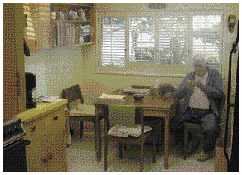
When we redo a room, we look for ways to improve lighting and provide color contrast; our goal is to make the space both easier to navigate and more stylish. For example, we use color to set up a distinct contrast between wall and floor, and contrasting elements like chair rails and baseboards to make the room’s edges more visible.
Before
After
Another approach is to create flooring inlay patterns that outline major pathways. We frequently highlight countertop edges with contrasting strips of color, too; we steer clear of single-color decorating schemes that can confuse depth perception and invite accidents. In fact, many of our customers prefer more intense paint colors; as we age, our eyes lose sensitivity to color, especially in the blue spectrum.
Glare can be disorienting for people with cataracts or glaucoma, so we avoid glossy counter surfaces.
Sometimes we lay laminate flooring in the kitchen and hallways; its smooth, hard surface is easy to navigate with a walker or in a chair. In living rooms and bedrooms, we may use a low-nap, stain-resistant carpet over a thin pad. We like the BerberMax pad (Leggett & Platt, www.lpurethane.com), which has the added advantage of repelling moisture and resisting mildew.
If a resident uses a wheelchair, we make sure to evaluate sightlines from a seated perspective; sometimes we’ll end up reorienting lighting fixtures to eliminate glare, or we’ll lower a window’s location to improve operation and the view outside. Adding skylights is a good way to increase natural lighting.
We commonly install remote-control ceiling fans in bedrooms and sitting areas; these are easy for homeowners to operate from a chair or bed.
To improve general navigability throughout the house, we replace existing round doorknobs with levers. Sometimes we’ll replace wall switches with Decora-style rockers lighted for nighttime safety. Both changes, though minor, are of real benefit to people with arthritic hands.
Thermal comfort. Since many older houses are drafty and underinsulated, we may add insulation or even tighten the exterior shell.
On one recent project, for instance, we replaced old ’70s-era fixed aluminum windows with operable vinyl units. In the living room, we tore out a drafty masonry fireplace and installed a thermostatically controlled gas model. The home already had air conditioning, but we increased the ceiling insulation to R-49 to mitigate the effect of a hot summer attic.
Working Kitchens
The kitchen is always a main focus of our work, especially for any client who uses or foresees using a wheelchair.
Typically in older homes the door into the kitchen is too narrow, and there’s often not enough room in the kitchen itself to turn a wheelchair. While modern power chairs can turn on a dime, accessible-design guidelines still prescribe a 5-foot turning radius. Plus, keep in mind that there’s frequently more than one person working in the kitchen.
Consequently, we often have to find floor space, either by removing cabinets or stealing additional space from adjacent rooms. Unfortunately, the added space can be costly and is unlikely to add equivalent value to the home. Still, because the kitchen is the center of the home’s activities, the expense is usually acceptable to the client.
Along with adding open floor space, we improve the lighting — both undercabinet and overhead — and add accessible pull-out cabinet storage, which is easier for both seated and standing residents to use.
We also like to install side-swing wall ovens. With these units, there is no need to bend over to reach inside, and the side-swing door is relatively effortless to operate. Frigidaire makes a well-priced unit; other manufacturers offer similar models at higher cost.
We have found that a modified off-the-shelf kitchen cart is great for transporting hot or heavy pots across the kitchen or to the dining table; the cart also serves as a handy work surface that can be tucked away in the cabinetry when not needed.
Safe Bathrooms
The bathroom is potentially the most dangerous room in the house for the elderly, so we concentrate on safety features there.
Grab bars. We install grab bars as a matter of course, always adding blocking if we have access to the wall cavity. When consulting with clients, I often liken grab bars in the bathroom to seatbelts in cars; back in the early ’60s, seatbelts were an option that many folks took a rather dim view of. Now you can’t buy a car without them.
Similarly, grab bars may signal frailty to some, but in reality they provide common-sense support for people of all ages. Furthermore, these days they can be flawlessly integrated into the decor, thanks to modern materials and designs.
On one of our jobs, the clients insisted on keeping the regular towel bars in the bath used by their elderly father. Predictably enough, they called a year later to say their dad had pulled one loose while using the toilet; they asked us to replace them with real grab bars.
Accessible shower. Even with the addition of grab bars, many elderly folks are not able to step over the sides of traditional tubs, so we frequently replace tubs with low-threshold shower units from Best Bath (800/727-9907, www.best-bath.com). We find these units easy to install on a remodel and we like their layered construction, which allows seats and bars to be attached anywhere.
We seldom install standard-height toilets anymore; everybody — young and old — appreciates comfort-height units, which are about 2 inches taller than the traditional johns, because they’re easier on the knees. We have installed a range of models from Toto, Kohler, American Standard, and Eljer, to fit budgets and design preferences.
For better traction, we treat bath tiles with No Skidding coating (800/375-0571, www.noskidding). This product is easy to apply and actually has a greater friction coefficient when it gets wet.
Undertile electric radiant heating is a good fit on many of our jobs; tile can feel cold in any climate, and this is an economical way to add comfort.
Occasionally we’ll have to work on the framing to make it easy to enter the bathroom in a wheelchair. We try to do this as inexpensively as possible, borrowing from nearby space as needed. A 3/0 pocket door makes for easy passage.
Don’t Forget Storage
Major storage areas are crucial for people downsizing from a larger home, so we’ll add lots of shelving where we can. An attached garage is ideal for this, but we’ll also look for other places to tuck accessible storage.
On one job, we enhanced the garage storage by applying a no-slip coating to the slab, Rust-Oleum’s AS5400 System Anti-Slip One-Step Pedestrian Epoxy (800/323-3584, www.rustoleum.com).
As both homeowners and remodelers start paying more attention to universal design principles and taking note of all the advantages that come with aging in place, I have no doubt we’ll continue to discover better ways to design and construct senior-friendly housing. And the more our industry adopts a mind-set conducive to aging in place, the better and more permanent our homes will become.
David Dickinsonis a principal partner of In Your Home, a Portland, Ore., remodeling company that specializes in the aging-in-place market.
For More Information
Training Programs
NAHB’s CAPS (Certified Aging-in-Place Specialist) program, 800/368-5242, www.nahb.org
National Resource Center on Supportive Housing and Home Modification online courses, 213/740-1364, www.homemods.org
Web Resources
Online courses (see above); news; directory of home-modification programs and such resources as safety checklists and product listings
www.ncsu.edu/www/ncsu/design/sod5/cud/
Downloadable documents, including house plans, ramp designs, and “simple solutions”
www.aarp.org/families/home_design
Checklists and sections on modifications for bathrooms, walkways, and kitchens
Articles on ramp design and a manual of design and construction for modular wheelchair ramps
www.cornellaging.org/gem/research_index.html
Articles on home modification with an emphasis on safety and independence
General site focused on preventing falls
Site for seniors; includes a section on housing options