Airborne sound can only travel through air pathways. Since walls and floors are continuous, once you plug keyholes, cracks around windows and doors, and various penetrations for mechanical and electrical systems, you effectively block those sound paths.
Blocking Airborne Sound The weatherstripping that seals outside windows against drafts also seals out airborne sound, at least while the windows are closed. You can take the same tack with an interior door, weatherstripping it just as you would a door to the outside, complete with a threshold or sweep. If you’re adding a door as part of a remodel, use a solid-core door rather than a hollow-core for better sound control. Electrical outlets in open-cavity stud walls are another easy sound path between rooms. These can be plugged by removing the outlet from the wall, stuffing some mineral fiber insulation behind the box, sealing the holes in the box with silicone caulk, and re-installing the box. Ductwork. Cutting sound transmission through ductwork is not as simple. The problem shows up in cases where the duct outlet that serves a “quiet” room shares a common duct with an outlet in an adjacent noisy room. A lot of sound can be transmitted if the outlets are close together, less if they are distant from each other. The best fix is to separate the takeoff points as much as possible. If you can’t do this, you’ll help things somewhat by lining the inside of the duct with acoustic insulation. Be sure to size the duct to compensate for the added insulation.
Vibrations
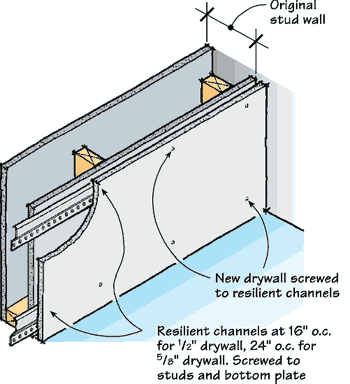
In many cases, noise transmitted directly through walls or floors may be a much greater nuisance than airborne noise. These sounds are caused either by noise in one room that vibrates the intervening floors or walls or by physical impact, such as doors slamming and footfalls. To get a feel for how this works, think of the drywall surface on one side of a 2×4 stud wall as a diaphragm that vibrates in response to sound pressure waves in the air or a door slamming against it. The studs, rigidly attached, pass these vibrations right through to the drywall on the other side, which passes the noise to the next room. The key to stemming this noise route is to isolate the elements of the wall from one another. An easy way to do this to an existing wall is to add a second layer of drywall on the far side, attached with resilient channels (see Figure 1).
Figure 1.To improve the sound-dampening ability of a existing stud wall top) or ceiling (bottom), add a second layer of drywall supported on resilient channel. The channel helps isolate the new wall of ceiling surface from any vibrational noise that might be carried through the original framing and drywall, reducing sound by around 40%. The channels act like springs to absorb the vibrations from the main wall, cutting the structure-borne sound by about 40%. (You can use a similar approach for the ceiling of a room with living space above.) An even better solution is to build a separate new wall (Figure 2), which will give you a cavity for new wiring and a surface for the receptacles.
A better sound-dampening option is to build a new wall alongside an existing wall, separated by 1/2 inch to break the sound path. Adding batt insulation will additionally cut down on airborne sound between the rooms. Adding R-11 batts helps absorb airborne sound. Jerry Germer is an architect in Marlborough, N.H.