If you read trade magazines and other publications geared to builders, you already know that there are all kinds of local, regional, and national awards programs for excellence in building and remodeling. On the surface, these might seem like an excuse for builders to get together and pat one another on the back. The reality is quite different. After more than 20 years of competing for and winning awards, I’m convinced that good builders win awards because they’re good, but also that winning awards can help make a good builder even better.
Award-Winning Benefits
There are some obvious benefits to being able to present yourself as an award-winning builder. First, it attracts new customers by putting your name before the public in a favorable light. Local newspapers often cover awards presentations as news, and this is the best advertising you can get. I have many customers who first heard about our company in this way.
Second, awards are very reassuring to customers who have heard about you from other sources. When I hold a sales meeting in my office, I don’t have to say anything about the many awards we’ve won over the years — they’re right there on the wall. This tells the customer that we’re a solid company with an established reputation for doing top-quality work.
Building a portfolio. But there are also some important spin-off benefits. You need good photos to enter awards competitions, and that forces you to get more and better photos of your jobs than you otherwise might.
We enter six or eight competitions annually, and over the years we’ve built up a large photographic portfolio of our most successful past projects. When customers describe the type of kitchen they have in mind, for example, we can often pull out photos of a similar project. This often helps bring the clients’ ideas into focus, and it also demonstrates that we’re organized and experienced.
Web fodder. Our collection of photos also came in handy a few years ago when we made the decision to set up a website. We were able to scan a selection of before and after shots and post them on the site, allowing potential customers to take virtual tours of many different projects.
Customer participation. A builder who plans to enter a project in an awards competition has to obtain a signed release from the client before doing so. In my experience, that’s not a problem for most people. (To protect privacy, contest rules usually prevent customer names and addresses from being made public.)
Many of my customers, in fact, are interested to learn that their home may be in the running for an award. If their project wins, they’re often far more excited than I am. Besides being tickled to death that we did our best work on their house, the customer is also left with the feeling that they hired the best possible person to do the job. They’re quick to share the story with their friends and neighbors, and that often leads to more work.
Planning a Campaign
How do you go about winning awards? It’s simple: by entering contests. Lots of builders do potentially award-winning work, but most of them either don’t realize it or feel that they can’t justify spending time entering contests when they have so many other things to do. That’s understandable, but short sighted.
Seed money. Contest entry costs are a budget line item for our company, because that’s the only way to make sure the necessary work gets done. This year, we’ve budgeted $2,500 to cover entry fees, photography, and the hours that a staff person and I will spend in preparing a half-dozen or so applications.
Contests and categories. I’ve found that local awards benefit my company most directly. Several years ago, we competed for and won a prestigious national remodeling award. That made us feel great, and the medal looks good hanging on the wall, but as far as I know it’s never brought me a single customer. On the other hand, I do a lot of work for clients who hear about me through an awards program run by our local NAHB affiliate, the Peninsula Remodelors Council.
The Showcase Awards program, as it’s called, includes about ten entry categories, such as Residential Interior, Kitchen, Bathroom, and Residential Exterior. Each of these appears in two different price ranges: one for projects under $50,000, and another for projects that cost more than that amount (see Figure 1). Contest entries are due by the beginning of September, but we start planning many months ahead.
Figure 1.Awards competitions are usually divided into categories by project type and price range. Concentrating on mid-range projects in less popular categories improves the odds of success.
Early each year, we compare the list of contest categories to the jobs we have coming up, to decide which projects to enter. One of the first things we consider is the amount of competition each category is likely to attract.
For example, builders and remodelers take special pride in their biggest, most spectacular projects. (I think of projects like that as potential “salesmanship awards,” since selling a job like that is often the real challenge.) As a result, contests receive a lot of entries for big, high-end projects and fewer entries for middle-sized and small jobs.
Small is beautiful. Don’t overlook very small projects that turned out extremely well within the limits of a tight budget. We’ve done well in the Small Job category of our local program, which has an upper limit of $5,000. Because these aren’t as exciting as larger projects, they attract fewer entries, so the odds of winning are a lot better.
We also try to spread out our entries. If you enter several projects in the same category, you’re effectively competing against yourself. It’s usually more productive to play the odds and enter as many different categories as possible. Don’t overlook the possibility of dividing a single large project into several smaller categories. When we do a whole-house remodel, we may enter the master bathroom in one category, the exterior addition in another, and the remodeled kitchen in a third.
Photographs and Applications
In most cases, the photos you provide will be all the contest judges have to go on when evaluating your entry. (In a big national competition, the judges may also make a site visit, but the right photos are still necessary to get you to that stage.) A project may be a tremendous success in every way, but if you don’t have good photos, the judges have no way of knowing that.
Before and after. I take the before and after photos of our jobs with a fully automatic 35-mm camera loaded with print film. Even though I don’t know much about photography, this gives me good results.
A professional photographer might come up with nicer-looking photos, but I’m not entering a photography competition. What really matters is that the judges can clearly see what’s going on. Taking the photos myself lets me focus on the sort of construction details I want the judges to notice. (The Showcase Awards judges are remodelers, architects, and other building industry professionals.)
The right lens. Small spaces like bathrooms and kitchens are difficult to photograph successfully with a standard fixed lens, because you can’t pull far enough back to fit everything into the frame. A wide-angle lens gives you a wider field of view but introduces a “fish-eye” distortion. On the advice of a local camera shop, we bought a 20-70-mm aspherical zoom lens made by Tamron. The aspherical feature means that the lens is designed to reduce the distortion found at the edges of photos taken with a conventional wide-angle lens. It’s also very versatile. At the 20-mm end of the range, it gives me good interior shots. Zooming into the 50-mm midrange gives me a normal lens, and going all the way to 70 mm provides a short telephoto that’s often useful for exterior shots.
Assembling the package. The specifics of completing an application will vary from one competition to the next. The Showcase Awards competition requires the following:
* a completed project information sheet (Figure 2)
* before and after photos with captions describing the work shown
* blueprints and/or floor plans
* specifications
* a signed release letter from the homeowner
* a written description of the job
Figure 2.A project information sheet sent with each contest entry provides the judges with basic facts about the job. A separate written job description, blueprints, and photos with captions add detail.
All of this information goes into a three-ring binder provided by the contest organizers, along with a separate cover letter on company letterhead. Once we have all the photos, plans, and the signed release in hand, it takes about four or five hours to complete the application.
We try to make it as easy as we can for the judges by arranging the photos in a logical order with clear descriptions. We strive for a varied and interesting photo package by including a mix of 8×10 prints with smaller 3x5s. The four or five large prints provide the big picture (hopefully producing an overall “wow” in the minds of the judges), while the smaller ones fill in the details.
When you’re looking at plans and photos of a remodeling project, it’s not always easy to tell how they fit together without puzzling over them for a while. We make a practice of identifying the locations of the photos on the prints or floor plans. This saves time and effort on the part of the judges and may give us a slight edge over the competition.
In both the photo captions and the written project description, we try to provide complete information without telling the judges what to think. For example, we might describe an expensive front door as a hand-carved solid mahogany door. Calling it beautiful or elegant or lovingly handcrafted might make you feel good about your writing skills, but it won’t enlighten the judges much.
On the other hand, it’s a good idea to include detailed information about features that were important to the homeowner. We recently had a customer who specifically wanted a bright light over the toilet so he could read comfortably. We provided one, and mentioned it on the entry form we filled out later.
Games contestants play. Each contest entry goes into its own binder, and the judges review each one separately without knowing who submitted it. To help keep the judges guessing, though, we alter each application slightly by using different type fonts and different paper stock.
Although this probably isn’t necessary, it’s sort of a game with us. We enter a lot of categories and win a lot of awards, so we think it’s to our advantage to make them appear to come from different sources. That could prevent the judges from saying, “Well, it’s really a tie, but this entry looks like it came from Criner. He won last year, so let’s give it to the other guy this time.”
Being a Winner
If you win an important national award, the organizers will let you know with a phone call. The winners of local competitions like the Showcase Awards are usually announced at an awards dinner. These can be a lot of fun, and they can provide some useful insight into the judging process.
I often find that the project I’d felt was a surefire winner turns out not to be, while the less exciting job I’d entered almost as an afterthought does win. The lesson is that it pays to place as many entries as possible, because you can’t necessarily predict what the judges will be looking for.
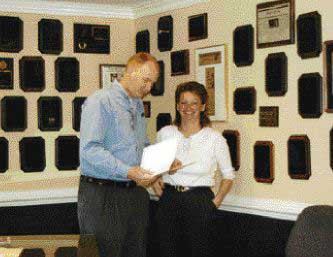
Don’t forget the white shirt. After the awards have been given out, the winners usually pose for photos. The Showcase Awards places a photo of the winners on the back cover of a special supplement on remodeled homes that appears annually in our local paper. That’s a very visible location, so I make an effort to show up well in the photo.
One of my strategies is to remember to wear a white shirt to the dinner and take off my jacket for the photo session. That way, the dark-colored awards plaques I’m holding will show up well against the light background (Figure 3).
Figure 3.Local awards programs are often showcased in local newspaper supplements and other media. When posing for photos (above), the author — sitting on the front row, far right — wears a white shirt to provide a contrasting background for his many newly won plaques.
This is also where winning multiple awards can really pay off. If you’re juggling a half-dozen or more plaques while the others around you have one, two, or three awards apiece, potential customers who see the photo are more likely to notice you.
Boosting company morale. An awards ceremony can also be a good way to recognize the contributions of your employees. The lead people on the projects we enter in the local competitions come along on awards night (at company expense, of course) so they can be part of the excitement.
When we won the National Remodeling Quality Award, we went even further. I took the whole company — all ten of our employees — to the awards ceremony, which was held in Indianapolis. We did it up right and had a lot of fun.
When it came time to go from the hotel to the ceremony, for example, we hired a stretch limo to take us there. It probably didn’t cost much more than hiring the three or four taxis we would have needed otherwise, and it was much more memorable.
We all came home feeling great. The whole company was practically walking on air, and you can’t put a price on that. Okay, you can: There were airline tickets, hotel rooms, meals, and all the rest. But it was worth it.
Keeping it going. Once you start winning awards, it’s important to keep winning them. Customers actually read the award plaques on your office wall, and they notice the dates. If you have awards from 1991, 1992, and 1993 but nothing more recent, your customer may wonder why your company isn’t as good as it used to be. It probably doesn’t hurt to miss a year here and there, but you will inspire more confidence if you can point to a continuous string of awards leading all the way to the present.
Robert Criner’s award-winning remodeling business is located in Yorktown, Va.