- Q. Can exterior foam sheathing cause moisture problems?
A.Ned Nisson responds: Exterior rigid foam sheathing is basically a high R-value vapor retarder on the outside of a wood-framed wall. Theoretically, it can cause two types of moisture-related problems: wet walls and wood siding failures.
In nearly 20 years’ experience, however, there have been no documented cases in which exterior foam sheathing was solely responsible for damage due to moisture accumulation within walls — whether in warm or cold climates. In fact, a controlled experiment at the U.S. Forest Products Laboratory, in Madison, Wis., showed that walls insulated with foam sheathing had moisture accumulation than similar walls sheathed with plywood. Evidently, the high R-value foam reduces the condensation potential by keeping the stud cavity warm. With R-11 batts in the wall, use a minimum of 1 inch of foam in cold climates; two inches is safer. Combined with proper air and vapor barriers, foam sheathing actually appears to be effective in controlling condensation.
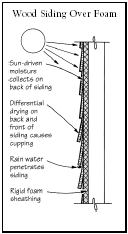
Wood siding over foam is another issue. There have been plenty of reported failures of wood siding installed over foam, but not much agreement over whether the cause was the non-absorbent foam or poor quality siding. The answer may be both.
With vertical-grained, all heartwood siding that is properly preserved and nailed, the sheathing type probably makes no difference. The siding should have little tendency to deform and the nails should resist minor warping force.
But with poor quality, flat-grained siding that is poorly preserved and installed, the situation is different. The siding may have a greater tendency to warp, particularly if up against non-absorbent foam sheathing.
The “official” solution to this issue is to select “good quality” siding (if you can get it) and install it properly. But the unofficial and probably safest recommendation is to install 1×3-inch vertical nailers over the foam at each stud. Not only does this create a 3/4-inch cavity to allow backside drying of the siding, but it also provides a much better nail base.
J. D. Ned Nisson is editor of Energy Design Update of Arlington, Mass., a monthly technical newsletter on energy-efficient building design and construction.
Q&A: Foam Sheathing & Moisture Problems
Expert advice on the tough calls faced by energy-minded builders
2 MIN READ