
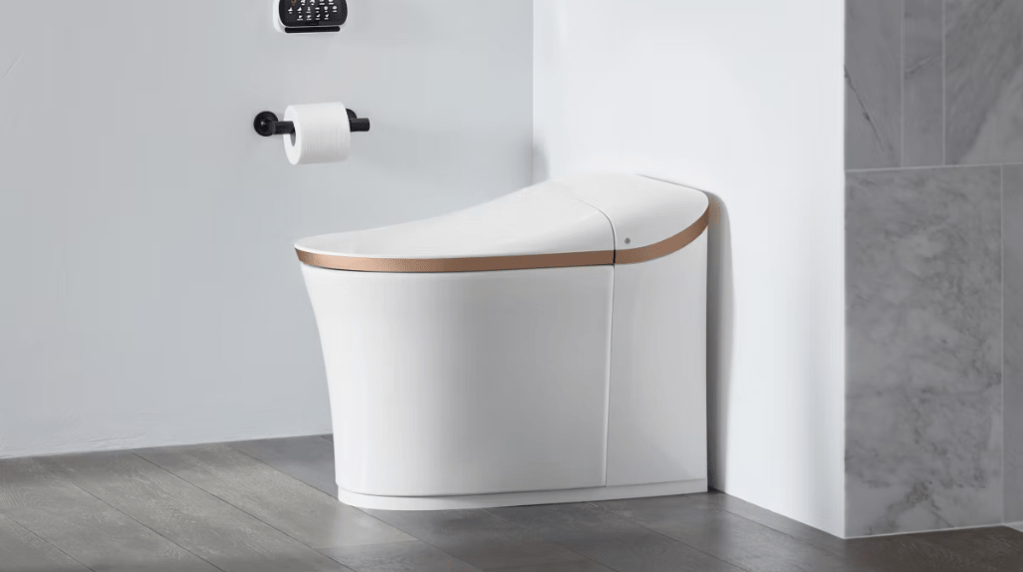
Daniel Kennerly, contractor partner at Alair Homes Orlando, Fla. worked on the New American Home, a 17,000-square-foot show home in Windermere that includes smart Kohler toilets throughout. The house was packed with high-end technology, but Kennerly says the real challenge was not the gadgets themselves. It was figuring out how to install them cleanly.
“All of them are smart, which means that they need power as well as water,” Kennerly says. In a modern home, exposed cords and supply lines would undermine the design. “You try to figure out how do we hide all of this.”
The solution: Treat the installation as a detailing exercise, not just a fixture hookup. Kennerly’s team created access panels beside each wall-hung toilet to conceal the shutoff valves and outlets. “Every one of the toilets in the house, both the supply line and the electrical or the power cord come out the back of the toilet, enter into the wall, and you never see them again,” he says. “So, yeah, it’s super clean.”
That emphasis on clean installation is likely to matter more as smart toilets move beyond luxury one-offs and into more mainstream remodeling and new construction work. Andrew Van Gorden, senior product manager at Kohler for smart toilet and bidet products, says awareness is already high. “Our research shows that over 90% of consumers in the United States are aware of what a bidet and a smart toilet are,” he says, adding that interest has grown significantly over the past five years.
For contractors who have not installed one yet, Van Gorden assures them that the process will feel familiar. “It’s installing almost like a normal toilet would,” he says. “You have a water supply line that connects to the water and you plug it into the wall. That’s maybe the main difference between a standard toilet.” Kohler also reduces friction with installation videos and support tools that contractors can use before or during the job.
And there are always workarounds for unexpected installation quirks. On the Alair project, the team ran into issues with supply connections because the toilets used larger water lines than the crew typically sees. “Your normal angle stops and supply lines don’t work,” Kennerly says. The toilets came with their own supply lines, but the team needed longer runs for the concealed layout and ended up adapting with washing machine supply lines to make the connection work.
That kind of field adjustment is what makes this category worth paying attention to. The products may be marketed around comfort and convenience, but contractors are the ones solving for outlet location, water location, access, and serviceability.
Even with all the added functions, Kennerly says the core of the fixture remains familiar: “At the end of the day, the actual function of the toilet is the same as the toilet that, frankly, you and I have in our bathrooms.”
Kohler backs its smart toilets with rigorous testing, warranty coverage, and a national network of Advanced Service Representatives who can help resolve issues in the field. For contractors, that support can make a newer category feel more approachable. Learn more.