by Aaron Hoover
Hurricanes may be a force of nature, but high winds and heavy rains can be engineered — and the engineers are getting good at it.
That was the impression conveyed earlier this summer at a gathering of leading hurricane wind engineers from several Florida universities and better-building advocacy groups in rural central Florida.
The engineers were spending a week experimenting on 10 unlucky vacant homes, with the goal of probing how hurricanes rip apart houses built before Florida’s first statewide building code in 1994 — and figuring out the best retrofits to prevent that damage. But the tests also showcased the most up-to-date arsenal in the art of hurricane simulation.
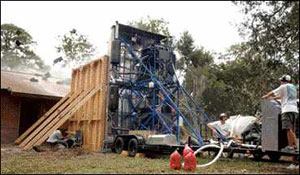
Most visible was a “Wall of Wind” machine. Described by one researcher as the “mother of all airboats,” the business end of the trailer-mounted rig was equipped with two caged airboat propellers, each driven by Chevrolet V8 502 motors. Built at Florida International University and completed this spring, the machine can generate 120-mph winds. Combined with “rain” sprayed in from a 500-gallon tank, the end product approximates a Category 3 hurricane in a space the size of a car.
“It’s not designed to blow down a house,” explains Kurt Gurley, an associate professor of civil and coastal engineering at the University of Florida. “It’s designed to test the components of the house that are having performance issues.”
Shingles and tar paper fly off of the roof of a vacant home in central Florida as a custom-built wind machine pounds it with hurricane-force winds. Part of a University of Florida-led hurricane research project, the experiment was one of several aimed at learning more about how hurricanes damage homes that were built before Florida adopted its first statewide building code in 1994.
So, too, is another weapon in the engineers’ arsenal: the 2×4 air cannon. Hauled in by engineers at the Tampa-based Institute for Business and Home Safety (IBHS), the trailer-mounted cannon has a long PVC barrel “charged” with compressed air.
The cannon can fire a 2×4 at 100 miles per hour, but the engineers were seeking to mimic flying debris from only a Category 3 storm. They pounded the homes’ windows, covered with Lexan protective sheathing, with 40-mph projectiles. The clear Lexan bowed severely, highlighting the need to space it far from glass panes.
One of the odder tools on site was the nail puller. Invented by Tim Reinhold, vice president of engineering at IBHS, the 2-foot puller looks like a giant’s wine opener — the kind with opposed handles that yank the cork free when pulled down. But instead of a corkscrew, the puller has a metal hook that attaches to the nail and a force transducer that measures the pressure required to pull it free.
Gurley says hurricanes often yank roofing plywood off of homes. The engineers use the puller to measure the forces involved, with the goal of specifying the size, number, and distribution of nails to ensure the plywood stays attached.
That’s a bit more complicated than it at first appears, however: Gurley reports that the vacant home tests revealed nail-pulling forces ranging from 30 to 200 pounds, depending on the size, condition, and location of the nail, such as if it was driven into a knothole.
The wind machine, air cannon, nail puller, and other equipment may be unusual, but they’re all essential to hurricane wind research, Gurley notes.
“We have our engineering equations and our assumptions, but there’s nothing quite like breaking something,” he explains. — Aaron Hoover