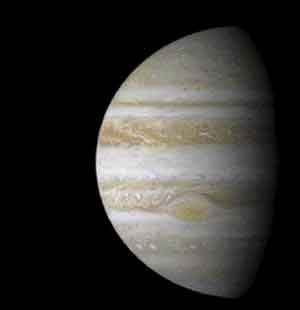
Welcome to Jupiter, home of the solar system’s largest hurricane. (Photo courtesy NASA/JPL/Space Science Institute)
If the perils of coastal storms seem bad, let’s be thankful we aren’t living on Jupiter. The giant eye-shaped swirl shown in the photo above is a hurricane that has been raging for over 300 years. The Great Red Spot, as it’s casually known, is the largest storm in the solar system, with a diameter of 15,400 miles (large enough to fit two Earths inside with room to spare) and winds estimated at 270 mph. By comparison, the most intense storms on Earth include Hurricane Camille, which created a 25-foot storm surge that landed in Mississippi in 1969, and Hurricane Allen, which swept over Jamaica in 1980. Both storms had winds estimated at 190 mph, though no one’s completely sure, since at those speeds all the weather instruments were completely destroyed.
All that can be seen on Jupiter are clouds. Unlike Earth, where clouds consist of water vapor alone, Jupiter’s clouds are made of ammonia, hydrogen sulfide, and water. According to NASA observers, the brown and orange colors may be due to trace chemicals dredged up from deeper levels of the atmosphere, while the bluish bands are areas of reduced cloud cover where one can see deeper into the atmosphere. As clouds are sheared apart by the intense jet streams that run parallel to the planet’s equator, streaks form in the atmosphere. The prominent dark band in the northern half of the planet is Jupiter’s fastest jet stream, with eastward winds of about 300 mph.
The Great Red Spot presumably persists on Jupiter because there are no land masses to disrupt the storm. On Earth, the difference in temperature between the warm ocean waters and cooler air above keep hurricanes alive. As a weather disturbance begins mixing the two temperatures, water vapor from the warm ocean surface evaporates, forming towering clouds that surround the eye of the storm. As water vapor rises and cools, it condenses, which releases latent heat. The released heat warms the surrounding air, making it lighter and promoting more clouds, thus creating the engine that drives the hurricane onwards until it moves over a mass of cold water or comes ashore, effectively cutting off its energy supply. — Clayton DeKorne