by Charles Wardell
People who live on islands understand the meaning of scarce resources and may be more aware of a home’s environmental impact than the average suburbanite. This marketing assumption panned out for Peter Taggart when he secured the job on Chebeague Island, Maine, of building what he calls “the most environmentally sensitive home we’ve done to date.”
That’s saying a lot. Taggart Construction of Freeport, Maine, has been pushing the green building envelope for a decade. Taggart serves on the board of the Maine Chapter of the U.S. Green Building Council, and has served as president of the Northeast Sustainable Energy Association (NESEA), a network of green builders and designers who share information with one another. “For years we’ve sent staff to the annual NESEA conference in March,” he says. “What we’ve learned is incorporated into this house.”
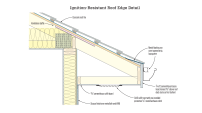
Designed by Curt Jensch, Taggart’s staff architectural designer, the house is set in a stand of white pine and birch, with tantalizing glimpses of blue ocean water filtered through the trees. Jensch went beyond passive solar design to offer natural daylighting in every room. Photovoltaic panels supply much of the electricity. Recycled cellulose insulation — R-28 in the walls and R-60 in the roof — keeps icy North Atlantic breezes at bay.
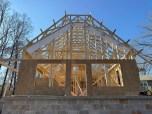
“It’s not as if you can throw down bamboo flooring and call the house green,” asserts Taggart. You need to understand technical concepts, like how vapor barriers and rain screens manage moisture, especially in a damp seacoast environment. “A lot of people these days want the green label. But what’s green is often invisible. It even comes down to how the framing is done,” Taggart says, referring in part to the home’s certified sustainably harvested framing and siding materials, and the indigenous woods he used as a substitute for pressure-treated lumber.
Green thinking also helped Taggart handle the expense of barging materials to, and trash from, the island. A slab-on-grade frost-protected shallow foundation used much less concrete and required only minimal site disturbance, compared with the typical Maine basement. Stem walls weren’t poured but built with insulated fiber-cement blocks. Rather than a dumpster, Taggart’s crew had waste piles for different materials and reused items whenever possible. The protective pallets used to ship windows, for instance, eventually found their way back to the house as blocking. At the end of the job, wood products were buried on site, along with stumps from the excavation. The wood will naturally decompose over time, with little or no impact on the island’s fragile environment.