by Aaron Hoover
The latest “hurricane machine” developed by engineering professor Forrest Masters will be deployed first to troubleshoot effective ways to deter wind-driven rain.
It’s huge, deafening, and can muster a 130-mph wind capable of tearing off roofs and knocking down walls. But University of Florida engineers say they may first deploy a new 3,800-hp hurricane simulator to solve a more subtle problem: how wind-driven rain enters homes.
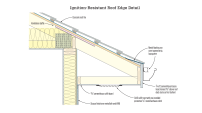
What engineers call “water intrusion” was a huge damage-producer during the 2004 and 2005 Florida storms. Although soffits have been identified as a leading cause, much remains uncertain about where to cast blame when windblown rain soaks wood floors, collapses ceilings, or damages drywall, says Forrest Masters, a UF assistant professor of civil and coastal engineering and lead designer of the new machine.
The machine, the world’s most powerful such portable wind machine, can pelt windows and other components, as well as entire structures, with steady or intermittent bursts of wind and raindrops, mimicking real hurricanes. That should give engineers the chance to test walls, framing connections, windows, doors, and soffits — both how they perform together on an actual house and how they perform separately. “We have a water-intrusion issue, and we need a systems approach to identify the origin and mechanism of the intrusion,” Masters explains.
This updated “hurrican machine” is the latest version of a growing arsenal of more and more massive hurricane simulators being produced by UF, Florida International University, and other research universities in the U.S. and Canada. It has eight 5-foot-tall industrial fans powered by four marine diesel engines. The engines get their cooling water from a 5,000-gallon water tank aboard the machine’s tow vehicle, a tank that is also the source of the simulated rain. At full power, the fans produce winds of about 100 mph. A custom-built duct funnels the air, accelerating the wind to 130 mph, speeds equivalent to a Category 3
hurricane.
The UF engineers first tested the machine shortly before hurricane season began June 1. A few weeks later, Masters met with code officials and representatives from major window companies and test laboratories. He is now working with these representatives on a research agenda for the machine.
The wind engineers will also put the machine to use in myriad other investigations. One of the more surprising: how hurricane winds affect trees. Kurt Gurley, a UF associate professor of civil and coastal engineering, notes that the researchers plan to work with horticultural scientists to learn more about pruning trees for storm survivability. The goal goes beyond canopy protection, he says.
“If you could create some pruning policy for various species of tree that reduces how much wind they feel,” he explains, “it would perhaps be nice preventive medicine for keeping power lines up longer.” — Aaron Hoover