by Ted Cushman
In the predawn hours of Friday, February 2, 2007, a line of severe thunderstorms plowed across the Florida peninsula, spawning lightning, hail, and three separate tornadoes. Tracking at about a mile a minute, the Groundhog Day tornadoes ripped through three counties, severely damaging or destroying mobile homes, site-built houses, and commercial structures. In the space of a few hours, weather killed 21 people.
On March 1, tornadoes struck Alabama. Eight high school students were killed in the town of Enterprise when a twister tore the roof off of the school’s gymnasium and collapsed a concrete-block wall. Six people died a few hours later when another tornado leveled a mobile-home park.
Everyone knows that coastal states are hurricane country. But the public does not associate the coast so much with tornadoes, and in fact, twisters are more frequent, and tend to be stronger, in the nation’s midsection. But tornadoes do strike coastal states each year, and weather scientists say this year’s “El Niño” conditions make strong tornadoes more likely across the Gulf Coast region.
Because of the hurricane risk, many coastal states already have tough wind-resistant construction standards, and the rest are moving in that direction. But can structures built to withstand hurricanes offer any protection from tornadoes? The answer, says Texas Tech wind engineer Larry Tanner, is yes.
To some extent, the recent Florida storms are a case in point. The tornadoes crossed country away from the coastline, where code calls for houses to handle a 110-mph gust, not the 130-mph, 140-mph, or even 150-mph gusts the code envisions closer to the ocean. In February, investigators inspected The Villages, a community where newer houses took a direct hit from one tornado. The engineers got a chance to see how effectively anchor straps, wind clips, and other code-required elements, expected to encounter lesser forces, would perform when pummeled by winds as high as 158 mph. “Even though it was a tornado, and not a hurricane, you could certainly see some of the benefits of the straps and the clips,” notes Tanner.
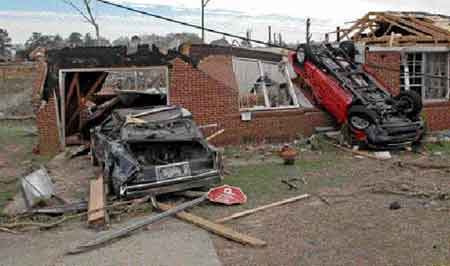
Severe tornado winds, while local in scale, can be more intense than hurricane winds. The March 1 Alabama tornadoes packed enough punch to toss vehicles like so many dice, which added to the cyclone’s destructive force.
Tim Reinhold, vice president for engineering with the insurance-industry-funded Institute for Business & Home Safety (IBHS), sent several teams of engineers out to survey damage in Florida and Alabama. Reinhold says his data show the value of newer code provisions — and he points out, “None of the deaths in Florida occurred in new homes that were built to the Florida Building Code.”
Crumple Zones?
Even a house on Florida’s southern tip, where design wind speeds top 150 mph, wouldn’t be designed for the 220-mph winds seen in the worst tornadoes. But Reinhold says that new Florida homes (including those in lower wind-speed zones away from the water) may still provide at least some protection for building occupants. If a house with enhanced bracing, nailing, and connection details suffers major damage, he argues, it “may not totally collapse around you.” That makes people sheltering in an inner room a little safer, he says: “It’s kind of like the crush area around a car. The middle ends up being a little more protected because the areas around it are a little stronger and absorb some of the impact of the tornado, and you end up with this core that is hopefully still standing. If you don’t get total collapse, people are more likely to be able to walk away from it.”
And not all tornado winds reach even the 110-mph threshold. “Tornadoes come in all sizes and wind speeds,” observes Reinhold. While the worst pack winds in excess of 200 mph, weaker tornadoes are much more common. A tornado rated at EF-1 on the National Weather Service’s new “Enhanced Fujita Scale,” for instance, would have estimated winds from 86 mph to 110 mph, based on observed damage after the storm. An EF-2 tornado would have winds ranging from 111 mph to 135 mph. That’s within the factor of safety for design engineering in a home specced out to face 110-mph gusts, Reinhold notes. “Once you get down to the EF-1 and EF-2 range,” he says, “homes built to the modern code have a decent chance of structurally holding together.”
What about designs rated for faster winds? “Builders in Dade County design for gust wind speeds of about 150 miles an hour,” notes Reinhold. “Taking into account the factor of safety, you might experience wind speeds of over 200 mph before you would see roof sheathing and other things coming off.”
Track Dynamics
Unlike hurricanes that blow over a relatively wide swath when making landfall, tornadoes touch down along a discrete “track,” and most of this track doesn’t see the cyclone’s top wind speeds. “A narrow strip gets the worst winds,” explains Texas Tech civil engineering professor Ernst Kiesling, a leading tornado expert. “If the [tornado] is rotating counterclockwise, there would be a strip just to the right of the center where the translational wind speed [from the storm’s forward motion] adds to the rotational wind speed. But the rotational wind speed dies down pretty quickly with the distance from the center. So if the worst wind speed in the tornado is, say, 200 mph — and we feel that is about the worst you’ll ever see — it’s 200 mph only in a very narrow strip. But most of the damage is done in a much wider strip, where the wind speeds are less. So you can help yourself a lot there by paying attention to the details and design of the whole house to reduce damage.”
The February 2 storms in Florida carved tracks just 200 yards wide. For residents of The Villages, the line between normal life and disaster was a thin one. Resident Karen Donnelly runs an information and networking website for the community at www.TheVillagesGuide.com. Living just a mile from the storm’s path, Donnelly says, “At first I thought we had a near miss. But after going to look, I feel like we were worlds away from it — because when you look at the damage, just a few feet makes the difference between things that are totally destroyed and things that look untouched.”
As is typical in tornado events, the February 2 Florida storms left a narrow storm track, defined by damage that varied depending on construction methods. Homes closer to the edge of the storm track faced more moderate winds. An aerial view of The Villages (top), a planned community of relatively new site-built homes, shows major damage to a few houses but nothing as severe as the trail of devastation at a different location to homes predating Hurricane Andrew (bottom).
Missile defense: Tornado winds turn everything from lawn furniture to scraps of destroyed buildings into airborne projectiles traveling at deadly velocities. The plywood sheathing of this home in The Villages was able to stop an iron chair (top left), but framing lumber penetrated roofs and walls at other locations.
Toughening the Core
Coupled with luck, it’s clear that stronger construction can save lives as well as property in tornado events. But experts temper their optimism with caution. Larry Tanner explains, “I wouldn’t want to give people a false sense of security. In a house built to code, your interior room is less dangerous in a tornado, but it’s not safe.”
And while incremental upgrades offer partial benefits, there are practical limits to hardening and toughening a whole house, says Ernst Kiesling. There are two major considerations in design, he explains: “First of all, the building must have the structural integrity to withstand the forces imposed by the wind. Second, it must be able to withstand the debris impacts.” It’s the flying debris that makes protecting occupants such a challenge, says Kiesling. “If you tried to make the whole house safe, that would mean every door, every window, the roof, and all the walls must be able to withstand the debris impacts — and that’s not practical.”
Instead, notes Kiesling, “our design approach is to focus on a small area such as a closet, a bathroom, or a pantry — some room just large enough to hold the occupants. It’s more economical to harden and stiffen that so it will provide a high degree of occupant protection. And then that room should be structurally isolated so that it would remain standing even if the rest of the house is destroyed.”
The Federal Emergency Management Agency (FEMA) has embraced Kiesling’s “safe room” concept. It offers a design manual, FEMA 320, as a free PDF download from the FEMA website. The International Code Council (ICC) and the National Storm Safety Association (NSSA) are completing a national standard for safe-room construction. And private companies now offer a variety of qualified safe-room designs and prefab packages using various construction methods, including steel-jacketed wood-frame rooms, reinforced concrete block, and insulating concrete forms (ICFs). Even door manufacturers are coming along: The website of Texas Tech’s Wind Science and Engineering Research Center provides a list of doors and shelters that have been tested against tornado debris impact as well as wind pressures (see “Debris Impact Testing” at www.wind.ttu.edu/General/Research.php).
Windows, Doors, and Debris
But aren’t all windows and doors in hurricane-zone houses supposed to be impact-resistant? Yes, but that has nothing to do with tornadoes. In fact, says Ernst Kiesling, hurricane-rated windows “are not significant for occupant protection even in a hurricane.”
Current hurricane window and door impact standards grew out of damage seen in 1992’s Hurricane Andrew and earlier storms. “Most of the loss was water damage to contents of buildings that happened because the envelope was perforated by flying debris,” explains Kiesling. Toughening roofs, walls, windows, and doors against flying objects, in other words, is meant to stop rain from entering buildings and destroying interior finishes, furniture, and the like.
The current standards are based on a missile slow and light enough for plywood or OSB sheathing to stop. The test standard for hurricane-resistant impact glazing in windows involves blasting the component with a 9-pound 2×4 launched at 34 mph, and in many localities, just supplying homeowners with OSB to place over their windows meets code.
Tornado-borne debris is a whole different animal, explains Kiesling. “First of all, buildings come apart suddenly and generate a lot of debris. And [the updraft] picks up that debris and carries it a long way.” Drawn into the funnel cloud, bits of shattered buildings take on devastating energy. That’s why the tornado-shelter impact test uses a larger (15-pound) 2×4 traveling faster (100 mph). That missile has 15 times more destructive energy than the hurricane window test applies — enough, says Tim Reinhold, to crack five layers of 3/4-inch plywood.
Masonry can be a tornado-resistant material, depending on the type and on reinforcing details. Wood-frame houses with brick veneer received major damage in the Alabama storms (top left ), and some unreinforced, hollow cement-block structures were heavily damaged or even reduced to rubble (bottom left and top right). But the fully grouted and reinforced block walls of this Florida house and garage remained standing even after a tornado ripped off the roof (bottom right). The walls also withstood strikes from flying debris.
Comparing Materials and Structures
So, what kind of structure has a chance against a tornado’s high wind pressures and its load of fast, heavy projectiles? The answer depends not just on the materials you use but also on the way you use them.
Concrete and masonry have the potential to outperform wood. But the well-worn phrase “built like a brick house” is misleading. Modern brick-veneer construction is just a layer of brick stacked next to a wood-frame wall. Brick ties brace the masonry against everyday wind pressure but don’t add to the wood-frame portion’s racking resistance, and a 15-pound 2×4 flying at 100 mph can penetrate not just the brick and the framed wall behind it but also interior walls.
Concrete masonry walls, popular in the coastal South, have also been tested. Ungrouted and unreinforced, block fares little better than brick veneer: the 100-mph 2×4 punches right through.
But concrete-block walls built to the newest Florida codes — with all cores grouted and reinforcing steel in every core or every other core — have excellent racking resistance, and they readily handle the tornado-test 2×4 (the block stays intact, and the 2×4 breaks).
ICF walls also excel, notes Tim Reinhold: “I’ve shot a 6-inch ICF wall with a 15-pound 2×4 jacked up to about 130 mph, and the missile just splintered. The foam blew off the outside of the wall, but there wasn’t even a ripple on the inside.”
A Closer Look at Load Paths
There’s more to surviving a tornado than an impact-proof wall. To handle the wind’s uplift and lateral pressure, all of a structure’s components have to be tied together, from the ridge right down to the ground. “You really need that complete load path, especially in a tornado,” says Reinhold. Anchoring walls to foundations, as well as roofs to walls, is critical. Older homes often fail in this regard. In the aftermath of the March tornadoes, one of Reinhold’s investigators saw several Alabama foundations that had been swept clean: “There wasn’t an anchor bolt in sight.” But even in the new Florida houses, built to stricter requirements, investigators documented spots where serious hardware had parted company with its wood framing, either at the sill or at the wall top. If there’s a weak link in the chain anywhere, say the engineers, that’s where the structure will fail.
A continuous load path, including foundation and roof anchorage, is a key factor in resisting wind loads, yet even fully nailed hurricane ties (top left) and foundation straps (bottom left) may not be enough to resist a tornado. In the Alabama storms, a lack of foundation anchors contributed to the total destruction of the home that used to rest on this foundation (top right), where, noted Tim Reinhold, “There wasn’t an anchor bolt in sight.” Nails (bottom right) don’t qualify.
Costs and Benefits
Tornadoes kill only a few dozen Americans a year — an almost zero risk for the average person. And mobile-home deaths account for a disproportionate share of that low total. So even tornado experts concede that upgrading a site-built house just to reduce tornado risks is a dubious investment. “I think the best reason to have a tornado shelter is peace of mind,” says Ernst Kiesling — “just to know that there is a safe place available for you and your family.”
Happy camper: Surviving a tornado can change one’s priorities. After riding out the Groundhog Day tornado in his home, a resident of The Villages who escaped with nothing worse than small cuts and bruises is just happy to be alive. Never mind the jumble that was once his home.
Factor in coastal hurricanes, however, and the picture changes. A tornado might strike a given spot as seldom as once every 10,000 years. But on the coast, says Kiesling, “it’s almost inevitable that a house will be affected by a hurricane in its life cycle, and the probability is very high in some areas that it’ll be affected by more than one.” Having a safe room means you don’t have to evacuate when the hurricane comes — and that represents real value.
“There are both public benefits and individual benefits to keeping people in place,” Kiesling points out. “The individuals avoid the cost of evacuation and alternative housing, they don’t have to worry whether they can bring their pets, and all the rest.” And society benefits from a smaller, more manageable evacuation. “In some areas, evacuation is not even practical, as we saw in Houston with Hurricane Rita,” says Kiesling (when hundreds of thousands of residents fled their homes only to be trapped on the area’s gridlocked roads). “Sixty-plus people were killed trying to evacuate, whereas nobody was killed by the hurricane — well, the storm didn’t even occur in Houston.”
The tornado winds that collapsed this attached garage and ripped off its roof exceeded design wind speeds for this location by around 50%. Even so, most of the house remains structurally intact, and the occupants survived. Extreme events like this give scientists and engineers a chance to analyze which particular elements in the house’s load paths were overwhelmed and to consider how construction details might be improved so that wood-frame houses would stand a chance against moderate tornadoes as well as hurricanes.
For coastal dwellers, Kiesling reasons, a storm shelter amounts to a sensible precaution, and the cost of making the room essentially tornado-proof is not much more than making it hurricane-proof. Viewed in that context, peace of mind about tornadoes is just icing on the cake. ~
Contributing editor Ted Cushman reports on the building industry from his base in Great Barrington, Mass.