Flying debris a hazard from abandoned and unmaintained homes
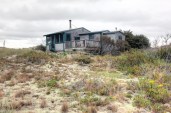
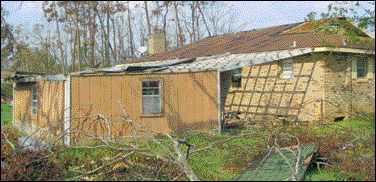
The weed-choked lawns, stagnant swimming pools, and vandals may not be the only problems with the rapidly rising number of foreclosed homes in Florida and other coastal states. Vacant homes are also likely to be more vulnerable during hurricanes and high-wind events, sustaining more damage and threatening neighboring homes with flying roof tiles, siding, or other debris.
So warns the Institute for Business and Home Safety, a Tampa-based advocacy group for disaster safety funded by the insurance industry. The group says the rising number of foreclosed homes in hurricane hot spots will lead to increased hurricane damage unless the homes are adequately prepared for storms.
“The issue is that people aren’t maintaining homes, and they are not thinking about protecting them,” says Tim Reinhold, vice president of engineering at IBHS. “If shutters don’t get put up and a storm is coming through, you have a greater potential for the house coming apart.”
About 1.1 million homes nationwide were in the process of foreclosure at the end of June, according to the Mortgage Bankers Association. Nearly half of those homes — just over 500,000 — were located in the coastal states extending from Texas to Maine, according to a May analysis for IBHS by RealtyTrac, an online marketplace that tracks foreclosures. With 189,623 foreclosures, Florida was the leader, followed by Texas (with 77,830) and Georgia (55,764).
Cities everywhere are already struggling with derelict properties, declining neighborhoods, and falling property values tied to foreclosures. But should a hurricane strike, these problems are likely to multiply, especially for cities with high numbers of foreclosures. At least some of these cities are in high-risk coastal areas: Florida’s Cape Coral-Fort Myers area, for example, had the nation’s second-highest foreclosure rate in May, with one in every 79 households in the foreclosure process, according to RealtyTrac.
There are few signs, however, that either banks or municipalities have begun to grapple with the risk.
Banks typically take over the upkeep and maintenance of foreclosed homes as they attempt to resell them, often turning over the responsibility to property inspection and maintenance companies. One such company is Integrated Mortgage Solutions, based in Houston. The company uses a network of independent contractors to inspect, maintain, and/or repair an inventory that in June totaled 100,000 homes in several states, a number that had tripled in the previous 18 months, reports Cheryl Lang, IMS president and CEO.
Lang says she is aware of no one in her industry that is in the business of preparing foreclosed homes for hurricane contingencies. “It really brings up a good question that I don’t think we as an industry have addressed,” she notes.
She explains that putting up shutters, moving in yard furniture, and other hurricane preparations easily made by homeowners are not so simple when a home is in foreclosure. Often, the legal process takes several months, during which time the bank’s access to the home is restricted by law, she says. Plus, it is difficult to know until the last moment exactly where a hurricane will strike. For banks with many foreclosed properties, making a judgment call to act could quickly get expensive.
County and city governments, Lang suggests, may be better positioned to take advance action to protect homes. But the task may not be on their radar, either. Jim Blink, manager for code enforcement operation in Hillsborough County, Fla., which includes Tampa, says he’s not aware of any county program to safeguard homes in hurricanes. The county does have a small property improvement program to maintain abandoned homes, but the money for that program has already been spent through the county’s fiscal year ending September 30, he notes.
IBHS “is probably absolutely right. There will be no one to safeguard those properties,” Blink admits.
That not only poses a risk to neighboring properties, but it could also worsen the foreclosure crisis, Reinhold notes. As hard as it is to sell foreclosed homes, it will only get harder if the homes are damaged, he says.
“You’re going to have mold and other stuff coming in there, and that’s going to make it even less likely that someone will pick up the property,” he explains. — Aaron Hoover
Rhode Island Proposes Global Warming Building Regs
New rules would lead to more stringent standards for coastal buildings
oastal builders wondering how climate change theory might affect their bottom line should keep a close eye on Rhode Island. The nation’s smallest state is considering new regulations aimed at coping with anticipated effects of climate change — specifically, more forceful hurricanes and a rise in sea levels predicted by some authorities.
Builder groups are in discussions with the state but have yet to get involved in debating the issue.
Within the next six months the Rhode Island Coastal Resources Management Council, which oversees development along the state’s 400-mile-plus coast, expects to propose rules raising minimum first-floor elevations on new structures to accommodate a projected sea-level rise. Other rules could follow, including more stringent wind requirements in coastal zones that today are not considered most vulnerable to storms.
Work on the new rules started in 2006, when the council was authorized to work with the state’s building commissioner to adopt new codes “to take into account climatic changes and potential climatic changes and sea-level rise.”
Relying on advice from a panel of scientists from Woods Hole Oceanographic Institution, the National Oceanic and Atmospheric Administration, the University of Rhode Island, and elsewhere, the council estimated a potential sea-level rise of 3 to 5 feet the next century. As a result, the new rules are likely to raise elevations of new coastal structures based on their design life. The longer the structures are likely to last, the higher the first-floor elevations will have to be, according to Grover Fugate, executive director of the council. Structures having an expected life span of 100 years will need to elevate their first floors 5 feet.
Also on the table as a result of the council’s projections: new rules that apply Rhode Island’s most stringent “Coastal V-Zone” codes to homes currently built in the less stringent “A-Zone.” That’s because if predictions about rising sea levels turn out to be true, they will place many A-Zone homes in the V-Zone, Fugate says. “If you’ve got a structure expected to be there 50 years, the policy may be that you have to build to V-Zone standards,” he explains.
The Rhode Island Builders Association has yet to come out against the proposed rules but has met with Fugate and raised some concerns, according to Roger Warren, the association’s executive director. “We recognize there may be some issues that need to be addressed,” he says, but adds that the association is awaiting further information before making additional comment.
On the other hand, Warren is concerned that Rhode Island’s already “very limited” land available for development will shrink if the council’s proposals become law. And increasing elevations raises the cost of construction and may have other consequences as well, he notes.
“What does it do to neighboring properties in terms of view?” he asks. “There are lots of issues that haven’t been explored.” — A.H.
Builder Groups Skeptical About New Efficiency Standards
Concern grows that new regulations will raise home prices
Energy codes in California, Florida, and other states are becoming increasingly stringent. In June, for example, Florida governor Charlie Crist signed an energy bill that schedules a 50% increase in building efficiency by 2019. That comes on top of a new state energy building code, to go into effect at year’s end, that will raise efficiency by at least 15% and as much as 28%, according to the Florida Home Builders Association.
While the new rules will help reduce homeowners’ energy bills, builders are concerned about potentially higher home costs and other unintended consequences. “There are cost consequences, and there are design issues, and there is ‘can we even get there?’ ” says Doug Buck, governmental affairs director for the Florida Home Builders Association.
Jack Glenn, technical services director for the association, estimates that the code changes will raise the cost of homes “several hundred to several thousand dollars” depending on the home and the upgrades chosen.
Options to meet the new code requirements will likely range from reduction in window areas to high-
efficiency air conditioners to solar water- heating systems to increases in building envelope insulation, he predicts. As for the future 50% requirement, he is uncertain whether current building technology can achieve that efficiency without requiring homeowners to make lifestyle changes.
Glenn suggests that increases in efficiency standards should be correlated with market demand. “If people are really energy conscious, they are willing to pay extra money,” he notes. “If they are not and you haven’t changed the mind-set, then they are going to balk.”
That position is echoed by the National Association of Home Builders, which has responded to the building efficiency/climate change trend by urging “voluntary, incentive-based initiatives,” according to a policy paper published last year. This year, in April and again in July, builders representing the NAHB reinforced that message in testimony to congressional committees, stressing tax breaks, government funding initiatives, and other nonregulatory efforts to encourage growing market support for green building.
“Policies that encourage energy savings are the most meaningful at stimulating greater demand for conservation in home operation,” read a summary of July 17 statements by NAHB representative and St. Louis builder Matt Belcher to the House Subcommittee on Energy and Air Quality. “The ability of aggressive building code mandates to achieve massive energy emissions savings is incredibly limited.” — A.H.