Setting a new precedent for wind codes, Florida focuses on reroofing
Under a new Florida law, any reroofing job performed in the state of Florida must now include upgrades to the roof structure and a peel-and-stick water barrier. These two rules, along with measures to upgrade roof-to-wall connections and opening protection on some homes, are intended to update the majority of the state’s housing stock. According to census figures, about 78% of Florida’s homes were built before 1992’s Hurricane Andrew. The destruction from that storm led to a building code change that is widely seen as an effective standard for building hurricane-resistant homes.
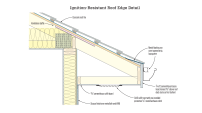
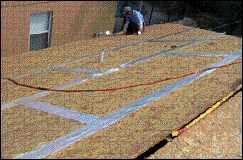
Under a new Florida law, roof sheathing may need renailing, and a secondary water barrier, such as 4-inch flashing tape, must be installed before any existing home can be reroofed.
On Every Reroof
The “roofing mitigation rule,” as the new law has been dubbed, essentially requires roofers to nail off the sheathing with ring-shank nails and apply peel-and-stick — either by taping panel joints with 4-inch-wide flashing tape or by applying a continuous SBS roofing membrane — prior to installing a new roof on existing single-family homes.
There seems to be little argument about the nailing requirement. “It’s a no-brainer,” urges Carolyn Ackerland, of Gary’s Roofing Service, based in Sarasota, Fla. “We see so many roofs that are stapled down; it’s not that big a deal to nail them off. This has just become a standard part of what we do.” The rule boils down to making sure that plank sheathing has two 8d ring-shank nails in every rafter or truss. If the roof has panel sheathing instead, it must be nailed off every 6 inches with 8d ring-shank nails.
Homes valued at $300,000 or more may need improvements to the roof-to-wall connections prior to reroofing. This work must be done by a licensed general contractor, not a licensed roofer, so companies like Gary’s Roofing Service, which holds both licenses, will be in the best position to benefit from the new law.
Ackerland sees value in the peel-and-stick rule, too. Taping the seams proves more labor intensive than applying a continuous membrane, she says, but it also allows a roofer to strip back to a clean deck on the next reroof. “There are always trade-offs,” Ackerland acknowledges. “We do our best to educate the homeowners about the options. But some type of secondary water barrier is needed. Hurricane Charley opened our eyes to that.”
For High-End Homes
Besides the two basic reroofing rules, additional mandates apply to homes in windborne-debris regions that are insured at $300,000 or more. In this case, the roof-wall connections must be reinforced with uplift hardware and gable-end bracing. The rule defines the amount of reinforcing not only in terms of uplift resistance but in monetary terms as well: a minimum of 15% of the cost of the reroof must be applied to strengthening the roof-to-wall connections. This means that if a reroof costs $10,000, at least $1,500 must be spent on reinforcing the roof-to-wall connections. Since this amount may not be enough to reinforce all of the roof-to-wall connections on the home, the law assigns priority to strengthening the gabled sections of the roof above hipped sections and to strengthening framing connections near the corners of the roof over connections in the middle of wall sections.
As first adopted by the Florida Building Commission, the new law was written to go into effect on October 1, 2007. However, legislative maneuvers prevented the ruling from being filed with the Florida State Department, delaying the effective date to January 1, 2008. Parties seeking the delay argue that the new law imposes new inspection procedures to verify the sheathing nailing that have yet to be established. Questions also remain about whose responsibility it is to establish the value of a home during permitting, and how contractors are to choose which parts of the structure must be improved. Citing one example of the confusion the law is bound to create, Steve Munnell, executive director of the Florida Roofing, Sheet Metal and Air Conditioning Contractors Association, writes: “If a residence has four roof ends and the total cost to improve all four would be 20% of the total cost of reroofing, should the consumer do only two or three? … If so, how does the consumer or contractor select which two or three should be improved?”
While the details have yet to be ironed out, the law will assuredly provide increased opportunities for contractors, although which contractors has also been a sticking point. Roofers are restricted from installing the uplift connectors required to improve the roof-to-wall connection, providing more opportunity for licensed general contractors than for licensed roofers. — Clayton DeKorne
Debating Climate Change
No simple answers in the search for causes
The costliest hurricane in history. Atlanta reduced to 90-day supply of freshwater. A Florida drought so severe, Lake Okeechobee caught fire. Few would argue that the Southeast has experienced its share of major weather-related catastrophes in recent years: the region is in its worst drought since record-keeping began in 1895.
But scientists remain uncertain whether Hurricane Katrina, the widespread Florida fires last spring, or the worsening drought parching Georgia and neighboring mid-Atlantic states can be blamed squarely on global climate change.
“None of these can be ironclad links to climate change,” says Stephen Mulkey, a professor of botany at the University of Florida who recently served as science advisor on global warming to the Century Commission for a Sustainable Florida. “But they are indicative of the kind of pattern we expect.”
While much of the Southeast experiences severe drought, elsewhere marshlands have been swamped by rising sea levels. The exact reasons such changes have occurred are often numerous, making it tough to pinpoint causes. But evidence is mounting that the changes are global and likely to get worse.
Global vs. Local Impacts
The Intergovernmental Panel on Climate Change, the United Nations panel of 2,000 climate experts, in mid-November warned of “abrupt and irreversible” impacts from global warming. Although the IPCC has been at its most dire predicting future events, the report cited many changes already underway, including retreating glaciers, thawing permafrost, and snow loss in alpine areas. It was hardly the first to note big events sweeping northern latitudes: this summer, for example, scientists reported that the Arctic had lost a third of its summer sea ice since measurements began 30 years ago, and that the loss had speeded considerably since 2005.
But, at least for now, many changes to weather or natural systems in warmer regions of the U.S. and Southeast are either less dramatic or, as scientists sometimes put it, within the range of historic climatic variation. On other fronts, such as whether climate change is increasing the severity of hurricanes, the debate continues.
Mulkey says local trends muddy the picture further by either masking or counteracting the effects of overall climate change.
Eleven of the last twelve years rank among the twelve warmest years in the historical record of global surface temperature, according to the IPCC. But one recent study found that Las Vegas has cooled in recent years, thanks to the efforts by residents in planting and irrigating trees and shrubs, Mulkey says. Florida’s irrigated agricultural areas have seen a slight cooling effect for similar reasons, he says. Historically, Florida freezes have advanced farther and farther south, as farming and development have uprooted the state’s heat-trapping wetlands.
Of current impacts of climate change on the Southeast, “I wouldn’t use the word ‘minor,’ ” Mulkey says. “I would use the words ‘obscured’ or ‘camouflaged.’ “
Subtle Signs
That said, a handful of studies have documented current impacts. Mulkey’s colleagues at UF have found that palm trees are dying on Florida’s west coast as a result of climate-change-driven sea-level rise. Although levels globally have risen only 3.1 millimeters, or .12 inches, annually since 1993 — a far cry from the IPCC’s projected rise of as much as a half meter by 2100 — local rise, combined with increased tidal flooding, appeared to be severe enough to kill the most seaward palms in the low-lying study area, according to research published this year in the journal Global Change Biology. The trend is accelerating: of 88 large, mature palms that died at the North Florida site between 1992 and 2005, 66%, or 58, died since 2000, the researchers say.
“With expected increases in the rate of sea-level rise coupled with increasing drought frequencies resulting from global climate change, accelerated rates of coastal forests disappearance are likely and may already be evident,” botany Professor Francis “Jack” Putz and four other authors concluded.
Elsewhere in Florida, widespread coral bleaching in the Florida Keys may be tied to hikes in ocean temperatures. Saltwater intrusion from sea-level rise has swamped some low-lying sources of the Keys’ freshwater, says the U.S. General Accountability Office.
Other states also have experienced changes. Maryland’s Chesapeake Bay and coastal Louisiana are among states that have lost thousands of acres of marshes to open water, though separating the effects of sea-level rise from those of development, land subsidence, oil production, and other local changes is problematic. Some species of ducks have stopped migrating to South Carolina because of warming temperatures in their northern summer grounds, according to news accounts. And trees in North Carolina and elsewhere have suffered from insect infestations tied to prolonged drought.
“It’s subtle and small right now,” Mulkey notes. “But to ignore what the huge majority of peer-reviewed literature is saying is foolhardy.” — Aaron Hoover