New Orleans won’t be the only U.S. city grappling with flooding over the next century. Rising sea levels and sinking coastal lands mean cities all along U.S. coastlines face a predicted rise in ocean water levels. The increase could be from a manageable few inches to a catastrophic several feet.
Nowhere to Run
Among the U.S. cities facing a threat from rising sea levels, Palm Beach, the Riviera of the U.S., won’t be forsaken. Property values between Palm Beach and Miami are estimated at a trillion dollars. No one is about to abandon the area. Rather, say planners and scientists, Florida will seek massive public works to hold back the sea. Projects that, while spread out over a longer period than the reconstruction of the New Orleans levees, will likely dwarf that $10 billion cost.
“We’re humans. We want everything to be kept the same,” says Dan Trescott, principal planner for the Ft. Myers-based Southwest Florida Regional Planning Council.
With a grant from the Environmental Protection Agency (EPA), that council late last year completed Florida’s first attempt to tackle sea-level rise from an urban planning slant. The study found that nearly 97% of developed Palm Beach County within 1,000 feet of the ocean sits 0 to 10 feet above sea level. Because South Florida’s tides can add 5 feet to normal sea level, nearly all of the county’s 56,000-plus coastal acres would flood regularly if seas rise 5 feet. A less severe rise would leave higher ground dry but inundate lower areas and open them to more frequent storm flooding. The most vulnerable places include not only many of Palm Beach’s mansions but also West Palm Beach, Boca Raton, Jupiter, and 20 other cities.
So, the planners concluded, Florida is likely to pull out all the stops to hold back the sea in Palm Beach County. But even that may not be enough. “I just don’t think there’s enough money or fill to hold it all back, myself,” Trescott warns.
Other recent EPA-funded sea-level-rise studies have led to similar conclusions. A 2004 study of the Boston area, for example, found that “the total property and contents damages and emergency services … over the next 100 years could range from $20 billion to $94 billion if there are no adaptive responses except rebuilding after floods.”
There’s not enough money or fill to hold back the sea
For residents and policy makers alike, the importance of these studies depends enormously on two related processes: how much sea levels may rise globally, and how much coastal land sinks regionally, a process known as subsidence. The combination leads to relative sea-level rise, which is the figure that counts for local communities.
Growing Concern
There is little debate about why seas are rising. The main culprits are the expansion of water as it warms and the melt-off of polar ice, phenomena both tied to global warming. How far and how fast seas will rise is much murkier. The U.N.-backed Intergovernmental Panel on Climate Change says that most studies predict a global sea-level rise of 4 to 35 inches by 2100. Research released this spring concludes that ice loss in Greenland and Antarctica has accelerated. And while people tend to think of climatic change as slow and predictable, the Earth’s geological history suggests sea-level fluctuations are “never a smooth story” and have a potential for rapid change, according to University of Miami geologist Hal Wanless.
Meanwhile, much of the East and Gulf coasts are sinking. This is caused by the diversion or drying up of rivers that once moved soil from inland to coast, wave-driven erosion, and withdrawal of groundwater or oil, spurring underground collapses. The rate of subsidence varies, with Galveston, New Orleans, and parts of North Carolina among the coast’s fastest-sinking areas. Seas are rising about 3 feet per century along the Louisiana coast, according to the EPA. Seas have risen more than 2 feet in Galveston since 1900, Wanless says. In South Florida, the rise has equaled about 9 inches since 1930. For Palm Beach, The Treasure Coast planners estimated a 90% chance of seas rising 10.4 inches and a 50% chance of seas rising 19.8 inches during the next century.
One underlying result of sea-level rise is that 80% to 90% of U.S. beaches are eroding, notes Florida International University professor Stephen Leatherman, otherwise known as “Dr. Beach,” in his 2001 book Sea Level Rise: History and Consequences. But beach erosion, which has many causes, is rarely tied to sea-level rise in public debates. And the issue has to date mostly eluded public interest. That’s just now starting to change, say planners and scientists. “The political system is not designed to look long term, so you can hardly get anyone at the local level to even consider it,” Trescott says. “But I think this is the beginning of it.”
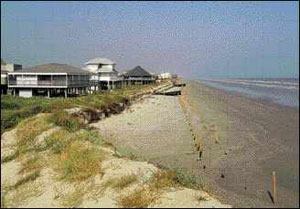
Today, a narrow dune separates low-lying homes from the encroaching sea near Galveston, Texas, which is among the coast’s fastest-sinking land areas. In relation to the land, the sea level near Galveston has risen more than 2 feet since 1900.
The Treasure Coast sea-level rise report is the first of several that will soon document Florida’s vulnerability to sea-level rise along its entire coast. This spring, Miami-Dade County created a Climate Change Advisory Task Force aimed in part at advising the county commission on “adaptation measures to be taken in response to the challenge of global warming.” Other coastal cities starting to incorporate sea-level rise into their plans range from Medford, Mass., to Olympia and Seattle in Washington, says Susan Ode, outreach officer for the ICLEI USA office of Local Governments for Sustainability. “Especially on the coasts, they are starting to understand that there are just things we must do,” Ode says. “There isn’t really the luxury of waiting.”
Three Options
Coastal cities have three main options as the waters rise. They can uproot and retreat; raise their elevation; or build levees, dikes, and other hardened engineering structures to keep the water out. Retreat is probably the best option for sparsely populated regions. But, with 13 of the world’s 20 largest cities located on the coast — and 53% of the U.S. population living in counties that border the oceans or Great Lakes — that’s more the exception than the norm. Communities will likely turn to renourishing, filling, elevating, and armoring instead.
Cities considering elevating will not only have to raise houses (or raise currently elevated homes higher) but also elevate roads, retail strips, sewer pipes, power substations, and water-treatment facilities, Trescott notes. At the very least, that will involve massive amounts of fill. Ironically, in southeast Florida, “We’re having a fill crisis now just trying to deal with the development level,” Trescott notes.
Dikes, breakwaters, revetments, bulkheads, floodwalls, and other shore stabilization and protection measures are also expensive and energy-consuming to build. A seminal 1991 study on sea-level rise, “Greenhouse Effect and Sea Level Rise: The Cost of Holding Back the Sea,” estimated that it would cost $270 to $475 billion to armor the entire U.S. coast against a sea-level rise of 1 meter, or about 3.2 feet. But that was with no future development, and today that estimate seems exceptionally low. Yet, the study noted, without any such protection, “a one-meter rise in sea level would inundate 14,000 square miles,” half of it today’s wetlands, half of it dry land.
With much of the East and Gulf coasts at or barely above sea level, more and more communities will have to rely on seawalls to help stem rising sea levels.
Tailored Development
Without a firm grasp on the severity of the coming sea-level rise, perhaps the best option is for communities and residents to tailor future development. Scholars have imagined a range of scenarios in which building and zoning laws could be tweaked. For example, for barrier islands, which tend to migrate landward, “governments might create a system of transferable development rights in which one could fill and build on a bay-side lot, provided that an equally large structure on the ocean side was removed,” writes Jim Titus, a Maryland lawyer and national expert on sea-level rise, in a 1991 paper that examined the impact of sea-level rise on a New Jersey barrier island.
According to researchers, 80% to 90% of U.S. beaches are eroding, requiring beach improvement efforts, such as this berm restoration in Pensacola Beach, Fla.
As for private interests, Trescott says he is skeptical that builders and developers will ever make sea-level rise a consideration, because they are short-term investors in property. But Titus isn’t so sure. Hurricane safeguards have become a selling point today for coastal homes. So might planning for sea-level rise become a development’s selling point, he says. He suggests, for example, setting aside beachfront land that is particularly vulnerable to erosion and orienting streets perpendicular to this land. The goal: to prevent an entire street of homes from being wiped out as the seas rise.
“The first step is get away from a situation in which real estate agents and builders and developers feel like they have to deny the situation to sell a house,” he says. — Aaron Hoover
Green Building Gains Ground in Gulf
Concern for hazards released by flooding, plus rising energy costs, stirs green building interest
When New Orleans architect and green building advocate Dan Weiner happened into a church a few months after Hurricane Katrina, members proudly showed him all their rebuilding achievements. He admired their work — until the fumes in the daycare nearly knocked him down. “They used toxic, off-gassing adhesive and paint to get the school open quickly, and they were sticking children in there,” he says.
The experience illustrates the challenge that Weiner and others in the green or “sustainable” building community face in New Orleans. The city’s massive rebuilding needs offer a one-of-a-kind opportunity to put into place the ideas of green building on a scale out of the reach of other built environments. But residents trying to get back into their homes and businesses as quickly as possible may lack the knowledge, money, or access to expertise to pursue green techniques. “There’s such an urgency to get back into buildings that you may make decisions to your own detriment,” says Weiner, a board member of the Green Project, a New Orleans-based group working to recycle construction materials from damaged homes.
FEMA workers inspect lead paint peeling off a flooded wall. Such perils have come into the spotlight after Katrina, prompting green building advocates to push for rebuilding with fewer hazardous materials.
Green building uses techniques and materials that raise energy efficiency, pose no threat to human health, and are recycled or come from environmentally friendly sources. After years of steady growth, it has entered the mainstream, helped by a rise in energy costs. A 2005 survey by McGraw-Hill Construction and the National Association of Home Builders predicted the $7.4 billion industry will go from its current 2% market share to at least $19 billion and a 5% market share by 2010.
The potential for New Orleans to serve as a kind of test city for green concepts has drawn the attention of both local and national organizations. Santa Monica-based Global Green USA is one of several with active programs in the city. As Monica Gilchrist, a staffer with Global Green USA, puts it, when rebuilding New Orleans “why not do it better? Why not do it more energy efficiently and more healthfully?”
Katrina paved the way for green techniques not only physically but also psychologically, advocates say. Already socked with increased natural gas costs, residents are facing electricity rate hikes of as much as 140% as local utility Entergy seeks to pay for restoring power lines and production, says Forest Bradley-Wright, with the New Orleans-based Alliance for Affordable Energy. “People are seeing astounding utility bills, and that makes them receptive to these types of opportunities,” he explains.
There are some big hurdles, however. For starters, the city’s “very old building stock,” as Bradley-Wright puts it, makes incorporating green techniques and materials in rebuilding a unique challenge — at least at the sophisticated level possible with new construction. That said, the age of the city’s homes make them ideal for realizing another green priority: building products recycling. The Green Project has already dismantled six homes and “skimmed” dozens more for reusable scrap, much of it otherwise unobtainable century-old wide-plank cypress or heart pine, according to Weiner.
But the bigger challenges may be education and money. People may not know, for example, that they can buy low-VOC (volatile organic compound) paint, now a standard product offered by big paint makers such as Sherwin-Williams, Weiner says. And though green products are worth it in the long term, they are often more expensive up front.
Still, advocates are cautiously optimistic. “What I hear time and time again from residents is that New Orleans has been behind the curve,” Gilchrist says. “This is an opportunity to catapult it to the head of the pack.” — A.H.