Builders take notice of the species they plant
As a landscaping tree, the laurel oak is fast-growing, leafy, and tolerant of poor soil — qualities that have made it a popular choice for new homes and planned communities throughout the tree’s native range in the Southeast.
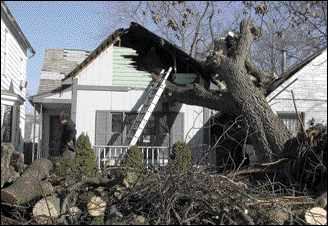
But the hurricanes of the past two decades have revealed a downside: the laurel oak topples in high winds. Studies of downed trees after recent Florida hurricanes have pinpointed the laurel oak as perhaps the most common of large trees to fall. “I’ve measured four hurricanes in the Pensacola area,” said Mary Duryea, urban forestry expert at the University of Florida, “and in every one of them, laurel oaks have wreaked havoc.”
Toppling trees prove to be a leading culprit in damaging houses during high-wind events. Builders and planners seeking to make new communities as hurricane-hardened as their houses have learned to pay attention to the kinds of trees they plant.
Used to be, tree falls were dismissed as unpredictable and uncontrollable. But urban foresters such as Duryea are bringing order to the chaos. By surveying urban canopies in the aftermath of hurricanes, they are learning how different tree species fare and how to plant and maintain trees to maximize survivability. The research is of interest not only to developers and planners but also to insurers, whose billions in payouts for the 2004 storms included millions for damage in Orlando and elsewhere inland.
Though it is not widespread, some have already called for trees to figure more heavily into insurance considerations.
Laurel oaks (Quercus laurifolia) “are such a risk factor that I would suggest that people’s insurance should be based on the types of trees they have,” Jim Lushine, a meteorologist with the National Weather Service in Miami, told the Lakeland Ledger last year. “I wouldn’t be opposed to even seeing some kinds of trees banned in Florida.”
By surveying urban canopies in the aftermath of hurricanes, they are learning how different tree species fare. |
For developers and planners seeking to make new communities as hurricane-hardened as their houses, the message is to plant smarter. Fortunately, how-to information is becoming readily available. Those seeking an in-depth treatment can turn to landscape architect Pamela Crawford’s 2005 book, Stormscaping: Landscaping to Minimize Wind Damage in Florida. But a brief discussion is also available in the just-published “Assessing Damage and Restoring Trees After a Hurricane,” from the UF Institute for Food and Agricultural Sciences (downloadable for free at http://edis.ifas.ufl.edu/EP291).
The publication’s six authors make clear that planting smarter is partly a matter of choosing wind-resistant species. They list dozens of hearty candidates among palms, pines, and deciduous trees. Duryea’s research has shown that sabal palms (Sabal palmetto), live oak (Quercus virginiana), and southern magnolia (Magnolia grandiflora) are among the hardiest. Decay resistance is an important factor in wind resistance: live oaks tend to resist decay, while laurel oaks are prone to it.
How developers and community planners design tree layouts is also important, the authors note. They write that the most important and often overlooked design element is leaving enough soil space around the tree for its roots to grow. Trees expected to grow large should have at least 30 feet of unpaved space around their trunks; medium trees, at least 20 feet; small trees, at least 10 feet. Soil should be well drained, allowing roots to dig deep. “To provide anchorage for the tree,” the authors write, “roots need to spread beyond the edge of the canopy and grow deep in the soil.”
The authors also suggest that landscapers and developers group trees together in larger spaces rather than planting them singly in small spaces. This is to take advantage of trees’ natural tendency to support each other when bowed by wind. Even with the right species correctly planted, homeowners have to prune trees carefully to make sure they continue to be wind resistant, the authors note.
In a paper on tree damage following Hurricanes Erin and Opal in 1995, Duryea notes that the hurricane aftermath can leave neighborhood residents opposed to trees because of the damage they can cause. Yet trees have many benefits, such as shade, which helps homeowners conserve energy, Duryea writes. The implication is, the value of urban forests trumps their risks, especially when trees are planted and maintained to ride out hurricanes intact. — Aaron Hoover
Currents
The 24-hour Difference
The National Oceanic & Atmospheric Administration opened a new research institute to focus on improving hurricane forecasts. Dr. David Shaw, director of the new Northern Gulf Institute at Stennis Space Center, said that simply improving the ability to accurately predict the strength and position of a hurricane at landfall within 96 hours, up from 72 hours, would drastically improve evacuations, saving lives as well as the frustration incurred by unnecessary evacuations.
Increased Threat
Researchers remain divided over the question of whether global climate change is increasing tropical storm frequency and intensity. But one thing not disputed is the increase in the destruction. Philip J. Klotzbach, a hurricane researcher at Colorado State University who disputes the link between global warming and stronger storms, told The New York Times: “There is likely to be an increase in destructiveness from tropical cyclones regardless of whether they are getting more intense or not. This is largely due to the increase in coastal population and wealth per capita in hurricane-prone areas.”
Premium Prices
Insurance woes a driving force for building better houses
In the aftermath of eight hurricanes and $36 billion in insured losses in 2004 and 2005, home and business owners are facing insurance premium increases as high as 194%. And they are demanding relief, driving insurance reform to the top of the list of hot issues in Florida.
A special committee appointed by former Gov. Jeb Bush made 50 recommendations in November aimed at lowering rates and reducing risks to insurers. During recent elections, GOP gubernatorial candidate Charlie Crist and Democrat Jim Davis sparred over who offered the best package of reform ideas. And the Florida legislature planned to meet in a special session in mid-January to tackle the issue. But it was far from clear that all the political activity would ever amount to significantly lower rates for Florida’s over 4.4 million homeowners anytime soon.
“What is it that they can do that is going to cut premiums?” asked Gary Landry, vice president of the Florida Insurance Council. “We have to have adequate premiums.”
Unfortunately, there is no single patch for the gaping hole of trillions of dollars of exposed coastal property. That was made abundantly clear by the governor’s Property and Casualty Insurance Reform Committee’s recommendations, which spanned ten areas ranging from reinsurance to building codes to market incentives. Lawmakers were widely expected to ease the rules for insurers to buy reinsurance from Florida’s hurricane catastrophe fund, with insurers presumably passing along savings to consumers. But that was viewed as a short-term solution done in the hope that private reinsurance rates will come down.
Although it would not lower premiums universally, the idea that seemed to gain the most traction with both lawmakers and insurers was increasing incentives for homeowners to make their homes more hurricane worthy.
“Probably the best thing in the reform committee package,” Landry said, “is the mitigation efforts.”
Mitigation techniques such as elevating a home, building shear walls, and installing tie-down hardware will count most when the next big storm comes.
Mitigation Minded
As longtime director of the Federal Alliance for Safe Homes, a Tallahassee-based disaster safety organization, Leslie Chapman-Henderson can recall a time when people brushed aside mitigation — the measures aimed at strengthening homes to prevent damages.
Today, she says, both Florida residents and politicians increasingly view hardening homes against hurricanes as central to storm preparedness.
As evidence, she cites the overwhelming response to a new state program offering free home inspections for hurricane worthiness and matching dollars for retrofits. Florida launched My Safe Florida Home in August; 58,000 people had applied by November. To meet the demand, state lawmakers were expected to expand the program this year.
A couple of changes have pushed mitigation to the forefront.
One, the four 2004 hurricanes gave many Floridians a firsthand view of how homes built to withstand hurricanes compare to those that don’t. Visible evidence in many neighborhoods was supported by research showing homes built after the 2002 Florida Building Code fared far better than earlier homes built under less stringent codes.
Two, in response to miles-long traffic jams in the 2004 and 2005 evacuations, Florida’s emergency managers have switched from advocating widespread evacuations to urging residents in all but the riskiest locations to stay in place. The result is, mitigating homes is increasingly viewed as a way not only to protect property but also to safeguard people.
“I’ve been around this movement for a long time, and the notion of sheltering people in place is taking on an increased level of importance,” Chapman-Henderson says.
“It’s a sea change, really, in attitudes.”
How mitigation will affect homeowner’s insurance premiums remains to be seen. A new law will require Florida’s insurance companies to disclose by March 1 exactly how much policyholders can reduce premiums through steps such as opening protection for windows and doors. But the numbers will differ based on the company, the location, and type of home. The biggest discounts will probably be available to homeowners in southeast Florida, still considered the state’s highest risk area, who potentially cut their rates by as much as 50%, Chapman-Henderson said. — A.H.