With dozens of law firms involved, tens of thousands of potential homeowner plaintiffs, and multiple defendants up the whole supply chain, the burgeoning flood of lawsuits concerning Chinese drywall has the potential to clog the judicial system in states and Federal districts where the drywall problem is significant. Bogging the courts down in multiple, overlapping investigations of the facts could also possibly create a mass of conflicting rulings. In such cases, the Federal court system provides for consolidating multiple suits into a single court under a single judge. And that’s what happened on June 15th: The Federal Panel on Multidistrict Legislation ordered all Federal cases against suppliers of Chinese drywall to be assigned to the court of Judge Eldon E. Fallon, in the Eastern District of Louisiana, located in New Orleans. The Sarasota Herald-Tribune has a report (“Chinese drywall cases to be consolidated in New Orleans,” by Aaron Kessler) as does The New Orleans Times- Picayune (“Chinese drywall lawsuits to be consolidated in federal court in New Orleans,” by Kate Moran).
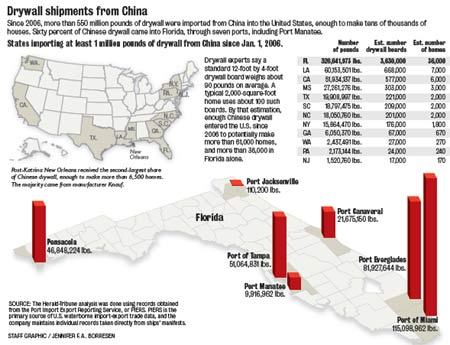
Florida markets received far and away the highest volume of Chinese drywall shipments during the peak importing years of 2005 and 2006, according to an analysis by the Herald-Tribune, while Louisiana received the second highest volume of shipments (see graphic above). Other states, including Atlantic seaboard states and West Coast states, received far lower volume, while inland states, with ready access to domestic supplies and higher shipping costs for transport from the coast, appear largely to have been spared the Chinese drywall plague.
But according to reports, Judge Fallon’s New Orleans court was chosen in preference to a Florida court not because of geography, but because of the Judge’s particular experience and skill in managing complex multi-party litigation. And while the Federal order will not apply to lawsuits brought at the level of the state courts, in the past Judge Fallon has succeeded in persuading the parties in some state-level lawsuits to join in a Federal court settlement of complicated drug liability litigation. Chinese drywall has become a hot issue in Louisiana. New Orleans Saints football head coach Sean Payton has the drywall in his recently built Mandeville home, and has moved out while the home is being fixed, according to a report in the Baton Rouge Advocate (” Chinese drywall plagues Payton,” by Associated Press sports writer Brett Martel). See Payton’s post-game interview mention of the topic on the Times-Picayune website (“Video: Payton on Chinese Drywall”). Litigation is sure to take years to produce a result. But shorter-term help may be on the way for some Louisiana residents, according to this report in the St. Tammany News (” Help on the way for Chinese drywall victims,” by Anne Lautzenheiser). Local and federal lawmakers have been meeting with officials from the Department of Housing and Urban Development (HUD) in search of a way to fund payments out of Louisiana’s “Road Home” fund, established after Katrina, to reimburse hurricane victims who ended up having their homes repaired or rebuilt using Chinese drywall for the costs of fixing the drywall problem. And in D.C., lawmakers are pressuring the Internal Revenue Service to provide tax relief for Chinese drywall victims, reports the Bradenton, Florida, Herald (” IRS relief sought for Chinese drywall,” by Duane Marsteller). Florida Senator Bill Nelson, Virginia Senators Mark Warner and Jim Webb, and Virginia Representative Glenn Nye have contacted the IRS for “clarification” as to whether being hit with the Chinese drywall problem would qualify taxpayers to take a deduction for an uninsured casualty loss, as they can if their property is damaged or destroyed by a storm or fire that they are not insured against.