Ted Cushman
Strict wind-resistant construction requirements in the 2003 International Residential Code (IRC) and International Building Code (IBC) can be a headache for many beachfront builders. But architects and contractors who work with structural insulated panels (SIPs) say the new rules could bring them a new competitive advantage — or at least, for once, a level playing field.
SIP builders have long complained about the need to get project-by-project approval to use their technology: They say SIP structural capabilities are well proven by engineering data and field experience. But for building departments that may not have seen a lot of SIP construction, requiring an engineered design may be the only path to assuring adequate performance of an unfamiliar system.
For houses in 110-mph and higher wind zones, however, states and municipalities recently adopting the 2003 IBC and IRC are now requiring an engineering analysis on virtually all homes, whatever the framing system used. SIP builders say this may erase one of the big negatives that has handicapped SIPs in the market — at least when it comes to building on the oceanfront. In the areas where stick-home plans need as much engineering documentation as SIP homes need, builders who choose SIPs are no longer facing any special hurdle.
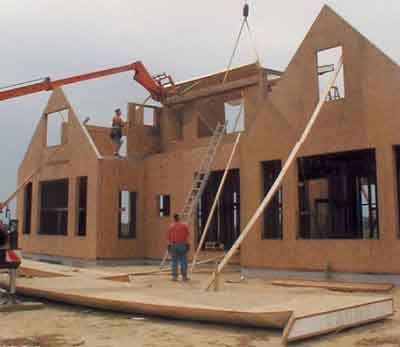
On a Long Island home, architect Bill Chaleff relies on structural insulated panels (SIPs) to easily meet stringent uplift requirements.
Architect Bill Chaleff designs and builds with SIPs on the east end of Long Island, where design wind speeds are set at 120 mph. Chaleff says SIPs are more than up to the code challenge: “I’ve already gotten permits for two houses, one in East Hampton and one in Southampton, under the new building code here, by showing my calculations to the building department to demonstrate that I can meet the required design loads.”
Understanding and Documenting Uplift
Hurricane-force winds apply a variety of stresses to a building. If a home lacks adequate shear walls and anchors, horizontal wind pressure tends to collapse wall systems or overturn the entire building, or the “sliding force” of the wind may simply push the building off its foundation.
In addition, there’s wind uplift. As wind flows over a pitched roof, aerodynamic effects create an upward suction, much like the uplift force that acts on an airplane wing (Figure 1). If roof sheathing isn’t adequately nailed, boards or panels can get ripped off the roof framing (see “Evaluating OSB for Coastal Roofs,” Winter 2005).
Figure 1. Wind passing over a building exerts positive pressure on the windward wall and negative (suction) pressure over most of the roof area. The wind pressure is concentrated at building corners, where eddies exert extra forces.
But if the sheathing does stay attached, it pulls upward on the rafters or trusses. These in turn pull up on the roof-to-wall connection, and if that survives, wall systems pull up against their attachment to the floor systems or foundation systems at their bases.
For coastal homes subject to the strict requirements of the current IBC and IRC, building departments will now require a design professional — architect or engineer — to document how a building resists this uplift force. The plans must show a “continuous load path” that handles the uplift at the roof surface plane and transmits it through specified connections of known strength down through the roof system, the wall system, and into the foundation. How the load-carrying task is accomplished varies from one structural system to the next, but in every case, it must be documented.
Documenting starts with estimating the uplift forces on the roof sheathing and overhangs. That can be done with calculations or with look-up tables. The result is a drawing that shows the entire roof surface hatched into segments, with a design uplift load designated for each section of roof area. Ridge and eaves zones experience higher uplift than mid-roof areas, while roof corners see the greatest uplift loads. If flying debris breaches windows or doors, internal pressurization caused by inrushing wind could drastically increase the total uplift pressure on the roof.
With design uplift load established, the design professional must specify step-by-step how the load will be transmitted through the building structure down to the ground, specifying adequate connections at each structural intersection.
Uplift Details
For roof-to-wall connections, Chaleff applies the high wind uplift values from roof corners to his entire roof. He then distributes that load over the roof-to-wall joint, secured by long hardened screws and hand-driven nails (Figure 2). He requires the outside walls to handle the entire uplift load, disregarding field attachments to midspan purlins or ridge beams, because only the wall panels provide a direct load path to the foundation wall. “I didn’t have to change anything about the way I fasten the panels together,” he notes. “I’m meeting the new wind codes using the same fasteners at the same spacing that I have always specified for our designs.”
Figure 2. In SIP construction, wind uplift loads can be resisted by self-tapping structural screws at roof-to-wall panel joints (A). In addition, metal straps spanning the upper and lower wall plates at the band joist (B) and anchors that secure the panels to the foundation (C) are required. “Balloon framed” SIP structures that use a continuous panel from foundation to ridge do not require the straps between stories, but the supporting attachment for the floor systems must be carefully specified. Additional anchors may be needed for shear-wall connections.
By contrast, says Chaleff, stick methods in coastal zones now involve complicated framing reinforcement (Figure 3). “To meet the uplift loads induced by a 120-mph wind, they have to put hurricane straps on every rafter or truss and on practically every stud, and they have to strap from stud to stud across the band joist between the first and the second floor. It can add $15,000 to the cost of a big custom house.” The difference makes SIP homes cost-competitive with stick homes in his area, says Chaleff — leaving him free to focus on the energy performance advantage of his preferred building system.
Figure 3.In high-wind zones, the steel connectors required to create a continuous load path to resist the wind uplift of a stick-framed assembly often include straps to tie trusses to wall plates (A), wall plates to studs (B), upper wall studs to band joists (C), band joists to headers, posts, and lower wall studs (D), posts to foundations (E), wall studs to lower wall plates (F), and lower wall plates to foundations (G). Additional anchors may be needed for shear-wall connections.
Fewer Connections
At least one Florida house has already provided a test case for SIP homes facing storm winds. Builder Cameron Bradford was the general contractor for the “Not So Big” Show House at the 2005 International Builders Show, a showcase home framed using Insulspan SIP panels (www.insulspan.com). The building was hit by three hurricanes in a row while still under construction in the fall of 2004.
“Hurricane Frances brought 105-mph measured winds at the airport,” Bradford says, “and our house survived without any damage at all. We didn’t even have the windows or doors in yet, and the wind came right inside the building.” But with SIP exterior walls and a flat SIP ceiling on the second floor supporting a truss roof, the Orlando house is “built like a plywood bomb shelter,” notes Bradford. “It was not damaged at all.”
Simple connection details were a real plus, reports Bradford: “The biggest advantage is the speed of construction.” The house took just four days to set, he says, “and that’s including our learning curve, using SIPs for the first time.” Tying the house down was a snap: “We used Simpson hold-downs at every panel joint into the slab foundation — that was definitely overkill. Then we had flat straps spanning the first-floor frame, just at the panel joints.
“In a stick frame, you’re installing two connectors for every stud, and six or eight nails per connector,” he explains. “That is a lot of nailing. The SIP walls were much, much faster.”~
Ted Cushman reports on the building industry from his home in Great Barrington, Mass.