by David Bentley and Elizabeth Churchill
Shutters are well-ingrained features of the American coastal design vernacular. Interior wooden shutters were the earliest protection for openings from intrusion or inclement weather. As glazing became more widely available during the 18th century, bifolding raised-panel shutters became a familiar feature of the interior finish. Typically, these shutters folded into a splayed jamb within the thick walls of traditional timber frame or masonry buildings.
Exterior shutters, or blinds, first appeared on coastal homes in America around the turn of the 19th century. In southern climates, fixed-panel or louvered exterior shutters could be closed over open windows to shade and secure the interior while still allowing for ventilation. On the well-ordered facades of neoclassical buildings of early America, exterior blinds became an important part of the overall design composition. The practical and decorative aspects of exterior blinds led to their common usage on many structures up and down the eastern seaboard through the end of the 19th century.
Traditional Shutters
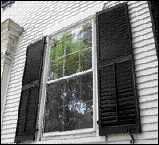
Traditional exterior blinds typically hung on wrought-iron pintle hinges attached to the window frame. These hinges allowed for easy removal of the shutters for maintenance and repair. Holdbacks, or shutter dogs, secured the blinds against the outside wall in the open position (Figure 1).
Figure 1. On the well-ordered facades of early American neoclassical buildings, exterior shutters play an important role in the overall design composition. Often called “blinds,” these exterior shutters hang on wrought-iron pintle hinges (right) attached to the window frame.
Following the introduction of modern heating and cooling systems, the importance of exterior blinds diminished, and their use declined. Many were removed rather than repaired or replaced, resulting in a significant loss of character to many 19th-century buildings.
Reviving Shutters
In our restoration work on historic coastal homes, we look for evidence of remaining shutter hardware around window openings, or look for old blinds stored in an attic or basement. In new construction, we often call for exterior blinds. As architectural features, shutters not only protect the fenestrations, but impart a traditional character to a new building as well.
Figure 2. In the design of Nantucket’s Harborside Cottages, the only waterfront condominium on the island, the authors called for custom board-and-batten exterior shutters to convey a traditional boathouse appearance to the individual units.
In the design of Harborside Cottages, Nantucket’s only waterfront condominium, for example, we used custom board-and-batten exterior shutters to convey a traditional boathouse appearance to the individual units (Figure 2). The shutters were constructed of 1×4 tongue-and-groove cedar with a V-groove joint, secured to a 1×4 Z-batten on the inside. Hung on wrought-iron pintle hinges driven into the casings, these shutters fold back and attach to the wall with holdbacks. When closed and secured with slide bolts at the top and bottom, the shutters protect the French doors behind from storms and provide additional security for the dwellings during the off-season.
Figure 3. In the design for a renovated home on Nantucket Harbor, the authors specified roll-down shutters to shade and protect the sunroom windows and French doors facing the water. The shutters slide on tracks hidden behind the trim.
When specifying shutters, we rely on wood blinds and shutter hardware manufactured and sold through a number of specialty suppliers. Kestrel Manufacturing (www.diyshutters.com) provides a broad range of louvered and solid custom wood shutters and a selection of traditional wrought-iron hinges, shutter dogs, and holdbacks. Vixen Hill (www.vixenhill.com) has similar offerings, manufacturing custom shutters in red cedar for increased durability and longer life.
Rolling Shutters
The ultimate in storm protection and security is provided by rolling shutters from Rolladen Rollshutters (www.rolladen.com). The interlocking vinyl or aluminum slats roll down inside aluminum tracks attached to the jambs to provide a continuous protective cover over the opening. Depending on the style and type of slat used, the shutter requires a 7- or 8-inch-diameter roll above and outside the opening to accommodate the shutter in the open position. The typical box enclosures supplied are visually prominent and difficult to integrate into the design of a building.
The authors incorporated the exterior-mounted box required for the rolling shutters into the design of the building cornice. Removable soffit panels provide access to the shutter for maintenance. In our design for a renovated home on Nantucket Harbor, traditional shutters with pintle hinges and shutter dogs were returned to the street side of the residence, maintaining its historic appearance. For the large triple-track sliding sunroom windows and French doors on the rear facing the water, we specified rolling shutters (Figure 3). But in lieu of the exterior-mounted boxes, the shutter housing was incorporated into the design of the building cornice, for an almost invisible installation when the shutters are open (Figure 4). Removable soffit panels provide access to the shutter for maintenance.
Exterior shutters can provide increased security and storm protection for seaside structures, both old and new. They can help restore the historical appearance of an existing building or provide a traditional character to new construction. When integrated into the design, exterior shutters can be used to enhance the appearance of a building as well as its protection. —
David Bentley and Elizabeth Churchill, architects on Nantucket Island, Mass., have been building seaside homes for more than 20 years. All photographs and details are by the authors.