by Gordon Tully
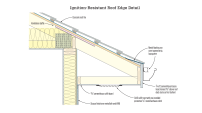
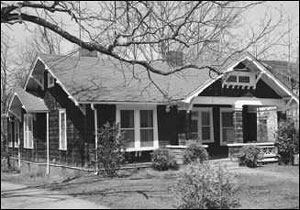
Gables are indispensable to many house designs, but wide overhangs (desirable for both aesthetics and shading) are real wind catchers. One answer is to support the overhang with struts — a characteristic of the bungalow style. In high-wind zones, the attachment of the strut to the wall and the roof edge should be reinforced with steel hardware.
Although not exactly a page turner, the latest edition (2005) of ASCE-7 is the definitive source for wind-load design. For designers with an engineering bent, the best way to gain a deeper understanding of the issues is to engineer a simple home using this document. Get help from a structural engineer or even from a sales engineer for a fastener manufacturer, as specifying the right number and type of anchor clips is crucial.
Here, we’ll concentrate on the consequences of various roof forms and details. The roof features that increase the risk of wind damage, in order of decreasing impact, are wind catchers, undesirable geometry, and interruptions (see box below). Unfortunately, these roof features are also desirable features for a stylish house. As compromise seems inevitable, it helps to know which features most compromise wind performance.
Roof Features at Risk Wind catchers • Open carports and patio roofs • Projecting roofs over entries, fixed awnings, canopies, and the like • Broad overhangs, especially with a thin cross section • Building roof, if windows or the garage door is blown in Undesirable Geometry • Low or high roof pitch • Thin or tall cross section Interruptions • Dormers and clerestories • Parapets and chimneys |
Wind Catchers
When positive wind pressure gets under an open structure, it gets added to the negative uplift pressure imposed by the wind, more than doubling the wind load. In a closed house, the interior pressure is the intermediate between positive and negative, minimizing the loading on each envelope plane. But removing the garage door or several windows (as the case might be if these were blown out in a major storm) would cause the interior to become positively pressurized, greatly increasing the load on all planes except the one facing the wind. This is why it is essential to reinforce the garage door and install windows that are firmly attached and capable of resisting impact loads.
To make matters worse, open roofs, projecting canopies, and roof overhangs are typically thought of as lightweight, inexpensive, and primarily decorative elements, and as such are often poorly detailed to resist uplift. Just where you need twice the wind protection, you typically get half.
In designing a carport or patio roof, every element must be carefully examined:
• Hold down each layer of roofing against uplift.
• Size and secure the roof deck for uplift. It pays to close up the deck with tape or sealant to eliminate positive pressure on the roofing and underlayment.
• Size each horizontal structural member for uplift. Note that ordinary joist hangers don’t resist much uplift.
• Anchor columns top and bottom. Use column bases that resist the design uplift.
• Provide enough weight or friction in the foundations to resist total uplift. Small pier footings may not do the job, and a slab may need to be thickened to hold the column anchors.
Projecting elements without columns, such as canopies and wide roof overhangs, need similar treatment for the roofing, deck, and framing. The load can be carried back to the building in two ways: with struts or as a cantilever. Struts anchored top and bottom are always the best solution. Make struts as long as possible to minimize loads, and engineer both top and bottom connections. Without struts, the structural members must cantilever. Don’t guess at the cantilever design — use the expertise of a structural engineer. Cantilevers are most highly stressed where they penetrate the building envelope, so good flashing and waterproofing are essential. Unfortunately, it is difficult to flash and seal a cantilevered wood beam, because there is no vertical step to resist horizontal water penetration, and the beam moves a lot when it is loaded. Steel can be very useful in cantilever design.
Undesirable Geometry
An intermediate roof pitch conforms to the natural flow of air around the obstacle (the home), reducing wind pressure on the roof. A steep pitch blocks the flow, adding positive pressure on the front plane and suction on the back. This added pressure occurs high up, increasing the tendency for the home to tip over. A low pitch creates suction over the entire roof. The current “neo-modern” fad features both flat roofs and large overhangs, neither of which are desirable features.
The height of the house impacts the wind load, too. A taller home intercepts more wind, increasing the loads on the mudsills and requiring more careful engineering and construction. A thin cross section (as in a single-wide mobile home) increases the uplift on the windward side and can be toppled if not securely tied down. Both features, however, are important for creating good neighborhoods with relatively high densities, which often requires deviating from a wind-smart design. While each house in a dense community to some extent protects the next from wind on the vulnerable long sides, it’s critical that you get the hold-down details correct.
Interruptions
Interruptions add wind load and compromise the roof’s resistance. Figure 1 shows an ideal wind-smart home: one story, almost square, with a hipped roof at an intermediate pitch, no interruptions, short overhangs, and no attached open roofs or canopies. Figure 2 shows a “gable-on-hip” design, adding interest and providing for a window or attic vent. The projection adds turbulence, but the intrinsic shell-like structure of the hipped roof is retained.
Ideal Wind-Smart Roof
• Intermediate pitch
• Hipped
• Short Overhangs
• No attached open roofs or canopies
• Compact squarish form
• One-story design
Figure 1. A square hip is the most durable roof design for high-wind zones.
Gable-On-Hip Roof
Shaded band acts as a shell, providing added strength
Figure 2. A gable-on-hip design adds visual interest. While the small gable will create more turbulence, the basic design is still sound.
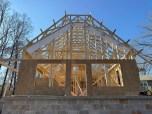
Gabled roofs are known to fail in hurricanes when compared with hipped roofs, but they are indispensable for most designers. Figure 3 shows a “clipped gable” (also called a “snub-nosed gable”), where the highly stressed gable peak is eased off with a small hip. Such roofs (when built with desirable short rake overhangs) are found in early 20th-century Tudor revival designs and in southern colonial churches, neither of which are commonly found in high-wind zones. Much more common are bungalow designs with clipped gables, but they have undesirable long and thin roof overhangs. Struts under the eaves are also authentic to the bungalow style (see photo, page 7), and may be necessary in high-wind zones.
Clipped Gable (Hip-On-Gable) Roof
Reduces turbulence at peak uplift, where forces are greatest
Figure 3. A clipped gable reduces the wind force where it is the greatest on a gable design — at the peak.
The take-home message: Almost any design can be engineered to resist almost any wind load, given careful engineering, closely supervised construction, and a generous use of properly chosen fasteners and tie-downs. But relative to commercial construction, home building is usually weak in all these respects. Stay as much as possible with wind-smart features, and if you need to deviate, spend the extra engineering, supervision, and tie-downs on designs that give you the most bang for the buck.
— Gordon Tully is an architect in Norwalk, Conn., and teaches a summer executive education course at the Harvard Graduate School of Design. Illustrations by the author.