Andrew P. DiGiammo
When I’m driving through neighborhoods in coastal Rhode Island and Massachusetts, where I design and build custom homes, I keep an eye out for interesting design elements on both new and old houses. In the past eight years, I’ve noticed a resurgence of polygon bump-outs, round towers, and multifaceted bays. I’ve been using polygons in my own work since I started designing and building homes. For beginners, polygons can seem tricky to work with, but they are not difficult if you have a basic understanding of geometry. And they’re worth the effort: A nice bay or many-sided projecting room can serve various purposes in a house design.
Aesthetics Are Only Part of the Equation
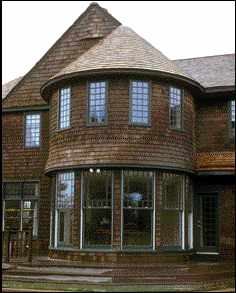
Visual aesthetics are just part of a bump-out’s value. A many-sided projecting room with windows adds interest to an elevation (Figure 1), and it can serve to capture a nice view, which is especially important for homes near the ocean. But round or polygonal projections can also help the way a space functions. In a coastal home where wind loads are a factor, some walls may need to be nearly windowless for structural reasons, and interior shear walls can create long, narrow rooms. Projecting bump-outs with angles, curves, and windows can bring light into these areas, creating interior spaces that are strong and sheltering while still welcoming in the outdoors. And by the nature of its shape, the attached polygon becomes a buttress, contributing strength to the house through its geometry.
Figure 1. A multisided projecting room with windows adds interest to the elevation and brings in light while offering expansive views. The tower is a section of a duodecagon — a 12-sided figure that can be readily adapted to a circular form on the outside.
Polygon rooms can even be an economical feature for a project where the budget is limited. I like to start with a simple rectangular footprint, then enhance just one or two rooms by adding a bay or a circular or polygonal projection. That way, I can provide a spacious living or dining area without having to make the whole house wider.
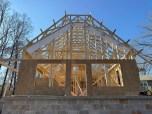
I always use a pure geometric form: a polygon with equal angles and equal sides. That symmetry simplifies the framing (Figure 2) and helps prevent an awkward-looking result. But I don’t limit myself to octagons — I choose the shape that will do the most for me in the particular situation. Computers have made my life easier by eliminating the need to work the trigonometry for each option. If I specify the number of sides and the diameter of the polygon, AutoCad generates the shape and allows me to place it wherever I like.
Figure 2. Using a pure geometric form helps maintain simplicity and symmetry in design massing, as well as in construction details such as roof framing.
Twelve Faces
The duodecagon, or 12-sided figure, is probably my favorite. It tends to work well with typical room and window dimensions: Twelve faces (or six, if I’m using only half of the figure) can gracefully define a room that is 12, 14, or 16 feet wide, and the dimensions of each wall panel tend to work well with window sizes, leaving just enough wall space around each window for comfortably sized trim.
A 12-sided figure creates angles gentle enough to be readily adapted into a circular form. When I create circular towers or round rooms, it’s usually only the outside of the room that is finished round. My crew frames up the room with flat walls, then ties all the wall sections together and sheathes them for strength. We can then set all our windows into the flat wall panels, which is much more practical than trying to set them into a round wall. We apply curved windowsills to the exterior, and furr out the outside walls horizontally with pieces ripped from wide 2-by stock, with the proper radius curve on the outboard face and the flat inside face nailed against the wall. Placing the furring at 5 inches on-center or so, we can nail shingles right to the furring to create a smooth, curved shingle face around the whole outside wall. Inside the room, we stick to the flat-sided polygon shape, using mitered baseboard and mitering the window trim so that the side casings meet in the room corners (Figure 3).
Figure 3. A figure with 12 or more sides can be adapted to a round exterior shape with curved horizontal furring. Inside, the windows bring in views, light, and air, and staying with a flat wall surface allows the use of simple mitered trim details (bottom). Upstairs (top), the curved, windowed wall opens up the end of a long hall space defined by structural walls.
When you think about it, this can be the simplest way to treat that rounded space. It saves us from having to create all the angles and corners on the outside, with multiple beveled corner boards or other complicated carpentry, but it also lets us stay away from curved drywall or baseboard on the inside of the room. The result is a space that is interesting when viewed from either the inside or the outside, opening up the interior and taking full advantage of light, views, and cross breezes. — Andrew P. DiGiammo is a design/build contractor and a partner in an architectural firm in Assonet, Mass. All photos by Ted Cushman.