by Andrew DiGiammo
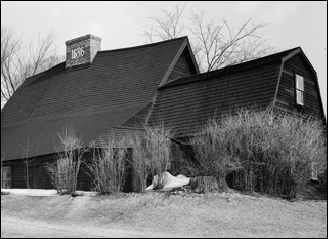
The gambrel roof style has a long history of enduring the elements. Some of the longest-standing wood-frame houses in America have gambrel roofs that date from the 1600s (see the photo below for the consummate example). I see a lot of gambrel roofs on Victorian-era houses in towns along the eastern seaboard (although the slightly different “mansard” variation is a more typical coastal style), and I also find gambrels on many shingle-style seaside summer homes built in the early part of this century.
Considered the oldest wood-framed house in North America, the John Fairbanks house in Dedham, Mass., dates to 1636. The two gambrel additions were completed later, probably around 1668.
In new construction, the style lives on into modern times, adapted slightly for platform framing methods. Even gambrel roof trusses, including space trusses that enclose usable attic space, are commonly available today, although when I use the gambrel form I prefer to stick-frame it.
Practical Advantages
What accounts for the gambrel’s enduring popularity? For me, the gambrel is a practical and attractive way to create usable space under a roof.
I’ve always felt that houses look better when the roofline springs from the first-story wall plate, rather than from the second story. The cape style, of course, is the classic example. But a cape roof can rob usable space from the upstairs floor plan. A gambrel gives you back that room, without having to form huge dormers.
The floor plan isn’t the only issue, however. A cape roof with a full shed dormer provides little or no space for ductwork. (Capes, in my experience, are a nightmare to air condition.) A gambrel roof, on the other hand, not only gives you very nearly a full second story, but it also creates a small attic in the upper, triangular portion of the roof, where you can run wires and ductwork. If a gambrel fits in well with the historical character of the area in which you’re building, then it’s a win all around.
Style Meets Structure
A roof, however, is never all about aesthetics or just about enclosing space. There are significant structural issues, too, and while old timber gambrels have survived, the form doesn’t translate perfectly to dimensional lumber. One gambrel rendition, for example, that dates from the late 1800s and early 1900s, relies on a complex assembly with a lower, steep-pitch set of rafters springing from the wall plate up to a 4×6 horizontal nailer at midroof (Figure 1). A knee wall supports the lower portion of these rafters but places a sizable point load on the floor joists.
Figure 1. Late 19th-century builder guides show this gambrel framing concept, which the author has emulated using modern materials. Taken together, the structural impacts — the load of the upper roof, the upward reaction of the knee walls, and the restraint at the main wall plates — place the lower rafters in bending. The knee walls transmit part of the roof’s weight onto the floor joists, which must be designed to handle that point loading.
I have built gambrels using a similar design, but I rely on upper-story web floor trusses to carry the point loads. Yet even with trusses for joists, the result is still not entirely satisfactory — there is enough minor movement in the floor system to create a small amount of finish cracking in the rooms below.
Another example found in one old house near the shore that I remodeled shows how the gambrel was understood in the days of balloon framing. In this case the upper portion of the main house walls served as the knee wall for the space upstairs (Figure 2). Orig-inally built as a summer cottage in the late 1800s, this house was a little underframed even for that era, and the movement of the roof betrayed some of the flaws in the concept.
Figure 2. In a late-1800s gambrel the author remodeled, floor joists were attached to the side of the main wall studs, resting on a 1×6 ledger board let into the studs. The upper portions of the stud walls served as knee walls in the upstairs rooms. The outward thrust of the lower gambrel rafters caused the wall plates to sag when the floor-to-wall connections slipped. And the nailer where the upper and lower rafters meet, which was too small to serve as a beam, had also sagged.
For the roof to work, the upper part of the balloon-framed walls would have had to act as a cantilever, resisting the thrust of the lower rafters. But the main floor joists weren’t well attached to the wall — they were nailed only to the 1×6 let-in ledger board rather than securely attached to the wall studs. The wall plate had bowed horizontally, and as the studs pushed outward, some of the joists had slipped out of position and dropped. The 4×6 nailer at the midroof joint had also sagged (although it had some end support, it was too small to function as a beam).
I managed to preserve most of that structure by reinforcing connections and by shoring up the roof rafters with new partitions, closet framing, and posts here and there. That roof had been there a hundred years, and it will probably go another hundred now. But I also saw that if I were to frame a new gambrel, I wouldn’t want to emulate that example.
A Rigid Frame
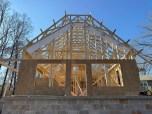
When I built my own house, I designed the gambrel roof as a full-span rigid frame. Instead of a horizontal nailer where the sawn-lumber rafters met, I connected them with 3/4-inch plywood gussets (Figure 3). Each midspan rafter knee is a rigid connection. Because the joints are rigid, the loads on the roof induce a lot of bending force in the rafters; therefore, I used 2x12s that could fully resist the bending. (The 2x12s gave me lots of room for insulation, too.)
Figure 3. Using a rigid gambrel frame made with 2×12 rafters and glued and nailed plywood gussets, the author was able to get a 28-foot clear span. For gravity loads, the system is analyzed as a triangular “three-hinged arch” — the ridge connection and the two rafter-to-plate connections are thought of as hinge connections, while the midspan gussets are treated as rigid joints. The birdsmouth at the floor plate helps transfer a moderate horizontal thrust to the floor diaphragm, while the gussets joining the rafters at the roof peak help stabilize the structure under unbalanced wind-load conditions.
This is an unusual solution, and the loads were tricky to analyze, but there’s a considerable factor of safety in the oversized sawn lumber and in the heavily nailed gussets. The roof is performing fine in service, and I get all the benefits of the gambrel — plenty of usable space with the aesthetic appeal of a roof that springs from the first floor.
Architect and builder Andrew DiGiammo owns and operates a custom design/build firm based in Assonet, Mass.