by David Bentley and Elizabeth Churchill
Since colonial times, the wood shingle has been recognized as an ideal material for protecting seaside homes. Originally hand-split from durable species of wood — cedar, cypress, oak, chestnut, and certain species of pine — these tapered shakes in random widths were layered over spaced wood sheathing on timber frames to provide a watertight shell against coastal storms. Shakes from 18 to 24 inches long were typically applied with an exposure of 5 to 7 inches, resulting in triple coverage at every point on the building exterior. By design, shakes channel wind-driven rain that gets forced through the outer joints back out, over the underlying layers, preventing water from damaging the sheathing and structure below. Weathered to a natural gray, these wood shakes provided a durable, low-maintenance surface that lasted for decades.
As sawmills became widely available in the colonies, taper-sawn shingles replaced the earlier hand-split shakes for most applications. By the late 19th century, industrial mass production combined with the expansion of canal and rail systems provided widespread access to precut shingles in numerous shapes, allowing for a variety of decorative effects.
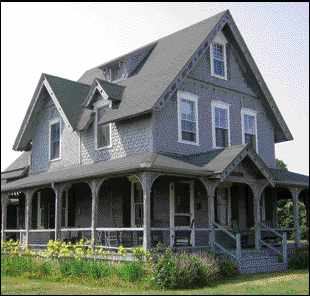
Figure 1. A striking example of the decorative use of pattern shingles is seen at Idlemoor — a home constructed on Nantucket Island in 1884. Most of original sidewall material (above) remains intact today.
PATTERN SHINGLES
A striking example of the decorative use of pattern shingles is seen at Idlemoor — a home constructed on Nantucket Island in 1884. Built in the Stick style, this house incorporates a variety of traditional cut-shingle patterns across its panelized exterior (Figure 1). Wood clapboards and three different cut shingles — applied with the butts aligned and staggered in five different patterns — combine to create a complex decorative expression from a simple kit of precut uniform elements. With continued maintenance of the painted slate blue-gray finish, most of the original sidewall material remains intact today. Although the shingle designs used on Idlemoor are no longer available, similar precut white cedar shingles are currently available in several traditional patterns from Maibec’s Victorian series shingles (www.maibec.com; 800-363-1930).
Detailing the shingled house provides opportunities for the decorative use of patterns to create variety and interest in new construction as well. In a recent design by the authors for a new house on Nantucket, a staggered shingle pattern covers the gable ends over a standard, random-width pattern below (Figure 2). A chalk line set 1 1/2 inches above the course line guides the raised-butt alignment. A variant of this pattern can be created by aligning wide shingles along the course line, with narrow shingles staggered by 1 to 2 inches above, resulting in a more ordered composition.
FRIEZE DETAIL
Figure 2. In a new house built by Edward O’Brien of Nantucket (left), the authors’ design called for gable ends with a staggered pattern over a standard random-width pattern below. The patterns are separated by a continuous frieze of flared shingles and bed molding that wraps the first-floor plate line (illustration, below).
The patterns on this house have been separated by flaring the gable-end shingles over a continuous frieze and bed mold that wraps the building at the first-floor plate line (Figure 2 illustration, above). On the waterside gable, a second water table over the French doors leading to the balcony separates the staggered-butt pattern on the upper walls from the more complex dovetail pattern on the upper gable (Figure 3). Similar to its use in the waterside gable at Idlemoor, this custom-cut pattern creates a striking geometric effect, albeit one that takes extra effort to produce, so the effect was reserved for only the most prominent location.
Figure 3. Similar to its use in the waterside gable at Idlemoor, this custom dovetail pattern creates a striking geometric effect. It requires extra effort to produce, however, so the authors limited it to the most prominent end of the house.
ROOF PATTERNS
Shingle patterns were frequently incorporated into roofing as well. The most common traditional roof patterns used a band of a simple shape, or a periodic double shingle course, wrapped horizontally around the woven hips and valleys of the roof. By the mid-20th century, most original wood shingle roofs, like those at Idlemoor, had been covered or replaced by readily available and less expensive asphalt shingles, often resulting in a significant loss to the building. In addition to the loss of character, asphalt shingles fail more frequently in windy coastal regions. Wood shingles, with a unique combination of light weight and wind resistance, coupled with new pressure treatments that achieve a Class C fire rating, are the more durable roofing material choice for many new and renovated seaside homes.
Asphalt shingles fail more frequently in windy coastal regions. Wood shingles, with a unique combination of light weight and wind resistance, are more durable. |
In our exterior restoration of Flaggship, built in the Second Empire style, historic photographs dating from a period shortly after the home’s construction in 1890 revealed a decorative band of “fish scale” shingles around the lower pitch of the original wood-shingled mansard roof and in each gable end of the 12 intersecting dormers (Figure 4). By matching the shingle patterns from the photographs, the house was returned to its authentic historic character using heavyweight (5/8-inch butt) red cedar shingles that were custom-cut on a band saw. To increase the life of the roof, Cedar Breather nylon matrix from Benjamin Obdyke (www.benjaminobdyke.com; 800-346-7655) was applied under the roofing to promote airflow between the shingles and the felt weather barrier laid over the original wood sheathing.
Figure 4. To complete the exterior restoration of Flaggship, circa 1890, the authors consulted historic photographs that revealed a decorative band of “fish scale” shingles on the home’s mansard roof and inside the gable end of 12 dormers. The restoration work on this roof was completed by John Rex.
TIMELESS CHARACTER
Whether on the roof, or used as an exterior siding, wood shingles continue to provide a durable and practical material for coastal houses today. Shingle-style detailing and decorative patterning can add character and authenticity to seaside homes. Naturally weathered in the sea air, the shingled house rapidly attains a patina of age in a manner unmatched by any other material, effectively relating houses to one another and to their seaside surroundings.
— David Bentley and Elizabeth Churchill, architects on Nantucket Island, Mass., have been building seaside homes for more than 20 years.