by David Bentley and Elizabeth Churchill Surrounding any home with an abundance of flowering plants not only enhances the structure but also helps to integrate the building into the natural environment. Perimeter planting beds around a home’s foundation, laid out in picturesque curves, soften the edge of the structure, merging it into the landscape. This is especially true for homes at the coast, where the lack of trees and other larger vegetation can give a house without added landscaping flourishes a particularly desolate, even tenuous look. In such cases, simple features such as window boxes, overflowing with a variety of blooming colors and textures, and trellises, covered with roses or other flowering plants, are particularly useful for highlighting the beauty of the house while further anchoring it to its surroundings (Figure 1).
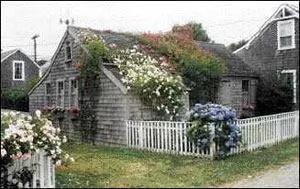
FIGURE 1. Flower boxes combined with wall and roof trellises provide a traditional flourish to the fisherman cottages of Siasconset, Mass.
Successfully incorporating plantings in and around structures to achieve this natural, seemingly effortless look, however, requires careful attention to construction detailing. To promote drying, adequate ventilation must be provided between plants and wooden materials. The use of durable species and the timely maintenance of paint and other finishes will also contribute to the long-term compatibility of plant materials with the house.
Window Box Gardens
We’ve had the best success with window box frames supported on wooden brackets attached with two 3/8-inch-diameter hot-dipped galvanized lag bolts into studs beneath the window. To increase the life of the window box, we construct it from western red cedar, leaving an open bottom. Two struts span the sides of the box to support the type of plastic plant liners that are readily available at most hardware stores and nurseries (Figure 2). Maintain a space of at least 1 inch between the box, the windowsill, and the wall to allow drying.
Window box treatment
FIGURE 2. Constructed of western red cedar, the window boxes are designed to hold conventional plastic plant liners, with the bottoms open to prevent them from rotting out.
Owners can get a jump on the season by starting the plants indoors in the liners in the early spring before placing them on the house. Plants we’ve had success with in containers include geraniums, lobelia, alyssum, impatiens, nasturtium, verbena, and petunias. Ivy geraniums and other trailing plants add an especially picturesque quality to the dwelling. As window boxes tend to dry out faster than planting beds in the ground, use a soil mix that promotes water retention (Pro-Mix; available from plant nurseries and hardware stores). Regular watering with a liquid fertilizer, such as Miracle-Gro, will promote vigorous plant growth.
Rose Trellises
The rose-covered fisherman cottages of Siasconset, Mass., are widely known for their quaint scenic charm. Wooden trellises support climbing roses up the walls and over the roof, literally covering the houses. Traditional varieties of rambler roses used for trellises include the miniature double pink ‘Dorothy Perkins’ and the single deep pink ‘American Pillar’ with white center. A prolific newcomer, the large double light pink ‘New Dawn’ rose, will rapidly cover the walls and roof.
We recommend rose trellises (preassembled on the ground before installation) constructed from 1×2 western red cedar, left unfinished to weather. The verticals are attached to the house with stainless-steel screws, and the horizontals are placed over these to hold the rose canes away from the house to promote drying (Figure 3). Roof trellises should be attached to strips of lead-coated copper flashing layered into the roof shingles to avoid penetrating the roofing. Trellises can be removed from the building and laid back, with roses still attached, for maintenance of the siding or roofing beneath.
Rose trellis detail
FIGURE 3.When attaching trellises to a house, secure the verticals against the house and the horizontals over the verticals. This will hold the rose canes away from the building finish to promote drying.
Used as a design element, rose trellises can balance windows, doors, and other features in composing building elevations. Lattice spacing can be varied to fit wall areas between openings to create a continuous grid across the wall. Roof trellises can be aligned with wall trellises to express an overall grid over the entire exterior. To define a larger grid, double up trellis units. Concentric arrangements, spider web configurations, and other geometric patterning provide an extensive variety of expressions.
“Summer Houses”
Beyond the two-dimensional representations used to decorate building surfaces, rose trellis can also be extended into three dimensions to define architectural space. A trellis-covered deck can be attached along one or more sides of the house or constructed as a freestanding garden pavilion, sometimes referred to as a “summer house.” In our renovation of a 1920s Colonial Revival house in Siasconset, the owners asked for a deck on the water side of their house. To integrate the deck with the historic character of the house, a porch addition would have been the traditional approach, but the owners did not want to lose any of the daylight through the colonial sash windows. Our solution was to extend an existing trellis-covered seat outside the back door into a trellis-covered deck overlooking the ocean (Figure 4).
FIGURE 4. Appearing as a traditional attached porch, the trellis-covered deck on the sea side of the house offers a combination of shade, privacy, and naturally framed views of the ocean.
We retained the existing antique climber roses growing on either side of the door by framing the deck around them. The trellis structure, painted to match the house, was constructed of 4×4 Doug-fir beams and columns, spaced approximately 6 feet on-center, with 2×4 rafters spaced 24 inches on-center. The ends of the rafter tails were shaped with a simple profile. Around the corners and over the arched seat, we used curved beams built up from thin layers of wood laminated with epoxy. To support the roses across the rafters, we laid 1×2 western red cedar lattice strips, left unfinished, 12 inches on-center. Profiled 2×4 top and bottom rails span the distances between posts, with 11/4-inch-square balusters evenly spaced approximately 5 inches on-center.
Covering the deck with the rose trellis creates an ideal transition space between indoors and out (Figure 5). The natural ceiling provided by the roses, combined with additional roses planted around the outside to climb the support posts, defines the deck as an extension of the interior space while at the same time remaining part of the natural surroundings. — David Bentley and Elizabeth Churchill, architects on Nantucket Island, Mass., have been building seaside homes for more than 20 years. All photographs and details are by the authors.
FIGURE 5. A trellis-covered deck provides a natural transition between indoors and out. The deck beneath the trellises was framed conventionally with 2×6 pressure-treated joists, spaced 16 inches on-center, and supported by a spaced ledger against the house and by a 6×6 grade beam on 12-inch-diameter concrete piers around the perimeter. The decking itself is 3/4×4 Doug fir, spaced 1/8 inch apart, nailed to the joists with stainless-steel ring-shank nails.