by Clayton DeKorne
Emergency housing teaches a lesson in home design
“Architecture is a language,” explains architect Marianne Cusato. “We all know the vocabulary — windows, doors, walls, roofs — but we don’t all know the grammar.”
Cusato, who participated in the Mississippi Renewal Forum led by Andrés Duany (see “Gulf Renaissance,” Breakline, in this issue), has articulated a traditional grammar of design for the Katrina Cottage, a 308-square-foot home that made its debut at the International Builders’ Show in January. Dubbed the “Tiny House,” the show model was stick-built and completely finished in less than 21 days by Jackson, Miss., builder Jason Spellings and his crew. Cusato expects the house to be mass-produced in a modular-house factory as an alternative to the mobile homes FEMA typically uses for emergency housing that, as we reported in January (see “Systems-Built Solutions,” Breakline, January/February 2006; available online at www.coastalcontractor.net), often become semipermanent housing fraught with problems.
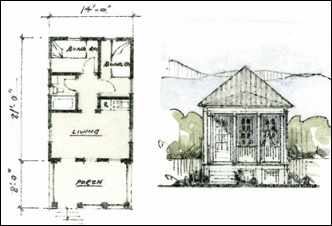
The base model of the Katrina Cottage: a 308-square-foot bunkhouse intended as an emergency shelter. Its designer, architect Marianne Cusato, expects this tiny house to be located on the properties of destroyed homes, providing a secure place for residents while they rebuild their old homes. Afterward, it can serve as anything — a home for relatives, a studio, a guesthouse.
“Physical appearance really matters,” argues Cusato. “It might sound absurd to insist on aesthetics for emergency housing. But without some sense of order in the parts that make a house, what is meant to provide shelter runs the risk of becoming its own long-term disaster.” Cusato’s underlying goal is to create affordable housing that residents can take pride in, rather than build “projects” that become institutionalized ghettos from the outset.
The Katrina Cottage is adaptable to a range of exterior treatments. “You can always reskin a cat,” notes architect Cusato. She is hopeful the cottage could be fashioned to fit the vernacular of any region, providing a sense of traditional design and instilling lasting appeal in any community faced with a housing disaster.
“If we’re going to bother to relocate all these people,” Cusato reasons, “it makes more sense to provide a place where people are inclined to put out window boxes rather than dump trash out the front door.”
Though the living area is small, it is still quite functional, as these photos of one bunkroom and the main living room illustrate.
The Squint Test
For Cusato, the ABCs of design are grounded in traditional forms that evolved out of practical needs. Before we had sophisticated flashing materials and housewraps, and materials with high strength-to-weight ratios that allowed much of the structure to remain hidden, durable buildings had to rely on good design. Cusato believes these elements are still ingrained in our aesthetic sensibility. In other words, what looks right functions right.
The rules of a good design boil down to what Cusato calls the “squint test” — a visual examination any well-designed home can pass if you squint at it from across the street:
Roof massing refers to the arrangement of the visible roof area in relation to the wall area. The goal is a pleasing balance of wall to roof area. Low-pitched roofs look diminutive and weak and make the walls look boxy. Steeper-pitched roofs create a more balanced proportion of wall to roof area (and drain water much better than a low-pitched roof).
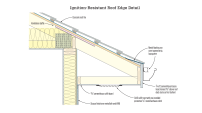
Shadow lines. Overhangs, inset windows and doors, and reveals on woodwork all create shadow lines that outline, and starkly differentiate, the individual elements of a building. Without these, a facade veers toward the bland and banal. Overhangs are particularly important for protecting walls from water and can help reduce summertime cooling loads when the sun is high in the sky. The wider the better, says Cusato. On the Katrina Cottage, the overhangs are only 9 inches, much less than Cusato would have preferred, but it was also important that the house parts could fit on a truck and roll down the highway. Cusato acknowledges that compromises had to be made, but in proportion to the width of the house, these overhangs still work to distinguish the roof area from the wall area below and still provide an adequate drip-edge.
Vertical openings. Keep windows vertical, Cusato urges. Simply put: Vertical openings are more pleasing. We tend to look at things anthropomorphically, she explains, and relate vertical shapes to the human figure.
Cusato believes that narrow windows also evolved for practical reasons: to maximize the amount of daylight without compromising structure. It’s easier to span a narrow opening than a wide, horizontal one, so there is an inherent economy of materials in using narrow headers. Narrow openings also make it easier to maintain structural integrity, particularly in regions where high wind loads must be resisted.
Balanced structure. Visible structures should balance. That means posts should be the same width as the beams they carry. A structure with a low center of gravity is sturdier than a top-heavy structure, and we subconsciously understand this. As Cusato puts it: “We know when a familiar song is out of tune. The same holds true for traditional architecture.” Spindly columns may be structurally sound, depending on the material, but will be out of kilter if they appear to support a massive beam. Similarly, if the posts are too massive, appearing much wider than the beam above, the overall look is too imposing. Even dimensions for both provide balance.
Alignments. Windows and doors should align at the same height. Symmetry also helps establish a sense of balance. Evenly spaced divisions created by the openings in the facade and by posts along a beam provide order and regularity that give a sense of balance and security. By contrast, asymmetry, a floating structure, and intentional misalignments to create a dynamic composition can be employed effectively in a building’s design, but these are the sort of architectural gymnastics that are unnecessary for the task at hand. Traditional forms, Cusato believes, make it much easier to build the Katrina Cottage quickly with the materials readily available after a disaster.
Taskmasters
The design challenge on this project, notes Cusato, was serving three masters at the same time: The project had to be affordable, built quickly, and look nice. “We tend to believe that you can have two of these at a time, but not all three,” Cusato explains. “If you want it affordable and fast, it’s probably not going to look nice.” That’s certainly been the assumption for emergency housing, Cusato maintains. But out of the Mississippi Renewal Forum, it became apparent that the Gulf reconstruction effort would require something more. Many people who lost their homes don’t have the resources to rebuild immediately. The Katrina Cottage is therefore meant to be moved onto the property and provide a place to live while the destroyed house is being fixed. Afterward, it can remain part of the solution. Beaufort, S.C., architect Eric Moser is developing a series of drawings that will demonstrate how the Katrina Cottage can be adapted, either as an addition to an existing building or ganged with other units, to create a larger home.
Bigger Than One
Cusato is adamant that the Katrina Cottage is not her creation alone. “It was developed by the largest architectural firm in the country — the collection of architects Andrés Duany brought together to solve the Gulf Coast crisis. We all put our heads together and listened to the concerns of people who lost everything to Katrina. This is just one response, and it’s much bigger than I am.”
— Clayton DeKorne is editor of Coastal Contractor.