by Andrew P. DiGiammo
As an architect and builder on the New England coastline, I work a lot in my own interpretation of the shingle style. The tradition employs a lot of low rooflines, where the roof springs from the first-floor wall, and consequently, I often wind up using various kinds of dormers to create usable space under those low roofs.
Utility with Flair
One dormer I frequently use is the “Nantucket dormer” — a sort of hybrid between a shed dormer and a doghouse dormer. We call it a Nantucket dormer because it’s rumored to have been developed on Nantucket Island, where it’s a common roof feature on many homes. But you can also find this dormer style used throughout New England on old houses.
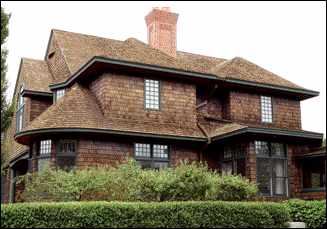
Figure 1. A Nantucket dormer provides the headroom of a shed dormer with visual appeal of two doghouse dormers. Here, it is used to define one side of an entire house, where a plain shed dormer would have been too boxy.
I like this style because it allows me to get the practical utility of a shed dormer, for enclosing space, along with the visual interest and traditional look of doghouse dormers. From the exterior, it looks pretty much like two closely spaced doghouse dormers. However, the Nantucket dormer creates a larger clear space on the inside, defined by the area under the two doghouse roofs combined with the shed roof that connects them.
A typical use for this method is to open out a piece of usable space in a room over a garage. It’s useful wherever you want to build a large dormer into a roof but would rather not have a big, clunky-looking shed dormer. I’ve even used this element on a grander scale, as shown in Figure 1, in which one whole side of the second story of the home is framed out as a double set of hip-roofed dormers joined by a center shed roof.
Simple Framing
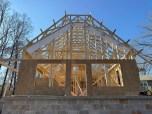
The framing for these dormers can be a challenge for my field crews. But in principle, it’s fairly simple: We frame the dormer opening in the roof by doubling up the rafters of the main roof system (Figure 2). The outside walls of the doghouse dormers rest on those doubled rafters. We frame up the front wall and side walls of the dormer, then we install the center, shed part, of the dormer roof, running the shed rafters back to tie into some kind of support — either all the way across the main roof to mate with the main roof rafters for the other side of the house, or else to some interior supporting structure like a bearing beam or wall. Again, we double the shed rafters on the ends of the center shed roof.
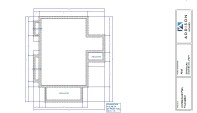
Figure 2. The trick to framing a Nantucket dormer is establishing the valleys for the two doghouse dormers (plan illustration top). The outside valleys meet the main roof, while the inside valleys meet the lower-pitched shed roof that joins the two doghouse dormers. While essentially a shed dormer in plan, the visual effect is closer to a pair of doghouse dormers (bottom).
At the elevation where the lines of the main, steep-pitched house rafters and the lower-pitched dormer shed rafters cross, we run headers across from each doubled shed rafter to its counterpart doubled main house rafter. Those headers are intended to catch the ends of the doghouse dormer ridge boards, which we install next. With the locations of those ridges defined, we can then place valley rafters for the intersection points where the doghouse roofs meet the main roof, as well as where the doghouse roofs join the center shed roof.
Usually I keep the dormer walls short, to accommodate the various pitches and to keep the dormers from visually dominating the roof. To gain sufficient ceiling height in the indoor room, I let the ceiling follow the plane of the rafters. So inside the house, the cut-up shed-and-doghouse roof planes are revealed, making for some interesting interior spaces.
I didn’t invent this form of dormer — it has been around for a long time. It’s an interesting and useful roof form that I can add to my bag of tricks, just to keep things lively.
Architect and builder Andrew P. DiGiammo owns and operates a custom design/build firm based in Assonet, Mass. Photos by the author.