When it comes to wind-resistant construction, engineers tend to focus on the details: Strong connections, tested components, and engineered elements, such as shear walls and diaphragms. But there’s also a benefit to stepping back and looking at the big picture of design. Certain building shapes, for example, are more advantageous in a high wind, points out New Jersey Institute of Technology architecture professor Rima Taher — and choosing those shapes can reduce the potential stress on the particular framing connections that hold the house together. In a 2007 review article in the Journal of Architectural Engineering, Taher notes decades of research showing that hip roofs, for example, are better than gable roofs when a hurricane hits. Wind tunnel testing at France’s Center for Building Science and Technique (Centre Scientifique et Technique du Btiment or CSTB), found that a roof slope of 30 degrees experienced the lowest wind pressures under high-wind conditions. Writes Taher:
“Studying the influence of the home shape showed that a compact building of a square floor plan — or even better: a hexagonal or octagonal plan form — which is equipped with a multiple panel roof — four or more panels — was found to have reduced wind loads. Hip roofs (four slopes) performed better than gable roofs (two slopes). For best results, a roof slope of about 30° was recommended. Roof overhangs generally suffer from important uplift forces which could, in some cases, trigger a roof failure. CSTB researchers suggested limiting the length of these overhangs to 50 cm (approximately 20 inches), especially for roofs that have a small slope. They also recommended disconnecting the overhangs structurally from the main building.”
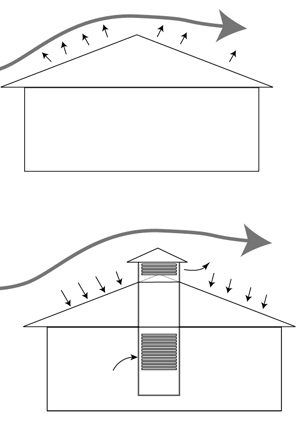
The French researchers also suggested some novel solutions to reduce wind stress on the building — ideas that may not be for everyone, but offer some food for thought. One solution tested was to provide a pressure-equalizing wind shaft at the center of the structure (see sketch). In French wind-tunnel testing, a model of a simple hip or gable roof experienced strong uplift pressures when exposed to high wind (top). But when a shaft in the center of the building allowed the outdoor suction to be transmitted to the interior of the building (bottom), the pressures were reversed, pushing the roof down in line with the typical gravity loads the roof is designed to withstand day in and day out. However, the idea would introduce complications involving weather-tightness and space conditioning. To address strong uplift pressures at roof edges, the French researchers investigated the effect of a wind-baffle assembly extending out from the house walls just below the eave. Acting as a “spoiler,” the baffles disrupt the turbulent vortex created when wind flows around the house corners and roof edges. In the CSTB wind tunnel, the baffles reduced wind forces on the roof by a factor of 1.5 to 2, reports Taher. Either short vertical louvers extending up from the roof edge, or a horizontal baffle extending from the wall (which could also serve to shade the wall), can be effective at reducing wind loads, the researchers found. Researchers at Texas Tech and at Colorado State University have also been taking a look at the roof-edge spoiler concept, using wind-tunnel equipment as well as full-scale building tests. Results of the experiments were promising enough that the scientists have applied for a patent on their idea. As their patent application explains the problem, “The greatest force on the building is known to be the uplift on the roof, and this is a very common failure mode. The worst suction on both gabled and flat roofs are known to occur beneath the vortices that form in the separated flow along the roof edges.” The sketch below shows how the strongest vortices occur at the corners of gable roof edges and roof peaks.
Wind pressures on a roof are most intense where wind sets up a vortex near sharp corners. The drawings here come from U.S. Patent No. 6,601,348, awarded to David Banks, Partha P. Sarkar, and Fukiang Wu. The researchers’ solution — phrased in a way to cover every possible version of the gizmo they have in mind — is “to provide unique rooftop apparatus structures and a corresponding technique comprising novel structural protuberances that extend at least partially into the shear layer/transition layer as identified here, to separate the flow therein.” The inventors suggest a wide range of applications, including spoilers at edges, corners, and ridges, as well as specially designed spoilers that lie flat on the roof during calm conditions, but lift up to disrupt the airflows when a strong wind blows.
The “novel structural protuberance” concept in the drawing above was devised by researchers David Banks, Partha Sarkar, and Fukiang Wu: an airfoil at the roof edge to split and separate the airflows and prevent the formation of a strong vortex. Below are more complicated versions of the idea, with a mechanism to allow the wind baffles to lay flat during calm conditions, but deploy automatically when strong winds occur. It’s hard to say whether this idea will catch on for typical houses in high-wind areas. But for important public structures such as police and fire stations or medical facilities, the idea is reportedly already being considered — and, in a few cases, adopted. Meanwhile, for residential designers, the simpler lessons of wind-tunnel testing and structural analysis are well within reach. Designers who are interested in optimizing their plans for wind resistance are well advised to consider such simple techniques as hip roofs, simple square or rectangular footprints, and well-placed interior partitions suitable for use as braced walls or shear walls.