by Clayton DeKorne
By now, images of the devastation wrought by Hurricane Katrina have been forever etched into the history of the United States. For the people displaced by this vast storm, however, the memory of Katrina is anything but trite. In the weeks and months after Hurricane Katrina made landfall near Buras-Triumph, La., over a million people evacuated the ruined regions of the Gulf Coast, resettling in every state in the country wherever life could be reconstructed.
During this exodus, refugees who made it to Indiana were directed to Terre Haute, where 27,000 square feet of floor space in the recently completed but still nearly empty shopping center had been loaned to charity groups for use as a sorting and distribution center of much-needed supplies. Displaced victims came from all over the state to accept whatever was available. The surge in donations and recipients was tremendous, recalls Chicago-based Bill Spatz, chairman of Spatz Development, the parent company of Spatz Centers, which owns the shopping center. “I called my son Bryan [president of Spatz Development] in D.C., and said, ‘We gotta do something.’ The scale of destruction [from Katrina] is unlike anything we’ve seen in this country before. We couldn’t sit back and just watch it.”
The shell of the home was contracted out to a modular home builder that constructs homes in a tornado-plagued Midwest. The homes are framed in steel and sheathed with OSB that is glued and screwed to the exterior walls to create a perfectly rigid shell. Impact-resistant windows and steel shingles complete the package.
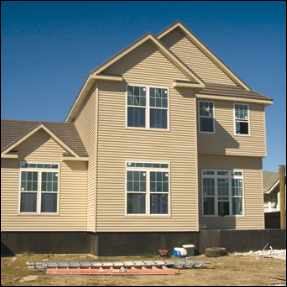
That brush with the aftermath of Katrina set Bill and Bryan Spatz in motion developing what would eventually be dubbed the Noah’s Ark Project — a steel-framed modular home built on a barge. It sits on dry land on Louisville Street in the Lakeview area of New Orleans — one of the neighborhoods hardest hit by the surge of Hurricane Katrina that spilled into Lake Ponchartrain and overcame the 17th Street Canal levee. The home looks like a typical 2,700-square-foot house with an asking price of about $525,000, belying the fact of its unique structure. For residential builders, it’s a study in what a coastal home can become in the hands of a commercial developer, and for the industry as a whole, it’s a concept that pushes the boundaries of how to build to protect against hurricane damage.
Rethinking a Foundation
Katrina will be remembered first and foremost as a flood event. In and around New Orleans, the higher-than-expected surge inundated the levees, filling up the low-lying land like a bathtub. The midtown Lakeview district was overrun when several panels of the 17th Street Canal levee failed, releasing a wall of water from the lake that filled up midtown and parts of Metairie.
The city of New Orleans got hit from two directions — on the east side from the surge funneling in from the Intercoastal Waterway, and on the north side from a swollen Lake Pontchartrain. In both cases, the rising water breached the levees, submerging more than 80% of the city. This setting established the design challenge for Spatz Development’s floating home.
In the face of such a flood risk, Bill Spatz reasoned that any rebuilding efforts in the area ought to involve homes that can rise above the water. He contracted with barge-builder Marine Inland Fabricators of Panama City, Fla., to craft a 3-foot-tall barge — in essence a floating crawlspace welded together from plate steel and iron trusses that could carry the weight of a steel-framed, 2,700-square-foot home. It functions as a crawlspace through which to route water and sewer lines, but it remains completely outside the thermal envelope, and all the HVAC for the house stays within the modular units above it.
To keep the home from floating down the street, pilings were driven some 30 feet into the ground on either side of the foundation near the house corners. Then, a pair of steel brackets was slipped around each piling and welded to the barge. These brackets are oversized to provide ample room to slip up the pole as the waters rise. The toughest part of this detail, said Spatz, was finding straight timber pilings, and taking care when driving them in, so the 10 feet that rose out of the ground remained perfectly plumb.
To keep the home from floating down the street, the steel foundation is tethered to pilings located near the home’s corners.
Noah’s Ark Project, as the home has been dubbed by Spatz Development, sits on a barge. Sections were built off site and craned into position. While this land-based vessel has been engineered to float the structure in rising floodwater, it also needs support to keep it from sinking into the soft local soils. Therefore, the barge sections rest on a slab, which is itself supported on approximately 30 pilings.
Flexible Utilities
A movable foundation presents a few unusual challenges with utility hookups. As the foundation begins to float, the water, sewer, and electrical lines must either disconnect or move with it.
Water and electrical proved easy enough: flexible piping serves as the house water main. And the local electric utility, for a moderate upcharge, provided a loop above the service mast that can accommodate the house rising up to 10 feet. The sewer was a bit more of a conundrum. After exploring a number of break-away connections, Spatz opted for a manual disconnect. This was in part a cost consideration: a simple valve with a gasketed disconnect was less expensive. But the rationale here also had to account for reconnecting the sewer once the floodwater subsides and the house settles back down. It’s highly unlikely it will come back to the exact same spot, and a manual disconnect would be easier to reconnect or replace.
Spatz originally thought the foundation would be built as three self-contained barge units. But to keep costs within bounds, it was built as one large barge in three sections. This meant individual sections had to be tied together with steel bridging inside and seam-welded on the exterior.
Wind Breaker
The house itself was contracted out to Benchmark Construction & Development, a modular home builder in Columbus, Ohio, which specializes in wind-resistant homes for the tornado-prone Midwest. According to Spatz, the house is designed to withstand wind gusts up to 200 mph. The exterior walls are framed in steel and sheathed with 3/4-inch OSB that is screwed and glued to the frame, creating a series of perfectly rigid boxes. Impact-resistant windows and doors complete the package, providing what Spatz calls an impenetrable shell.
For siding, Spatz opted for vinyl, which he feels can be a durable siding option for a coastal home when installed correctly. He uses commercial-grade (0.048- to 0.055-inch-thick) panels with a double-thickness nail hem and a stiffer square edge rather than a post-formed edge. He recommends doubling up on the number of fasteners per panel, using screws instead of nails. “There’s no reason vinyl siding should blow off in a storm if it gets installed correctly,” Spatz explains. “Whether it usually does is another matter.”
For roofing, Spatz chose steel roof shingles. The advantage of these over asphalt shingles is once again the connection. Most steel shingle systems are screwed into a steel track that is itself screwed down to the roof deck. “Pull-off is rare, even in an F2 tornado,” claims Spatz. Steel shingles come in a wide range of styles from tile to slate and shake look-alikes. For its debut on Louisville Street, the first home for the Noah’s Ark Project has a shake-style roof.
“All in all, this home looks like any other,” says Spatz. “No one would know how unique it really is.”
Clayton DeKorne is editor of Coastal Contractor. Photos by Jon B. Barry, www.artkeep.com, except where noted.