by Ted Cushman
At their 100% employee-owned building and remodeling company on the island of Martha’s Vineyard, the workers at South Mountain Company are essentially their own bosses. They make it a priority to find their own motivation, and the same independent, adventurous mentality that’s typical of clients on the island offers them ample opportunities for creative innovation. It’s as if the island itself, which sits apart from the Massachusetts mainland, has inspired a certain independent mind-set among the residents and workers alike. This is a market, and a company, that’s not afraid to venture off the grid.
Phil Forest, one of South Mountain’s employee-owners, has discovered this quite literally in his pursuit of photovoltaics. Forest didn’t join the company just to do photovoltaics, he says: “I came on board to build cabinets and do finish carpentry.” But in building his own solar-equipped, energy-efficient island home, he learned to “love the renewable energy stuff.” In recent years, clients on the Vineyard have begun asking a lot of questions about wind- and solar-generating technology. For Forest, that provided an opportunity: with backing from the company, he explains, “I started to take renewable energy on as my new career.”
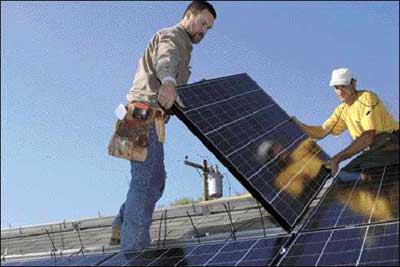
Production manager Charlie Morgan (left) and Ben Philbrick of Rhode Island-based SolarWrights maneuvers a photovoltaic panel into position on the roof of a Connecticut home. Then State of Connecticut puts up a per-kilowatt subsidy that makes the upfront cost of PVs easier to swallow — a trend that may catch on in other states as green building incentives become an increasingly important issue for policy makers.
Together with coworker (and co-owner) Rob Meyers, a trained energy rater who handles design work and estimating, Forest is widening this niche for the company, installing solar water heaters and wind-turbine generators as well as solar electric panels. In the past year, South Mountain’s renewables team has moved into the existing home market, offering energy audits and solar or wind power systems to anyone who has an interest.
As a self-taught solar enthusiast, Forest says, “I am by no means a long-term renewable energy expert. I’m still catching on — just as the building officials and the electricians are.” But South Mountain plays a key role as the general contractor: “We design the projects, we order the equipment, we coordinate with the homeowner and the electrician and any other subs that need to be involved. We do some of the work ourselves on the roof, installing the mounting hardware and setting the panels.” For large jobs, South Mountain turns for help to a solar specialist from the mainland, Rhode Island-based contractor SolarWrights (www.solarwrights.com). But as Forest puts it, “You don’t have to have been doing solar for 20 years in order to make solar part of a remodeling business.”
First Step: Conservation
Solar panels are a costly investment, and they may not be for everyone. Clients need to address their electricity consumption head-on. Forest starts by helping clients find efficiency upgrades to limit their electricity needs. In new construction, the design process emphasizes conservation from the beginning; for existing homes, the first step is an energy audit to zero in on easy savings.
“If someone wants solar panels,” explains Forest, “first we’ll go around the house and say, ‘Look, you could change these 10 light bulbs, and replace that 20-year-old fridge, and you won’t have to have as big a PV system.’ By reducing the load, you’ve just achieved, for less money, what you would have gained by investing a lot of money to generate renewable energy.”
The same logic applies to new building design, says Forest, but there is even more room to maximize the savings. South Mountain’s latest solar project was a “net-zero carbon footprint” home — a super-insulated house with 6.4 kilowatts of roof-mounted solar generating capacity, designed to produce as much energy as the home uses on an annual basis.
Triple-glazed south-facing windows, a well-insulated and tightly sealed building enclosure, compact fluorescent lights, and efficient appliances trimmed the house’s heat and power needs, while two pellet stoves (one upstairs and one downstairs) supply the home’s heat without electric pumps or fans. But conservation is not about sacrifice, says Forest: the occupants enjoy all the comforts of modern life. “There is no compromise with this house,” he says. “In fact, I think it may be more comfortable than a conventional house, just because of the warm walls and the daylight.” Appliances like the refrigerator and stove are sized to meet the family’s needs: “We tell people to shop for exactly the size they need — not bigger, but not smaller either — and then we just tell them to choose the most energy-efficient model available.”
Phil Forest (far right) expanded South Mountain Company’s remodeling business to include renewable energy services — a niche he obviously enjoys with company renewables sales manager Rob Meyers (immediate right) and Martha’s Vineyard electrician Steve Gallagher (center).
But the designers relentlessly squeezed out a few watts of savings wherever they could find them. One example is the home’s Grundfos well pump — a variable-speed unit designed to supply water at constant pressure, whether it’s a trickle at the kitchen sink or a rush for the lawn sprinklers. The advanced pump uses a little less power than traditional one-speed well pumps (which have to work against the pressure of a storage-tank bladder). “We ran some calculations, and it’s not a tremendous electrical savings,” says Forest. “But it is more efficient. And when you combine 10 approaches like that in a house, where every single one makes a small difference, then you get significant improvement in your household load.”
Solar System Choices
In the world of photovoltaics, there are three main approaches.
Grid-tied. Panels may supply some of the house’s power, all of it, or even more than it needs. When it’s dark or cloudy, the house draws power from the street; when the panels make extra power, the surplus is fed back to the utility power lines, spinning the meter backward. Depending on state law, the utility may pay for any monthly or annual surplus production at wholesale or even full retail rates.
Grid-tied with backup. Besides the grid link, the system can be set up with a battery bank to supply critical loads — refrigerator, well pump, and a few lights — in case power from the street fails. Unlike basic grid-tied systems, which have a code-required safety cutoff that disconnects the panels during a power outage to protect utility repair workers, a battery-backup system with appropriate safety switching still lets the panels power part of the house when the grid is down (as long as there is sunlight).
Off the grid. Fully independent systems with panels big enough to power the entire house, plus charge batteries for use at night or on cloudy days. A backup generator will probably be needed to ensure no interruption of service.
Grid-Tied Grid-tied systems are the simplest, requiring the fewest components and the least expense. Where no local subsidies are in place to offset the initial costs, these systems are the easiest to justify.
Grid-Tied with backup Grid-tied with backup. While these add some complexity and expense, a grid-tied system that has a bank of batteries (4) will provide power even at high-demand times in the event of a power outage — not a bad idea for a coastal location.
off-grid Off-the-grid systems are the most complex and expensive. In remote locations where utility lines do not exist, the costs are much easier to justify than they are where utility service has already been established.
Completely off-grid systems are the most costly and complicated. Balancing the panels and the batteries against the varying daily load is tricky. Sometimes extra solar power goes to waste, but at other times even the best systems need occasional help from an ordinary propane or diesel generator. Batteries add cost and complication, require maintenance, and have to be replaced when they wear out. Forest has never installed a purely off-grid setup. South Mountain has provided a couple of grid-tied systems with emergency battery backup; but for the most part, islanders have chosen to tie their systems to the grid and skip the batteries.
The simplicity of the grid-tied system is its greatest appeal. The panels on Forest’s own house, he says, are sized to produce somewhat less than the building consumes on average, even in summer months. “It’s a great system, because I’m using the power grid like a very efficient battery, without having to have a complicated battery system,” says Forest. “When I make excess, I store it out in the grid. And when I want it back, like at nighttime, it just comes back to me again.”
POWER UP. Rooftops are an obvious location for PV panels, but there’s not much point in undertaking an elaborate installation that will have to be disassembled in a few years, so it’s critical that they go down over new roofing. The panels get bolted to extruded aluminum rails (left and top), which are mounted on a series of L-brackets (above). The brackets are lagged into framing every 6 feet on center (every third truss) with liberal amounts of silicone caulk to seal the penetration — a system that is rated for wind speeds up to 125 mph in Exposure-C conditions, and according to Bob Chew of SolarWrights, who has more than 30 years in the industry, weathers well without leaking.
Solar Economics
Most people who use electricity pay for it as they use it, month by month. But when you buy photovoltaic panels, says SolarWrights’ founder and 30-year solar veteran Bob Chew, “you’re buying an electric generating appliance that is going to generate, say, 30 years of electricity, and you’re paying for it all up front.”
Depending on the size of the system and the difficulty of the installation, says Chew, his crews can install solar generating capacity for between $7 and $11 a watt. “On big systems we get economies of scale,” he notes. “So, for example, yesterday I measured a 1-megawatt project. That’s a huge job, and so that’s going to be at the low end of that range. But for a 2-kilowatt system on a difficult roof, it might get as high as $11 a watt. The average is around $8 to $9 per watt, before incentives.”
At those prices, Chew says, PV-generated electricity can’t compete with utility power prices in New England (unlike in sunny Southern California, where the price of solar power is now close to parity with utility rates). However, the federal government and many state governments provide tax incentives and even direct subsidies that can make solar panels a reasonable investment, depending on where the homeowner lives.
Rhode Island recently canceled its state subsidy for solar power. “In Rhode Island,” says Chew, “we tell people right up front that photovoltaics systems aren’t a good financial investment, although we think they are a good social investment.” Next door in Connecticut, however, the state puts up a per-kilowatt subsidy that goes into the contractor’s pocket. “For installing a 4-kilowatt photovoltaic system, we’d get about a $16,000 incentive from the state,” says Chew. For larger systems, the rebate would be more.
Plug and play. These Kyocera PV panels are equipped with wires and plugs, allowing the panels to be connected in series as the array is mounted on the rooftop rails (left). Workers connect the plugs as they go (above). Connecting the entire array through the power inverter into the building’s main electrical panel on the ground calls for a licensed electrician.
Based on that math, says Chew, a rooftop solar panel in Connecticut pays for itself in about 12 years. After that, the power is free for as long as the panel lasts — “and the industry expects those panels to keep making electricity for at least 30 years,” says Chew. “If you can have something paid off in 12 years that’s going to generate electricity for 30-plus years, it’s a good investment.”
A typical house would need more than 4 kilowatts of capacity to break even on power. “You need about 6 kW for a medium electric load,” says Chew, “and a 10-kW system would take care of most houses. We do a lot of 6-kW systems and an awful lot of 10-kW systems.” Depending on the panel brand, a 10-kW solar installation would require about 820 square feet of rooftop real estate, says Chew.
As South Mountain Company discovered on Martha’s Vineyard, there’s a strong market for photovoltaics despite the high upfront costs. “People are asking us, ‘Hey, can I put PV panels on my house?’ ” notes Phil Forest. “They’re coming to us. That’s what is making this a viable business.”~
Contributing editor Ted Cushman has been covering construction business and technology since 1993. All photos by the author.
Sources of Information If you’re researching photovoltaics, a good place to start is Home Power magazine (www.homepower.com) and its 20-year archive of renewable energy coverage. To locate a professional solar or wind contractor, try the national clearinghouse at www.findsolar.com. And to compare component prices, try www.wholesalesolar.com (where you’ll also find a simple four-step guide to designing and speccing out a home photovoltaics system). |