Interview by James Gialamas
Robert Van Cleef started Yankee Housewrights as a residential remodeling business in 1985 in Jamestown, Rhode Island. Located on Conanicut Island, Jamestown faces the city of Newport, which is situated on the much bigger Aquidneck Island in Narragansett Bay. Both islands are richly populated with old homes dating back as far as the 18th century. With a wealth of remodeling experience in his toolbox, Van Cleef tells us why certain new construction projects don’t interest him and how preparing your business to handle two or three times its capacity can pay off.
HOW DO YOU DEFINE THE WORK YOU DO?
Remodeling. We prefer it. If someone comes to us with a plan that’s a plywood box full of drywall boxes, we’re not really interested. Remodeling and renovation work is so much more challenging. What we really like is making something look like it was always there, to be seamless with the original structure. Or in some cases we’re doing such a major remodel, if someone drove by they’d say, “I’ve never seen that house before.”
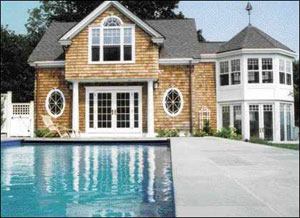
Built on the grounds of a circa 1895 manor house on Jamestown’s historic Shoreby Hill, this seaside pool house acts as the easternmost anchor for a dramatic reconfiguration of the landscaping plan for the estate. The pool house has the architectural symmetry of the main house at a pleasingly smaller scale.
DO YOU EVER DO ANY NEW CONSTRUCTION?
Yes, we do work on new construction, don’t get me wrong. We just laid the foundation on a house, but in a year from now, when it’s done, if you were to drive by you would never guess that it was just built. We’re building houses that look like they’ve been around for a while. We’re building houses that would tend to be considered more elaborate, heavier on the trim, than most new construction today.
WORKING ON AN ISLAND, DO MOST OF YOUR JOBS COME IN ON A SEASONAL BASIS?
Rarely. If we had an extra day, we could fill it with work. Being on the coast, the temperature is somewhat buffered. We were able to excavate and do site work all winter this year.
HOW MANY EMPLOYEES AND JOBS DO YOU HAVE RUNNING AT ANY ONE TIME?
We have five employees — actually five and a half. We’ll do maybe $2.25 million this year in sales volume. We probably have three jobs going at a time. I’m happier with one because we can provide fuller attention. But three is a necessity to do the kind of volume we do and to satisfy everyone who calls.
WHO ARE YOUR CUSTOMERS?
Our customers are generally 45- to 65-year-old educated professionals or people who are self-employed entrepreneurs. We appeal to a moderately narrow niche.
To accommodate the construction of a new pool, the driveway and children’s play area were moved, turning a relatively unused side entrance into the defacto “family entrance.” This glass-roofed entrance porch was built with an integral trellis wall and columned arbor to redefine the door as a primary entrance and provide a protected bridge between the driveway and the house.
HOW DID YOU GROW THE BUSINESS?
The National Association of Home Builders (NAHB) organizes groups of up to 20 contractors of like size in different marketplaces. The other company owners in my 20 Club are my board of directors. There are no secrets: It’s a full-cavity search. We have completely disclosed financials; we discuss all of the problems, all of the successes, everything about our businesses; and we meet twice a year. We met in Washington, D.C., this last time.
EVERYBODY’S BUSINESS IS COVERED DURING THAT TIME?
Yes. We eat two meals a day in the rooms and we are at it by 6:30 or 7:00 in the morning and we often go until 6:00 at night for three days. We have a CPA who goes over our financials. We track everything from the number of leads coming in all the way down to what your bottom line percentage is and then every piece of minutiae in the middle. This club has been in operation for just over six years. We were doing about $400,000 to $500,000 a year when I first started out in this club. We’ve grown four to five times since then. Frankly, it’s in large part because of the advice and counsel that we’ve gotten from these other business owners.
WHAT EXACTLY DID YOU GET OUT OF THESE MEETINGS?
We generally pick a topic — safety programs, employee manuals, contracts — it’s not just about how you’re doing financially. We discuss what a construction company has to deal with on a day-to-day basis. We share forms. We share the expertise. If I need some kind of subcontractor agreement form that I might not already have, I don’t have to make one up from scratch. I just put out an e-mail and I’ll get five or six back within a day. What we’ve tried to do at Yankee Housewrights is develop our in-house systems and our corporate structure from the inside, so that we have the capacity to run $2 million to $3 million, maybe even $3.5 million of business. We had the systems in place and the personnel so that once the volume came to us we were able to handle it. We started this when we were doing $800,000 or so, and we said, “We need to change the company from the inside to make it handle $2 to $3.5 million of business.” Last year we did about $1.7, and this year, as I said, we’re going to $2.25 million. If something surprising comes along later in the year, we can fit it in.
SO, THROUGH EXPERTISE SHARING, YOU’RE PREPARED TO HANDLE THE BUSINESS WHEN IT COMES?
Correct. One of the biggest benefits of the 20 Clubs is increasing the professionalism across the entire industry. It’s our goal to lay to rest the flea-ridden, smelly-dog image that the general public has of contractors and people in the construction industry. And to show that if you aren’t only shopping for price, you can find contractors who will act professionally, who are capable technically of handling any kind of problem that you throw at them, and who run businesses that have continuity and will be around if you have problems in the future.
To satisfy the client’s desire for “something of a nautical feel,” Yankee Housewrights designed and built an island with the gentle curve and rounded corners of a ship’s pilothouse and an oiled teak countertop featuring joinery that would rival the deck of the finest yacht. The ceiling grid of white coffering stands out against a background of varnished fir planks and defines the spacing of the windows and wall cabinets.
HOW STORM-WORTHY ARE THE OLDER HOUSES YOU WORK ON COMPARED WITH THE NEWER ONES?
Since Hurricane Andrew in Florida, building codes have gotten much stauncher. The load path now continues all the way to the foundation. Windows and doors are headered off so that there’s a continuous connection from the roof all the way to the foundation. I live right across the bay from Newport, R.I., where there is one of the highest concentrations of 18th-century residential buildings in the nation. These buildings have clearly passed the test of time, yet they don’t have any tie-downs to the foundation. They don’t have any fancy metal connections between the rafters and the rest of the house frame. Their builders didn’t have anybody telling them that you have to put the plywood in a certain direction and it has to lap over a certain amount. They have rough-sawn board sheathing on the outside of these buildings. Why do they hold up and others don’t?
If you look at houses built from 1950 to probably 10 or 15 years ago, until the ’90s when the code started to really crack down, you’ll see systematized construction. Levittown was the first track-style development after World War II. The Levitt brothers bought this property on Long Island and they started pumping out seven or eight or ten houses a week. They applied the kind of processes that Ford applied to the automotive industry to the housing industry. That’s when 4×8-foot sheets of plywood became the ubiquitous scale by which you build. They systematized construction, and there’s nothing inherently wrong with that. It doesn’t necessarily make a building less stable, but it made it possible to value engineer everything. There wasn’t much slack if a builder started cutting corners. If you’re going to build 3,000 units that are almost identical, then you can say, “If we pull a thousand dollars out of each building, that’s a $3 million savings. We can use fewer nails, we can use a product that’s cheaper, or we can skip a detail.” That’s how we ended up with rows and rows and rows of houses that we call “charm- and character-free.” They tend not to have a lot of longevity in terms of their ability to withstand the elements.
Before
After
This circa 1912 four-bedroom seaside cottage was purchased after suffering a devastating fire and several years of abandonment. It is situated in a historic district requiring its fundamental appearance to remain intact when viewed from the street. Unburned windows, many with unique five-over-one lights, were restored and reused. Five new windows required to complete the remodel were made at a local shop with sash and frame details to mimic the originals. The interior doors, pedestal sinks and faucets, and the fireplace surround were salvaged and reused.
IF YOU HAVE ALL THESE HOUSES FROM THE 1700S STILL STANDING, CLEARLY THE OLDER BUILDERS DID SOMETHING RIGHT.
These were houses that were essentially timber framed. So the structure went through from the foundation right up to the rafters. A lot of the sheathing, even though it’s board siding, runs continuously up the outside of the building. But they didn’t have infill plywood and structure every 16 inches. Sometimes they have structure every 5 to 8 feet. They bridge across that with rough-sawn board sheathing. Just because we have metal connectors and we use joist hanger nails and we lap plywood across from one wall, through a floor, up to another wall — that’s not the only way to build a house. People were building houses that worked before we had any of these advanced tools. In general, I would say that houses built after 1950 are to some extent less capable of handling storms.
IS THERE ANYTHING WE CAN PASS ON THAT’S CHARACTERISTIC OF YOUR BUSINESS?
Our mission is to provide residential remodeling and home building to a discriminating clientele in southern Rhode Island by providing them with service and workmanship that exceed their personal expectations and standards for excellence. And the important part is, we also supply our employees with a safe, respectful, enjoyable, and profitable place to work. The last part of it for us is the most important. If this company isn’t functioning properly, if we aren’t taking care of our own people, if we don’t give them a lifestyle that allows for rational comfort, then we’re not likely to be offering that to our clients. And so for us here, it’s treat other people the way you want to be treated. If you can do this, you can hardly have a bad experience. ~