Jim Gialamas
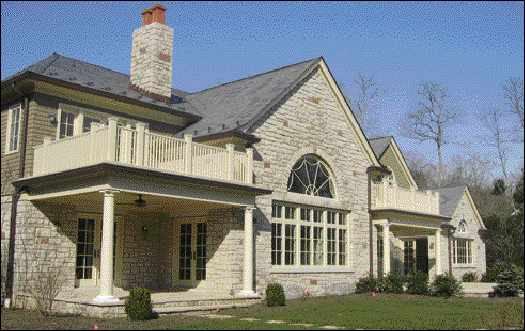
A $2.8-million knockdown: The Murphy residence — an 11,500-sq.-ft. home in Rumson, N.J. — exemplifies the work of Tim Cross (top) and the crew of Merrick Construction (bottom).
Tim Cross has built his contracting business in a section of Monmouth County, New Jersey, that encompasses the shore towns of Rumson, Fair Haven, and Little Silver. Cross pursues remodeling projects and new homes, balancing both kinds of construction as a strategy for regulating his work flow and increasing the growth of his business. The bulk of his clients are Wall Street employees who commute via ferry between their jobs on the stock exchange to the homes that Cross has either built or remodeled for them. His company, Merrick Construction, employs 10 high-end finish carpenters and turns out roughly $6 million per year in sales. Here, Cross reveals some of the details that keep his business in front of the competition.
Could you explain your strategy of pursuing both new construction and remodeling projects?
It has to do with keeping my crew focused on what they’re good at. On new homes, they concentrate on doing high-end finish work and specialty details. This includes coffered ceilings, custom molding around archways, paneled walls, and built-in bookshelves. They do things like set all the exterior windows with a laser rather than have the framer do it. We want everything at the same height throughout the whole house, so that the top of the casing matches up with the interior door casing — exactly. Not within a quarter of an inch, not within an eighth of an inch — exactly. So that when everything gets trimmed, it lines up all around. I’m a little bit meticulous.
But there are stages at the beginning of a new project when, except for having a foreman on site, my guys don’t need to be there at all. Subs take care of the masonry, roofing, framing, fascia, and siding; we don’t have to spend a lot of time there.
If I were doing new homes exclusively, I wouldn’t need my employees all the time. So to keep the crew busy, I use the time at the beginning of a new home to do renovations. On renovations, it’s more efficient to use employees than it is to use subs. You still have the standard licensed subs that go in and do their work, but for many things, it just doesn’t make sense. You’d get crazy pricing if you were to sub out interior renovations to a framing contractor. And he’s not going to put up plastic; he’s not going to be careful of the walls if he’s carrying in the 2x4s. You have to use the right people to do the right jobs.
Remodeling work, such as the gut rehab that transformed this older bathroom (right) in a Fair Haven, N.J., home into a state-of-the-art design (left), allows Tim Cross to keep his finish crews busy during the excavation and framing stages of a new house.
So by alternating crews, you’re building on an overall strategy?
Right. I stagger my starts. I am able to move guys from renovations to new homes when I need them. And if a renovation finishes up sooner than I thought and I need to put some guys somewhere, I can always put them on a new house — there’s plenty of work there for them to do. They might be there for a few days or a week, and when the next project starts up, I can take them out again. It’s easy for me to keep everybody busy when I have both types of jobs going, new work and renovations.
How do you schedule your construction season?
My strategy is to do two to three new homes per year. Ideally, I would like to start one in the spring, one in midsummer, and one in early fall, and throughout the year do renovations around that. The renovations are inside/outside work. It doesn’t matter if it rains. If we start a new house in September or October, we’ll have it framed — even an 8,000-square-foot house — and closed in by the winter. Then we can jump in and have the guys doing trim work during the wintertime.
After completing a massive addition and extensive renovation to the main house, Merrick Construction built a new pool house in Rumson that included a double inside/outside fireplace, kitchen, bath, and changing rooms (right). The slate roof is supported on temporary posts (left) while custom porch columns are on order.
Sounds like a tight calendar.
I have two time frames when the bids are going out. I’ll start getting calls in February, March, and April. In July and August, when most people are on vacation, the phone gets quiet. When the kids start going back to school, people start thinking about projects again, getting them started or completed before the holidays, so in September the phone rings off the hook, even into November. December and January are very quiet again. It’s just as busy in the winter for me as it is in the summer; it’s just different.
Who are you bidding against?
Generally, the same set of high-caliber contractors. I hope to be bidding against them, to be honest with you. I know they’re not going to be low-balling the project. We should all come in around the same number. Then it comes down to how you can sell yourself and your company. The quality of work is obviously part of that, but in these cases, everyone’s workmanship is good. You can almost take that out. What’s left? Service. Callback time. I know I can compete on service. That’s why I say I don’t mind bidding against the other top-flight contractors. I can sell that part of the job, knowing our service will stand out over the other contractors.
What are the key points that differentiate your service from the competition?
The level of organization we provide is key. It’s reflected in how we run projects and how we communicate with clients. These all play a role in providing good service.
My strength is giving meticulous attention to clients. I do this by holding regular client meetings between my foremen and each client. We hold these every week at the same time, so the client and foreman can discuss what’s going on and what’s coming up. We make ourselves completely available to the client: I have an office with a secretary, so someone always answers the phone. The clients have our cell-phone numbers, too. Communication and organization really matter.
That goes for the paperwork as much as for the work itself. For example, we work very hard at record-keeping and job- tracking through QuickBooks Pro. By paying attention to this “process aspect” of the business, we can estimate jobs very close to the actual outcome. This level of accuracy allows us to stay true to the estimate. We avoid charging for extras and avoid client surprises. This is really what sets us apart.
What’s the advantage of QuickBooks Pro?
QuickBooks Pro allows me to easily create job-costing reports. That’s basically a report card on how I’m doing on estimating, or how my employees are doing on their work. When I create the estimate, it’s going to fall within three main areas: materials, labor, and subcontracting. Within each one of those categories are subcategories. For example, labor will include finish, framing, exterior and interior trim work, wainscoting, rails, cabinets, and miscellaneous.
My employees all keep time sheets. When we get the job, I print out a copy of the actual contract without any pricing on it. It’s basically the same thing the customer gets. Everything has coding on it, for example, 2500 for deck framing, 3000 for roofing, 3500 for siding, 4500 for drywall, and it goes down the line. Whatever it is that they’re doing should be somewhere in that spec. Next to each item is a code that tells employees what code to put on their time sheets. My secretary enters those codes into the computer and they’re tracked to each particular job and each particular item within that job. That is one of the most important tools I have. The report shows estimated costs, and right next to it, the actual cost. There’s a “difference” column after that. Every time my secretary pays an employee, he’s got 40 hours, and those 40 hours are broken up into however many items for however many jobs. The computer automatically spreads that out and assigns the actual dollar amount to each estimated cost. Every week I can tell you exactly where I stand on every job we’re doing.
Setting that up in QuickBooks Pro must have required quite a bit of groundwork. Has it paid off?
Tremendously. I also do what’s known as historical estimating. I’ll be looking at another project — let’s say we just finished a 6,000-square-foot house and now we’re doing a 7,000-square-foot house. Basically, they’re the same size. I’ll compare the report for the job that is completed and look through it and see how I did — on estimating the trim work, on setting the windows, or trimming the exterior of the windows. If I might have overbid on the trim work on all the exterior porches, it’ll show me that.
What this has allowed me to do is get my estimating to be extremely accurate so that I’m usually within 5%, and often as close to 1% and 2%, of actual costs. If I look at the project and say we’re doing really well and it looks like from here on out it’s clear sailing, I might not charge a customer on a few items. Even if it’s listed on a change order with four or five different items — “plus $300” or “plus $4,000,” or whatever — I’ll also write in there what we did and “no charge.” This will be remembered and leads to the kind of referrals that win us the work.
Merrick Construction’s painstaking work to match existing slate, brick, and mortar resulted in seamless exterior of a small office building in Rumson, N.J. (above). The building’s 3,100-sq.-ft. extension for four ADA-compliant bathrooms and an elevator is now impossible to distinguish from the original structure. How’d you get where you are today?
I attribute a tremendous amount of where I’m at today to the JLC Live! shows. I’m still learning so much and will forever go to those classes without fail. I haven’t missed a year. I bring my guys now. And I’m putting them in classes, even some of the management classes, although they’re not project managers. I figure if they understand why the project manager is on them about this and that, it makes it a lot easier for them to do it. The time sheets are a good example. They sat in on the lead carpenter class that was taught by Tim Faller. And he talked about time sheets, and explained how they fall into estimated versus actual reports and how they all tie together. I have been telling them for years why I do it, but when they hear it from somebody else, and they’ve spent an hour and a half in that class, they say, “Boy, now we really understand why you need us to be so detailed with those time sheets.”
At the first conference, I was overwhelmed by how much improvement I needed. There was no way I could take everything I learned there and apply it. It was 1997 when I first got QuickBooks. With accounting, estimating, and job reporting, I knew I was going to need to be computerized. I made that decision early, when the company was smaller. It was easier to implement then, certainly, than it would have been after the company had grown.
How much has your business grown?
It’s doubled every year. In 1997, I think I was doing $250,000 total volume and $500,000 in 1998. It’s gone up by 50% every year since, almost right on the number. ~