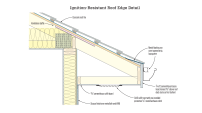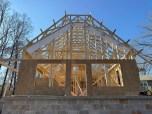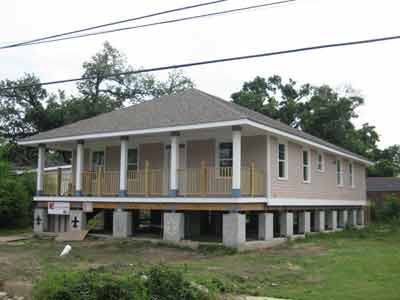
Elevated on four-foot piers, the Green Dream 2 “wash and wear” house has water-tolerant construction details that would allow it to survive deep water inundation with little need for repair or replacement of materials. In the aftermath of Hurricane Katrina, Louisiana State University professor Claudette Reichel, who chairs LSU’s “LaHouse” building demonstration project, invited building scientist Joe Lstiburek down to Louisiana to look at the damage and to offer advice on the reconstruction problem. After some study, Lstiburek proposed a set of construction details tailored to the conditions of a region like the low-lying Mississippi Delta. The idea was to build in a way that allowed a house to withstand being inundated briefly with floodwater — and allowed homeowners to quickly clean, flush, and repair their homes and put the buildings back into service. Coastal Contractor covered Lstiburek’s recommendations in July of 2006 (see “Low Country Rx: Wet Floodproofing,” by Ted Cushman, Coastal Contractor 7/06). Now, LSU has moved beyond theoretical prescriptions, building two demonstration houses based on the new principles. Claudette Reichel calls the concept the “Wash and Wear House.” The two homes have flushable, drainable wall and floor assemblies that are based on the same concept, but have different details. The first house (called “Green Dream 1“), with a HERS rating of 64, has high-density spray foam within the wall cavities, applied at less than full stud depth to allow a drainable space under the wallboard. The second home (“Green Dream 2“), still under construction, uses exterior-applied rigid foam insulation, leaving the wall framing cavities completely empty. Both homes use DensArmor Plus drywall, a paperless gypsum-board product from Georgia-Pacific that has a fiberglass mesh face and moisture-resistant core.
Rigid foil-faced insulation applied to the outside of the Green Dream 2 house leaves interior stud cavities void, able to be drained, rinsed, and dried in case of flood.
Underfloor insulation details also vary. Green Dream 1 has sealed rigid foamboard fastened underneath the floor joists, while Green Dream 2 has high-density spray foam applied to the underside of the floor sheathing.
Treated-wood floor framing and spray-applied foam insulation make for a water-resistant, easily washable assembly. The point is the same in each case, however, explains Reichel: “We’re combining high energy performance with hazard survivability. So after a similar event to the one that destroyed their previous home, the house would not only survive, but be very easily cleanable and restorable, with very little need for replacement of anything. You open a gap at the top and the bottom, flush it out, drain it, and ventilate it.” High-performance windows, good air-sealing, and advanced hvac mean the homes perform better day to day, says Reichel — “and if another Katrina happened, as soon as people are allowed back in the city, those folks can clean up and move in. They don’t have to wait for drywall, don’t have to wait for insulation, don’t have to wait for contractors — it’s just wash and wear.” More Green Dream 2 construction photos are available at the Green Dream 2 blog. We’ll take a closer look at the Green Dream houses’ energy-efficient hvac systems, hurricane-resistant insulated roof structures, and termite-resistant framing in upcoming issues of Coastal Connection.