Maine Passive House, Part 2: Airtight Junctions: Wall Base and Wall Top ~
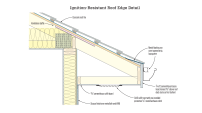
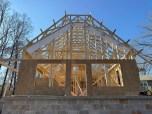
But what about the joint where the base of the wall meets the foundation? That’s always a head-scratcher for builders. Here again, Corson’s method is to use 3M tape. The mat slab foundation for the house, poured inside a foot-thick polystyrene insulating form, was placed on top of a continuous sheet of heavy clear poly, extending well past the perimeter of the slab. Once the first-floor walls were sheathed, crew member Donny Gummow carefully taped the poly to the OSB at the base of the wall (below). Next, the plan is to cut the poly back within a few inches of the house perimeter, fold it up onto the base of the wall, and tape it again. The wall is designed to be vapor-open throughout, says Corson. “The dew point location within the wall moves around from week to week and from season to season,” he says. “We don’t want to trap moisture anywhere in the wall — we need it to be able to dry in both directions. So at the base of the wall, we’re not folding the plastic up enough to stop the wall from drying to the outside. It’s just enough to air-seal the sole plate joint to the foundation. But now I don’t have to worry anymore about air leakage at that joint – I’m not caulking the plate to the sill or anything like that. It’s just sill sealer and anchor bolts.” Where the wall frame meets the roof frame at the top of the wall, Corson’s method is to connect the OSB wall sheathing to an OSB skin applied to the underside of the roof trusses. Achieving this means thinking ahead: after framing the walls but before setting the trusses, Corson packed out the top plate with narrow OSB strips, to make air-sealing of this juncture easier and more fool-proof. Then he placed Grace Vycor flashing tape over the OSB-padded wall plate (see photo below). After setting the trusses, the plan is to attach a continuous OSB ceiling to the underside of the trusses, seal the extended flap of pre-installed Vycor to the underside of the ceiling OSB, and seal all the interior ceiling joints and nail penetrations with more Vycor or 3M tape. This tape-sealed OSB skin — which extends up the outboard face of the 2×4 frame, then along the underside face of the roof truss system — will define the air-tight envelope of the home, buried well inside the insulated outer framing. For the framers, it’s an unusual blending of framing and air-sealing into one process — strikingly different from the more common practice in production homebuilding, where framing comes first and air-sealing comes later (if at all). The process is tricky to manage. But Corson says, “It’s really easier than doing all the framing first and the air-sealing later.” When the goal is to achieve the very strict air-tightness spec of the PassivHaus standard, he says, sealing while you frame is ultimately less labor-intensive and more effective.