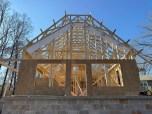
Builder Andrew Baer and his wife and business partner, architect Meghan Moynihan, picked a tough time to open a new design-build construction business in coastal Rhode Island in 2008. But the pair’s young business, Oyster Works, is succeeding well so far in the design-build niche, based on the company’s strong capabilities for integrating full-service design with full-service construction management and quality control. A case in point: this timber-frame cottage in a hurricane and flood zone, seaward of U.S. Route 1 on a coastal salt pond in Charlestown, R.I. The company tore down an existing older ranch house on the site, which would not have met modern energy or wind codes even with significant upgrades. They saved the existing concrete foundation — but had to elevate the new first floor by about 3 feet in order to get the first occupied floor above the location’s Base Flood Elevation (BFE). The new structure, a custom-cut timber frame clad with SIP panels, boasts high energy efficiency as well as a whole new level of style. A structural engineering analysis, required for a permit in the 120-mph design wind speed zone on the ocean side of Route 1 in Rhode Island, showed the timber frame was more than able to handle a hurricane. But bringing the wind load path down to the foundation through the new cripple wall system took some thought and some care. A triple 2×10 sill plate set on the foundation sill is tied to the concrete with half-inch threaded rod anchor bolts at 4’ o.c., drilled into the wall and set in epoxy adhesive, Baer explained. “First we had an engineer look at the foundation and make sure that is was good,” he says. “But then, because it’s a timber-frame building, which is a point-loaded structure, everywhere underneath where all of the posts would be, we placed a quadruple 2×10 post. And that quadruple 2×10 is separately anchored down into the foundation with threaded rod and a hold-down.” A wood I-joist floor deck was framed on top of this cripple wall for the first occupied floor, Baer goes on. But the posts for the timber frame extend down through this floor system and rest directly on the cripple wall, directly above the four-banger posts. (The photo above shows the holes in the deck to receive the timber posts.) More steel connectors were needed to continue the uplift load path for the structure: steel connectors at 2’ o.c. anchor the engineered rim board to the cripple wall, and 2-foot steel straps secured the timber posts to the cripple wall posts. In addition, steel straps spanned any joint between posts and beams up the whole height of the wall, from sill to eave. “The whole thing is positively tied into the foundation,” says Baer The SIP panels were curtainwall only, Baer explains — they weren’t considered in the wind resistance of the whole house, even though they probably do add some stiffness to the structure. “We didn’t look at the SIPs as contributing to the shear strength,” says Baer. “That shear strength is actually supplied by the diagonal bracing. We had a structural engineer analyze that, of course — in the 120-mph wind zone, you can just say you think it’s going to work.”
Project Profile: A Rhode Island Timber Frame Cottage
3 MIN READ