by Ted Cushman
Coastal builder Paul Buske has fond memories of his family’s summer vacations during his youth. Most summers, the Buskes would travel from Virginia to a North Carolina beach to spend a week or two at a rented one-story bungalow. “I slept on a Naugahyde couch on the screen porch,” recalls Buske. “Remember Naugahyde?”
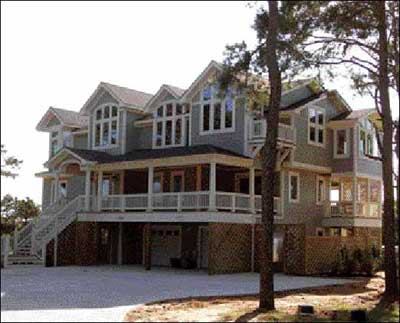
Nowadays, as CEO of Stormont and Company Builders of Kitty Hawk, N.C., Buske builds homes on the Outer Banks that are a far cry from the simple cottages he spent summers in during the 1960s and 1970s. Whether it’s a custom home for year-round occupancy or a second home or vacation rental, Stormont and Company typically builds wide, tall homes on piling foundations, with complex roofs and multiple levels, plus screened porches and decks. Most of the homes contain a full range of amenities, including something few would even have considered for a home back in the 1960s: an elevator.
Accessibility and Convenience
Buske first started to see the need for elevators in the early 1990s. “With a two-story house on pilings, you’ve got 8 feet to your first floor, and then your second floor,” he observes. “People were just getting tired of walking up and down stairs.”
Then, as the Americans with Disabilities Act (ADA) took effect, vacation-rental investors got more interested in providing handicapped-accessible houses. In the early 1990s, Buske recounts, the few accessible rentals on the market were only accessible at ground level: “They were set up with just a ground-floor bathroom and bedroom, but the person using those facilities was often left out of the interaction with the rest of the family. They couldn’t get upstairs where the rest of the crowd was hanging out, unless somebody wanted to carry them.”
Today, even the smallest elevators Buske provides have room for a person in a wheelchair and one other person. “With elevators, we can build a truly handicapped-accessible house,” Buske explains. As long as your bathrooms and everything else are ADA-compliant, the landlord can advertise the house as accessible.”
Landlords have learned that a home with an elevator can earn a rental premium, even from people with no special disabilities. As the U.S. population ages, more and more seniors are joining their families at the beach. An elevator equips the house to host a true family vacation that includes every generation, and even younger family members appreciate being able to bring in a full load of groceries without making a half-dozen trips up the stairs.
In Kitty Hawk, N.C., homes must be elevated at least 8 feet to rise above the base flood elevation. For elderly and disabled residents, however, this imposes a daunting challenge. Builder Paul Buske saw the shift in the home-buyer demographics over a decade ago and now provides an elevator to get above the BFE in nearly all of his homes.
Equipment Choices
There are three basic types of residential elevators:
• hydraulic-drive units that use a hydraulic ram to lift the cab
• cable-and-drum units that lift the cab using cables that wrap around a motor-driven drum
• electric chain-drive units that use an electric motor geared to a large, counter-weighted chain
Buske prefers the nonhydraulic solutions. “There’s nothing wrong with hydraulic elevators,” he says. “But with a hydraulic elevator, you need a dedicated space for the equipment: The hydraulic reservoir, the hydraulic pumps, and all of your electronics and electrical control panels have to be housed in a separate room. Then you just pipe your hydraulic fluid over to the hydraulic ram that lifts the elevator.”
Electric units don’t need all that space. “All of the equipment is either housed on top of the elevator itself or at the top of the elevator shaft,” Buske explains. “So we don’t have to give up 25 to 35 square feet to equipment, and we can use that floor space for something else that serves a better purpose for the homeowner.” The elevators Buske currently provides are Lev brand units (www.thelev.com), manufactured by ThyssenKrupp Access (www.tkaccess.com), that ride up and down a pair of steel rails fastened to the shaft wall (see “Anatomy of a Residential Elevator” ).
Anatomy of a Residential Elevator
Trade Relations
Surprisingly, even a relatively small market like the North Carolina barrier islands is served by more than one specialty elevator contractor. Buske has two local contractors to choose from, one supplying hydraulic elevators and one supplying the electric Lev brand. Should either of these be unavailable, elevator companies based in Greenville and Raleigh, N.C., also install and service elevators on the Outer Banks.
Currently, Buske’s preferred elevator vendor is Atlantic Elevators in Manteo, N.C. (www.atlanticelevators.com). “It just happened that the fellow that started this company a few years ago, Kenny Pekrun, was already a personal friend of mine. I knew about him, I knew his work ethics; it was just a perfect fit,” comments Buske. The electric Lev elevator brand has also proved itself reliable, claims Buske: “The installers need to find a company they can depend on to make a good product. They need to know that they can get their product in a timely manner and they can get parts when they need parts — just as I have to know that if I’m putting a product in my house, my trade contractor can service it, so that my homeowners aren’t sitting waiting for weeks or months for something to get fixed.”
Rough-In Requirements
Elevator manufacturers typically offer a range of sizes, with car floor areas ranging from 12 to 15 square feet. Lev elevator cars come in three standard sizes: 36 by 60 inches, 36 by 48 inches, and 40 by 54 inches. Intermediate sizes (in 2-inch increments) are available as a custom order, as long as the total area is between 12 and 15 square feet. For the sake of flexibility, Buske’s house plans always allow for an elevator shaft (known as the “hoistway”) that’s 67 by 67 inches square. That way, he can accommodate the longest elevator model available, and the space gives him complete flexibility for locating any size elevator on any side of the shaft — as long as the cab has only one door.
Besides the main door, Lev elevators can be fitted with an additional door on either side or on the back, so that passengers can enter through one door on one level and exit the car in another direction on the next floor. This allows for greater choice in room or hallway layout, as well as in access to the elevator.
Even in a large home, floor space is always at a premium, which is the primary reason Buske prefers electric elevators: The equipment to operate them simply takes up less space. All of the equipment can be housed at the top of the elevator shaft just below an access hatch that leads from the attic to the top of the “hoistway.” (By contrast, a hydraulic elevator requires an equipment room for the pump unit and electrical controller, which must be at least 30 by 36 inches to provide the necessary clearances required by the NEC.)
Providing for side or back doors, however, typically requires more care in framing the shaft and laying out the door locations. The code specifies certain tolerances for elevator doors, explains Kenny Pekrun. When the elevator’s accordion door is closed, and the home’s shaft door is closed, there can be no more than 5 inches of air space between them. This guideline is designed to prevent small children from being injured if they get caught between the doors. By the same token, the code allows only a small gap between the elevator floor and the main house floor when the elevator comes to a stop.
“With a single-door application, all that is pretty simple,” says Pekrun. “We can easily position the rail so that it brings the car close enough to the door. But with the two-door application, the shaft must be sized precisely to the [stock] size elevator.” Pekrun likes to meet with the framing crew to make sure they have all the measurements they need. It’s often unfamiliar territory, but he can ease things considerably by drawing the rail centers and the door centers right on the plates for them.
The shaft or hoistway (which must be sheathed with fire-code gypsum drywall) is framed like any other wall system, with studs 16 inches on-center and ordinary door framing. However, the rail system does require its own beefed-up backer in one wall: a post made of doubled 2x12s, glued and nailed, flanked by 2x4s on each side, also glued and nailed. This post, which Pekrun calls a “rail header,” serves as an attachment point for the elevator’s steel T-rails. Four-inch lag screws at specified intervals anchor the rails to the framing (see “Rail Header Detail”).
The elevator’s steel rail rides on a “rail header” framed out of 2x12s laminated together with glue and screws, and banded by a pair of 2x4s. Note: Temporary planks and decking are required fall protection during construction.
At the top of the shaft, the elevator needs at least 9 inches of headroom for the lift equipment. And at the bottom, it needs a 6-inch-deep “pit” in the foundation slab, reinforced according to specs provided by the elevator manufacturer — one more reason for Pekrun to stay in close communication.
Keeping Dry
Elevators come in especially handy for tall houses built on piling foundations. But at the same time, elevators can be vulnerable to flood damage. As Pekrun explains, the industry has taken that problem into account.
“FEMA has come through and redrawn all the flood hazard maps in our area,” says Pekrun. “We have all the various flood elevations and flood zone types to deal with. But FEMA also says that your elevator can land below base flood elevation — no problem — provided that your elevator has an automatic means to return out of the flood plain.”
Like most elevator companies, ThyssenKrupp Access now provides control circuitry designed to automatically return a Lev elevator to its “home floor” after use. “I can set it to return to any floor that I choose,” explains Pekrun. “Of course, here in the flood plain, we use the second or third floor. It has a timer, so once you get out of the elevator, 300 seconds later it will return to that automatic home floor, and stay there until it is called again.”
In some cases, says Pekrun, elevators may stop shy of the ground. “Occasionally, we locate the elevator at the top of a short access ramp to get it above the flood elevation. We make it a two-and-a-half or three-and-a-half-stop elevator. You can still access it from the driveway or ground level, but it doesn’t travel all the way down. In that case, we also like to set it to automatically return to an upper floor after use.”
Maintenance
Like any appliance, an elevator needs routine service. In most residential settings, says Pekrun, that doesn’t amount to much. In a house where just one family is riding it, the unit needs to be seen by a professional every 18 months to two years, he says. Once he makes the customer familiar with how to operate the unit, there’s not much that can go wrong, short of a lightning strike that could fry the control circuits. But the rental market, says Pekrun, is “a ‘nother egg to scramble.”
“You ever have somebody rent something from you?” he asks. “It’s like loaning out your lawnmower — it never comes back right. You rent out an eight-bedroom cottage, it’s going to have 20 people in it — and renters, I’ve always said, could tear up an iron bowl with a rubber hammer.” Pekrun speaks from experience. “Kids — we try to keep kids who are by themselves out of the elevator, but there is really no way to do it. Rainy days are terrible — they can’t go to the beach, so the elevator becomes an amusement park ride.”
If there’s damage, says Pekrun, it’s generally to the doors. “Kids are hard on doors,” he laments. “They will open the accordion door during the travel, and then the elevator will stop — that is a safety circuit.” If the gate is left open too long, the elevator will try to run three more times at intervals. “Then it shuts itself down, and I have to go reboot the computer. That happens frequently; or they start turning switches and pushing a bunch of buttons and then the elevator doesn’t know what to do, so it shuts down again.”
On rare occasions, the damage may be extreme. “If a young person is stuck in there screaming and shouting, someone may take a crowbar or axe or something, or take the main door off the hinges and start prying. Then we have to replace stuff. That is the worst thing.” Short of that kind of abuse, however, residential elevators are quite robust, says Pekrun, and should run for many years with minimal amounts of care.
The cab rests on a pair of sliding “sling brackets” that cantilever off the rails. The balancing counterweight, sliding down or up between the rails, lightens the load for the 230-volt electric motor (positioned at the top of the shaft) that hoists the load. Note at right that the bottom of the hoistway — the pit — is below the lower landing and is framed in with pressure-treated lumber to stave off moisture damage to the drywall at the lower reaches of the home. The slab on the pit floor must withstand a 3,200-pound impact load.
To meet fire code, the hoistway must be sheathed with drywall and taped, and be completely clear of any pipe, wires, or other obstructions. Typically, there’s less that a 1/4-inch tolerance in the finished dimensions from top to bottom, which means the framing must be dead plumb. Note the box in the upper right-hand corner of the door: it’s an automatic lock that secures the door when the cab is not in place. The magnetic plate on the rail opposite the door lock locates the floor, stopping the cab at the right elevation.
Aging in Place?
Pekrun hopes to see elevators make headway in mainstream home construction, as an upgraded version of the accessibility products like stair lifts and wheelchair lifts that he also sells. “People are getting older, and doctors are making people live longer,” he points out. “Building lots are more and more expensive, too, so people are building multistory homes. We are really trying to market our product with the idea that the aging population can stay in their homes. I tell them, ‘Buy the view that you want forever, and let me make it accessible for you now, while you can afford it.’ “
A former frame and finish carpenter, writer Ted Cushman has been covering construction business and technology since 1993. Photos by Paul Buske.