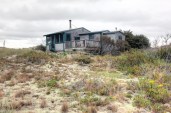
The Supreme Court of Texas has ruled 5 to 3 in favor of Galveston homeowner Carol Severance in a dispute with the State of Texas over Severance’s house, the beach it fronts on, and the public’s right of access to that beach — which, over the years, has moved closer and closer to the house. The upshot of the court’s ruling: Texas Land Commissioner Jerry Patterson can’t order Severance to demolish or move her building, even though erosion from Hurricane Rita in September 2005 re-shaped the beach in front of the house, submerging a parcel of land between the house and the Gulf of Mexico and moving the so-called “line of vegetation” — which the state uses to define the public’s rights of access — landward of the building. The Court’s ruling and opinion, authored by Justice Dale Wainwright, is available here (” Severance v. Patterson“), along with dissenting opinions written by the three minority judges. According to the ruling, the state’s ownership of the “wet beach” — the area between the high and low tide lines — is undisputed. But the public’s right to use the “dry beach,” between high tide and the first vegetation, depends upon formal easements or long accustomed use — neither of which, the court said, has been established in this case. “While losing property to the public trust as it becomes part of the wet beach or submerged under the ocean is an ordinary hazard of ownership for coastal property owners,” the court wrote, “it is far less reasonable, and unsupported by ancient common law precepts, to hold that a public easement can suddenly encumber an entirely new portion of a landowner’s property or a different landowner’s property that was not previously subject to that right of use.” The court’s ruling rests heavily on the distinction between “erosion,” a slow and imperceptible encroachment of the ocean or beach onto a private piece of land, and “avulsion,” a sudden submersion or uncovering of land caused by a singular, extreme event. Hurricane Rita’s rewriting of the coastline falls into the category of avulsion, said the court — and in that case, the state has no right to suddenly deprive the landowner of her customary and established right to prevent others from trespassing on her private land or house. In most states, a state Supreme Court ruling would end the discussion. But in Texas, Supreme Court Justice is an elected office — and Jerry Patterson, the Land Commissioner, is now urging voters to take matters into their own hands and oust the Justices who he says have taken away the public’s right to use publicly owned beaches. The Beaumont Enterprise has that story (” Official wants judges ousted for Texas beach ruling,” by Harvey Rice). Said Patterson: “We now have private beaches in Texas where the public can be excluded. I think folks should remember this when it’s time to vote.” Corpus Christi Caller editorial page writer Nick Jimenez agreed (” Render ballot justice to these five justices,” by Nick Jimenez). “Think about your lost right to a public beach when next you see the names of Justices Dale Wainright, Nathan Hecht, Paul W. Green, Phil Johnson and Don R. Willett on a ballot,” wrote Jimenez. But property-rights advocate J. David Breemer of the Pacific Legal Foundation, who represented homeowner Carol Severance in the case, argued in the Galveston Daily News that the court’s decision was less sweeping, and more reasonable, than opponents are making it out to be (” Severance decision was correct and just,” by J. David Breemer). Wrote Breemer: “The ruling acknowledged the public retains significant public beach access options. The state still owns all beach land to the high tide line, however far inland it goes, and can acquire additional private areas by proving prior public use or by buying it. Once a public right of way lawfully exists on private land, it can gradually shift inland. But the state cannot decree the public beach expands inland to swallow new areas of private land — land never before subject to public use — when a storm moves the grass.” Texas Land Commissioner wants Carol Severance’s beachfront house in Galveston torn down or moved to preserve public access to the beach. In reality, it seems likely that few parcels of land will end up fitting the facts in the Severance case: a property which has suddenly found itself in the sandy area between wet beach and vegetated upland as the result of a single major storm. For now, the result of the decision is simply that Carol Severance gets to keep her house on the beach. Only time will tell whether the case will create a precedent that ends up affecting other beachfront locations.
Texas High Court Limits Open Beaches Law
Texas High Court Limits Open Beaches Law
4 MIN READ