Every year at this time, JLC editors sort through piles of press releases and swarms of e-mails to round up a batch of building products — tools, materials, fixtures, fasteners — that we think will help you work faster and better. This year, we’re doing something a little different: focusing on products we discovered while walking the floor at JLC Live in Providence, R.I., in March. The sluggish economy notwithstanding, the exhibition hall was full, with manufacturers and suppliers of all stripes seizing the opportunity to reach the JLC audience. Here’s a small sampling of what we found.
Something New, Something Blue
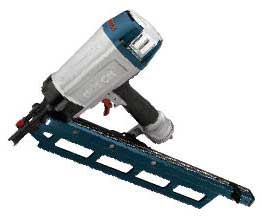
The sight of Bosch framing nailers must have turned a few heads at this year’s show. According to the toolmaker, the line of pneumatic nailers has been in development for several years, with thousands of hours spent field-testing and gathering feedback from users across the country. Bosch has introduced two framing guns — the SN350-20F full-head (1) and the SN350-34C clipped-head — with a roofing nailer, several finish guns, and a line of compressors to follow.
The air chambers on the framing nailers are designed with something Bosch calls “full force technology,” meaning that every bit of the air coming from the compressor is used to drive the fastener. Early reports from the field indicate that, indeed, the guns have plenty of power. Bosch also claims to have delivered this performance in a tool that’s smaller than comparable nailers, for better maneuverability. At 8.4 pounds, these guns are not particularly light, though they aren’t the heaviest out there, either.
Notable features include a rugged strike plate on the back for positioning framing (2), a spiked nose for toenailing (3), and an optional rafter hook (4) that can be picked up at stocking dealers for around $20. The guns are currently available online for around $300 each. Contact Bosch Tools at boschtools.com or 877/267-2499.
The Moment Has Come
The folks at Simpson Strong-Tie — the connector company — have done it again. This time they’ve packaged up the steel moment frame for delivery to your site, where it can be assembled by your crew using nuts and bolts (1). Custom builders in seismic and high-wind zones are used to dealing with lateral loads — in homes with walls of windows intended to take in the view (2), for example, or large garage openings. Steel is a tried and tested solution, but it’s typically meant that you had to plan for custom fabrication and schedule a welder to visit the site, not to mention enlist an engineer to do the design work. With the Strong Frame, the entire process is a lot easier. For one, everything’s pre-engineered to meet wind and seismic codes, including the foundation anchors, which are located with templates for accuracy. Frames are available in seven heights from 8 to 19 feet, and in four widths from 8 feet 2 inches to 16 feet 4 inches. You use ordinary wrenches to assemble the frame; squeeze-out from special washers loaded with orange silicone allows you to see when the nuts are properly tightened (3, 4). The frames come prepunched for wiring and mechanicals, and wood nailers are already attached, making it easy to tie the moment frame into the surrounding wood framing (5). Prices for the Strong Frame range from $3,000 to $10,000; contractor pricing may vary. Visit strongtie.com for design and installation instructions or to find a dealer.
Quick Concealed Fastening
Known for a decade for its reliable line of structural screws, FastenMaster recently introduced the Cortex concealed fastening system, designed specifically for composite decking and cellular PVC trim (1). The corrosion-resistant 2 3/4-inch-long Cortex screw is driven into the trim or decking using the setting tool (2), which disengages automatically when the screw head is at the correct depth beneath the surface. This leaves a neatly formed plug hole that is filled with provided plugs matching the trim or deck material (3). Currently FastenMaster has plugs to match Azek Trim, Azek Deck, EverGrain Classic Decking, TimberTech TwinFinish, Trex Accents, and Trex Escapes. A box of fasteners and plugs good for 250 lineal feet of trim costs $111; screws and plugs for 100 square feet of deck cost $98. For more information or to order, go to fastenmaster.com or call 800/518-3569.
Traction on the Roof
Titanium UDL-30 Synthetic Roofing Underlayment has an impressive set of specs: It’s 25 mils thick but weighs only 4 pounds a square; it has passed a nail sealability test usually applied to peel-and-stick membranes; and it’s warrantied for six months against UV damage. Verifying all of that would be hard, but the stuff sure makes a strong impression in person. Not only does its raised-grid surface grip the foot, but it’s extremely resistant to tearing and comes in a pleasing light-gray color — easier on the eyes and less likely to heat up than the typical black underlayment. UDL-30 should be fastened with 1-inch plastic caps. It costs around $140 per square. Go to interwrap.com or call 888/713-7663 for further details.
Pro-Quality Foam Gun
Drumroll, please: Though it’s never had the largest and certainly not the loudest booth, EFI — Energy Federation Inc. — has been an exhibitor at every East Coast JLC Live since the show’s humble beginnings in 1995, when a few vendors set up their literature on folding tables in a narrow hotel banquet room in Cambridge, Mass. This year, the company’s line of products — anything and everything intended to make homes tighter, better ventilated, more resource-efficient — is more broadly relevant than ever. If you haven’t visited EFI’s Web site, check it out: efi.org. And if you’re still using those 12-ounce cans of spray foam with the straw attached for your air-sealing efforts, maybe now’s the time to get a pro-duty tool. EFI’s starter kit, which includes a rugged Pageris gun, two 33-ounce cans of low-expansion foam, 10 nozzle tips, cleaner, and a case, sells for $169; call 800/876-0660 to order.
Preassembled Radiant Panels
With its HydroNex arrays (1), Watts Radiant is aiming to take some of the technical head-scratching out of installation and servicing of radiant heating systems — plus spare you the long, costly hours of pipe layout, joint sweating, and electronic wiring. The company has preassembled control, pumping, and mixing components onto panels designed to literally plug in between the heat source and the distribution piping. Main functions have been isolated onto four types of panels: primary circulation panels, with reset controls and manual or auto-refill (2); distribution panels, which use a variety of components — depending on customer preference — to provide high, mixed, or variable-mixed supply temperatures (3); specialized panels designed for unique heat sources, like solar or geothermal (4); and zone panels, built with manifolds and designed to be located in the zone served. Systems can range from basic to complex and everything in between; the beauty of the approach is that the many components have been preselected, presized, and prearranged into functioning, tested assemblies — the kind of installation that might make your plumber really happy and give your customer a system that can be serviced and supported for the long haul. According to Rich McNally of Watts Radiant, pricing for panels can be obtained through distributors. Visit wattsradiant.com/professional/hydronex.asp for more information.
Thinset Shower Pan
Attention tile-setters: If you’ve considered using a thinset shower pan liner but prefer to use a weep drain, you may want to try the ProBase from Noble Co. (1). It’s a presloped composite plastic base with a waterproof membrane laminated to the top. The base gets bonded to the substrate with modified thinset. A depression in the middle (2) allows the membrane to be clamped to the bottom half of the weep drain (3), which is waterproofed with a bead of NobleSealant 150. The height of the upper part of the drain is set according to tile thickness, and the depression is filled in with sloped mortar. A strip of NobleSeal TS membrane is applied around the base of the walls, to a height of about 12 inches (4). Corners are sealed with preformed inside and outside membrane corners bedded in NobleSealant 150 (5).
A 48-by-48-inch ProBase kit costs around $500; it includes the base, four preformed inside and four outside corners, membrane for the inside wall perimeter, a tube of NobleSealant 150, and a plastic shield for covering the drain while placing the mortar around it. Visit noblecompany.com for complete installation instructions and an installation video.
Narrow Shear Braces
Anytime you put two 9-foot-wide garage doors in the end of a 24-foot-wide building, you’ve got a potentially weak structure, especially if you build in a coastal wind zone. The three remaining 2-foot wall sections don’t give you enough length to provide reliable bracing with structural sheathing — at least the way sheathing is typically nailed. One remedy is to apply the “alternate braced wall panel” method found in the IRC (R602.10.6). A simpler way is to use a Shear Brace from iLevel. Made from 3 1/2-inch-thick TimberStrand, the braces come in 12-, 18-, and 24-inch widths, and heights of 7 to 13 feet for standard wall framing and up to 20 feet for tall walls. The product is sold in three formats: standard, for a single story; stackable, for multistory applications; and portal. Pricing varies, but a single panel for a standard one-story application (including the anchor kit) costs around $500. For more information, go to ilevel.com.
Hot Water From the Sun
Roof-mounted solar water heaters don’t always look that good. In fact, many of them are eyesores — which helps to explain why experienced solar thermal installers around the country have begun to adopt the new system from Velux. Having established its reputation as a maker of attractive, watertight skylights, the company has turned its know-how to making solar collectors, which — except for the hole in the roof — are mounted and flashed much like its raised-curb skylights (1). The collectors resemble oversized skylights (2) and can be mulled with skylights to good effect (3).
Velux packages the collectors with a solar water tank (4), a pump station and controller, a mixing valve, an air separator, an expansion tank, and propylene glycol to charge the system. A two-collector package, adequate for a two- to three-person household, costs around $8,000 to $9,000 installed, says Stephen Bohner of Alchemy Construction in Arcata, Calif. The system qualifies for the 30 percent alternative-energy tax credit through 2016. For more information, visit veluxusa.com.
4
Sticking Around
When 3M — the tape people — decided to get into the flashing-tape business, chances were good that they’d develop a decent product. They know a lot about how to make things stick to each other. According to Paul Engen, an engineer in the company’s industrial tapes division, 3M asked builders what they wanted in a flashing tape, and three requests came up again and again: They wanted something that was not too thick and that would stick in cold weather and to damp surfaces. Introduced last fall, the 8067 All Weather Flashing Tape claims to deliver on all three points. It’s 10 mils thick (compared with 25 mils for Grace Vycor Plus), can be applied at temperatures down to 0°F (and up to 120°F), and has an acrylic adhesive formulated to stick to a damp surface (though not a water-soaked substrate). The product meets the AAMA 711-05 specification for self-adhered flashing used in window installation, which includes a nail sealability test.
If you’re looking for a single roll of tape that will stick to a variety of common building materials — among them poly, housewrap, aluminum, OSB, and plywood — this may be it. The 75-foot rolls come in 4-, 6- and 9-inch widths. Right now sales are through the Internet; a case of 12 4-inch rolls sells for $225, or you can try a 4-inch-by-25-foot sample roll for $6.25. To purchase, go to shop3m.com and search on 8067. Use the code JLC at checkout for a 25 percent discount.