I used to run my business the way most contractors do: I’d visit potential clients, review the plans their architects had drawn, agree to bid against a group of other contractors, and then spend 10 to 100 hours estimating the work. When the bids were opened, I would feel discouraged if I wasn’t the low bidder. Or, if I was the low bidder, I’d wonder where I had made the mistake that allowed my price to be lower than everybody else’s.
Having to compete with so many other contractors was bad enough — but then, when the bids came in, the homeowners often found that even the lowest bid was way beyond their budget. At that point they had to make a choice: find a way to come up with more money, reduce the scope of work and spend money to redesign the job, or — worst of all — abandon the project altogether.
To ensure that he gets paid for the time he spends developing projects, the author requires clients to sign a letter of intent — essentially a contract for preconstruction services. If within six months the clients sign a construction contract, the preconstruction services are free. If not, they must pay the author an hourly fee for his time.
The bidders and the clients weren’t the only ones who paid a price. The architect, whose job it was to design a project that could built for the available budget, would end up looking unprofessional. Since the clients would resent having to pay for a design that couldn’t be built, their relationship with the architect could turn sour — often past the point of salvaging.
After many years of working under these conditions, I’d had enough: I decided to start negotiating contracts. The clients would select me as their contractor up-front and disclose their budget. Then the team I had helped to assemble — the clients; the architect; and me, the general contractor — would work together to design a project that was as close as possible to what the clients wanted for the available budget.
Actually, since no price negotiations occur during the process, the term “negotiated contract” is a bit of a misnomer. The negotiations have to do with the scope of work. The value of this approach is that it allows the clients to understand and consider the cost implications of design decisions as they are being made.
Making the Transition
At first, when people called and asked me to bid on their projects, I told them I no longer did competitive bidding but would be happy to estimate their projects if they would agree to negotiate the contract price with my company and not talk to other contractors.
Most callers responded by asking me how they could know they weren’t being overcharged if they saw no other bids. About the only thing I could tell them was that they just had to trust me.
As you can imagine, this approach did not work very often.
Offering something different. After repeatedly failing to convince clients to work with me on this basis, I realized that I needed to offer something more than simply my abilities as a craftsman and builder.
To figure out what that something was, I asked myself a question: What special skills does a general contractor have? The answer, I decided, was that we contractors know much more about what things cost than homeowners and architects do. We also understand construction methods and sequences. So if we can convince clients to bring us in early enough, we can help them — and the architect — weigh the cost implications of design decisions and create realistic schedules.
Therefore, about 10 years ago, I started putting out the word through my marketing activities that I wanted to be involved in projects as early as possible in the design phase. After a while, I began getting calls from clients and architects long before they were ready to start building.
Creating a realistic budget. Today, potential clients are usually just beginning to think about the design of their project when they call. I tell them that my company will work with them during the design phase. If they already have an architect, we will work with that person; otherwise we can use our staff architect or recommend another architect.
The most useful service I can provide prior to construction is to become what I call “the keeper of the budget.”
Very early in the design development process, I meet with the architect and the clients, and together we develop a schematic floor plan and simple elevations and sections.
We also come up with a series of assumptions about the structural systems, quality of materials, and finish selections. I then do a fairly detailed cost breakdown based on historic cost data from recent similar projects.
This cost breakdown becomes the first reality check for the design. If the estimate is at or under budget, the design work can proceed. But if the cost breakdown is over budget, the design can be revised before any further time and money is spent on it.
I continue to keep track of the budget all the way through the design phase. This is important, because every choice that is made — whether it concerns materials, room configurations, or anything else — has cost implications. And it’s my job to tell the clients what those implications are.
To stay on top of cost issues, I sit in on design meetings. Or, I can arrange to receive regular updates of the plans. I take this information and use it to update the cost estimate and make sure that the design is in line with the assumptions we agreed to early on.
If it’s not, I notify the clients that they have departed from the original assumptions and explain how that will affect the cost of the project.
Getting Paid
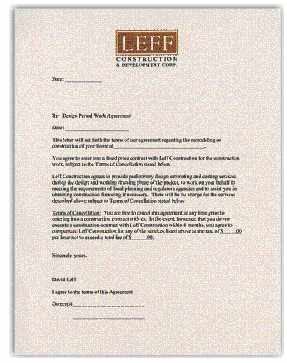
Before I’ll do any work on a project, the clients must sign a one-page letter of agreement (see example, previous page).
The letter states that the work I do for them during the design phase is free as long as they sign a construction contract with us within six months.
If the clients don’t sign a contract, or if they decide to drop the project or work with someone else, they must pay me for my consulting time. The letter indicates an hourly fee as well as a cap on total fees.
Efficient use of time. Why do I agree to provide this consulting time for free? Because the alternative is to spend time bidding five jobs in order to get one — the industry average for competitive bidding. I’d rather devote that time to doing something that’s very likely to result in a construction contract.
Once I explain how the process works, more than half of the potential clients I talk to agree to sign the letter of agreement. With those who don’t, I have spent only an hour or two of my time instead of the many hours I used to spend competitively bidding their jobs.
Becoming Part of the Team
Most of the architects we work with appreciate what we do; it takes the pressure off them to provide accurate cost input and gives them someone to talk to about which structural systems and construction methods would be best for the job.
One of the greatest benefits of this approach is that it makes the whole construction process much less adversarial. With competitive bidding, the incentive is to bid as low as possible and then, during construction, to find as many ways as possible to cut costs.
But with a negotiated contract, relationships are cooperative: Everyone involved can focus on helping the clients get as close as possible to what they want within the constraints of their budget.
David Leff is the owner of Leff Construction in Sebastopol, Calif.