I’ve spent most of my architectural career in conventional residential design, but for the past few years I’ve been concentrating on two types of factory-built housing. Working on affordable housing has given me a new respect for those builders and designers who try to make architecture on a budget that might seem to call for an oversized refrigerator carton. Here are a few tips I’ve picked up to make low-cost homes look better without busting the budget.
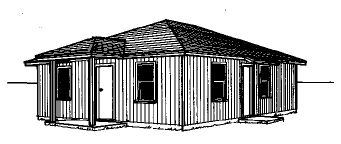
Figure 1.This plain house is an economical starter home for a “colonia” in South Texas. Just by steepening the front and back roof pitches, you add a certain dignity to the house that’s lacking in the version with the 5-in-12 roof slope on all four sides.
Rooflines
The pitch, overhangs, and detailing of the roof can make a house look cheap or classy. There’s nothing wrong with low-slope roofs (Frank Lloyd Wright used them extensively), but coupled with spare detailing and short overhangs, low slopes spell “cheap” to most buyers. Here’s a trick we developed for low-cost homes in Brownsville, Texas (see Figure 1). The designer of this 27×32-foot house naturally used the same 5-in-12 slope on all four sides of the hipped roof, resulting in a very plain house — though still a nice upgrade for someone who’d been living in a shack without plumbing. But steepening the end slopes to 30 degrees (the max allowed under the wind code) made the home more imposing when looked at from the entry end. A side benefit was a longer main ridge, increasing the stretch of an easy-to-frame gable roof from 5 feet to 16 feet and allowing many more sheets of OSB to be laid without diagonal cuts. Two downsides of this design are more complex angle cuts at the hips and a shorter overhang on the steeper roof (the hip beam has to run over the corner to align the fascia and wall height).
Another roof trick comes from my own 1929 two-story box of a house, which is exactly 24 feet square with a 5-in-12 roof pitch (plus various appendages on the first floor). The lower roof that creates the distinctive-looking “gambrel” shown in Figure 2 is just tacked on to the basic box. The front addition picks up the false roof and makes both roofs look more substantial (don’t copy the expensive shingled, segmented arches if you’re on a tight budget!).
Figure 2.A view of the right side of the house showing the false gambrel, as well as the addition that picks up the gambrel roofline. The arched porch is just visible behind the one-car garage addition that houses a guest bedroom and bath.
A favorite roof detail of my colleague Bill Zoeller terminates the eaves at a gable end in an elegant and cost-effective way (see “A Simple, Stylish Cornice Return,” 1/02, for a more expensive approach). He simply turns the gutter around the corner and then turns it again to cap it off. The gutter looks like a traditional molding, and the overall effect is classic — and inexpensive. This detail will work with any gutter, although a gutter with a traditional cross-section looks more authentic on a traditionally styled design (Figure 3).
Figure 3.The fascia is returned (left), then the gutter is wrapped around the return with two outside corners and capped off at the house wall (top left). The fascia return stands out whatever dimension is needed to allow room for the gutter corner piece and the cap. The drawing lower left also shows a bed molding under the eaves, which adds a lot to the design if the budget allows it.
Bay Windows
When you want to enliven a boring wall, a bay window is an obvious solution. Andersen and other window manufacturers have long made packaged bays, but I don’t particularly like their looks. Bays need to have three sides, either rectangular (which creates a terrific window seat that you can sleep on if it’s large enough) or angled at 30 or 45 degrees. There is no reason that a substantial rectangular two-story bay can’t be hung off the side of a home like a prefabricated design can, providing it’s properly engineered (Figure 4). You can use the sidewalls as brackets, or hang it from the top — anything that works with the design and doesn’t add much cost. You can prefabricate the whole thing on the ground if you have a cherry picker handy to lift it into place.
Figure 4.This admittedly undistinguished facade, typical of the two-story modulars that are popping up in the author’s part of Connecticut, looks much better with a hanging bay. Make it wide enough to lie down in, maybe use a single slider rather than two double-hungs (it might be cheaper); and let the rest of the windows in the sidewall land wherever they work best for laying out furniture. The bay turns a box into a home and could also turn a sale.
It’s important to keep the foundation straight, to avoid the cost of four corners when the foundation follows the bay. On level ground, you should hold the floor up at seating height to maintain at least 18 inches between the ground and the floor framing. If the ground drops off under the bay and the framing runs perpendicular to the foundation, you can avoid engineering a hanging bay by extending the floor framing and building the bay conventionally, while still saving on foundation offsets. But if the framing runs parallel to the foundation, hanging the bay avoids messing up the framing to tie back the cantilevered floor joists.
Gordon Tully is a senior architect with Steven Winter Associates, Inc., in Norwalk, Conn., and the longtime author of JLC ‘s “Building With Style” column.