If you were to ask the average American to define “home performance contracting,” you’d probably get a blank look. In fact, I doubt that most professional remodelers really know what it is. In coming years, though, I believe we’re going to see home performance contracting become a household term. My own company, GreenHomes America, is betting on it: After three years fine-tuning our business model in Syracuse, N.Y., we’re planning to go nationwide with company-owned branches and franchises, starting this year. What we’ve proven in Syracuse, we hope to repeat in every state.
Home performance contractors use a comprehensive “house as a system” approach to upgrading the energy systems in existing homes. We start with a complete battery of diagnostic tests and a careful analysis of the house’s energy efficiency, comfort, and indoor environment. We call this “testing in.” Then we apply the upgrades that make sense. After the work is done, we test the house again — “testing out” — to make sure that the measures we have installed are going to perform the way we intended and that we’re leaving the home in a safe condition.
We’re not consultants — we do most of the work ourselves. Our crews blow insulation, seal attics, put in doors and windows, and install furnaces and water heaters. We even put up solar water heaters and, occasionally, photovoltaic solar panels.
The way we work, homeowners get the benefit of “one-stop shopping” for the whole package of energy and comfort upgrades. More important, we take one-point responsibility for the way all the systems in the house will interact. It’s not the usual situation, where one trade contractor rarely thinks about how his work may affect what some other trade has done. In home performance contracting, we treat all the home’s elements, from building shell to mechanical systems, as related pieces of one big puzzle. We systematically apply our upgrades in ways that take into account how all those sub-systems interact.
In this article, I’ll describe the way my company operates in Syracuse — the business methods we use and the technology we employ to make existing houses function better.
Marketing and Sales
Our comprehensive approach is new in the local home-improvement market. For example, there’s no section in the Yellow Pages for “Home Performance Contractors.” So in Syracuse, we have ads under Replacement Windows, Insulation Contractors, and Heating and Cooling Contractors. And yet we’re not a window company, or an insulation company, or an hvac contractor — instead, we’re all three, but we’re also more than that. So when we get sales leads from various sources — TV and radio advertising, print ads, the Yellow Pages, our Web site, or people who have noticed our phone number on our fleet of trucks — our first challenge is to explain to the caller what it is that we really do.
Energy efficiency is our focus, and we deliver energy savings every day. However, many people who call us are not necessarily looking for savings on their energy bill. Most Americans don’t even know that a typical house can easily save 25 percent or more on its energy bills with a modest investment. So our typical customer is calling about something else — usually a comfort or performance issue, like a chilly draft or a room that’s too hot or too cold all the time, or some durability problem like ice on the roof or moisture-related paint failure.
No matter what the reason for the call, we always provide the same service first: One of our advisors (we don’t call them “salesmen”) visits the house for a comprehensive inspection. We visually inspect the building, inside and out. We check airtightness with a blower door, we test the furnace and water heater for combustion efficiency and safe operation, we use infrared imaging cameras to find insulation voids or thermal bypasses, and we use smoke pencils to locate air leaks. We “sniff” the gas piping for leaks. Depending on the situation, we may measure duct system airtightness and airflows. Then, once we know exactly what’s going on and how the house works, we recommend the upgrades that we predict will save the most energy most cost-effectively while also improving the safety and durability of the building.
Safety is one of the critical reasons for testing. We can’t come in and tighten up a house that already has a carbon monoxide problem or a gas leak — we don’t want to expose our crews to the hazard, and we clearly don’t want to risk the homeowners’ safety or incur legal liability. So without combustion testing and air-quality testing, we won’t touch the house.
We also never quote prices before we’ve determined what the house needs. Ultimately, of course, it’s the homeowners who will decide what to buy. After all, it’s their investment and their budget. We might recommend insulating and air-sealing the attic as a first step, and they might decide they want new windows instead. But they don’t have to make that choice blindly, because we give them good information to work from.
We occasionally lose customers. There are those who say, “I just want new windows, I don’t want you going down into my basement,” or “Joe said he would put in a new 95,000-Btu furnace for X dollars, I just want to know what your price is.” But most of the time, customers appreciate our need to know what we’re looking at before we start trying to sell them a product. And our goal is to have a lifetime relationship with every customer (in fact, one good reason to install the hvac systems ourselves is that it means we will visit that house again every year for routine maintenance).
Testing In
Our advisors are the primary point of contact with the homeowner. They need a lot of training to be ready for this work, because they do a lot: Each advisor is a diagnostician and a salesperson rolled into one. It’s quite technical — the advisor has to know how to operate the blower door, use the combustion testers, run the duct blaster, operate the infrared camera, visually inspect the house, and interpret all the results. But he also needs good sales and communication skills, because he has to make our analysis of the house understandable to a layperson — and at the end of the day, he has to put together a scope of work, sign the agreement with the customer, and get that deposit check.
Combustion testing. Furnace and water-heater efficiency are key elements of a home’s energy efficiency, and their safe operation (and that of the gas range in the kitchen) is important for the safety of the home. So our advisor checks flue gases with a combustion analyzer to measure the system’s baseline performance.
Appliance vent draft. The advisor also assesses the ability of heating appliances to draft properly. Flue draft and room air pressures are related: If the draft is weak, and there’s also negative pressure in the basement, the unit could backdraft and send combustion products into the living space. We need to know what might happen in the worst case. So the advisor closes all the windows and doors, turns on all the exhaust fans in the house — the range hood, bath vent fans, the clothes dryer — and checks the pressure difference between indoors and outdoors. He compares his reading with a standard set by BPI, the Building Performance Institute (bpi.org). Whatever change we make to the home must correct any pressures that fall outside recommended levels.
Sniffing for gas leaks. GreenHomes is “accredited” by the Building Performance Institute — a contractual relationship that means all our personnel must earn BPI certification. It also means we agree to correct certain deficiencies in any house we work on: We’re required to test for leaks on any accessible gas piping and repair any leaks we find (or, if they are on the gas company’s side of the meter, call the utility in to fix them).
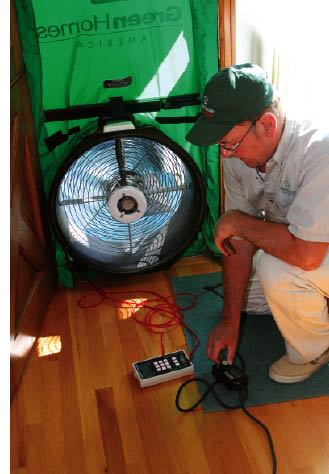
Blower-door testing. We use the blower door to measure the total air leakage of the house. If the house leaks too much, it costs too much to heat and cool. On the other hand, if it’s too tight, it may need mechanical ventilation for fresh air and will require direct-vented combustion equipment. Most houses we work on start out too leaky. So the “test-in” blower-door values provide us with a baseline; after we do our work, we’ll test again to make sure we accomplished the air-tightening we set out to achieve.
To run the test, the advisor shuts all the windows and doors, blocks off the fireplace, and installs his equipment in the door. He runs an air line from his manometer to the outside, then runs the blower-door fan and records the airflow required to bring the house to –50 pascals of pressure compared with outdoors. That number can be used to estimate the air-leakage area of the house envelope, which gives us an idea of how much air-sealing work will be needed.
The blower door gives you an aggregate airtightness number, but you still need to run around and locate the leaks, using smoke pencils. (The attic, by the way, is typically where most of the leaks are.)
Infrared imaging. The infrared camera lets us locate areas where there’s not enough insulation or voids — where somebody missed a spot, the batts are compressed, or blown insulation has settled.
The IR camera is also helpful for educating the homeowner. Rather than try to explain all the science, we can bring the homeowner along as we inspect, and show them the cold or hot spots on the screen. When the blower door is operating, those spots show up even better on the camera display, as the suction pulls outdoor air in through leaky uninsulated spaces.
Infrared cameras are getting better and cheaper as technology advances. The best new equipment will reveal insulation defects when there’s just a 5°F difference from inside to outside (it doesn’t matter whether the outside is warmer or colder than the inside, as long as they’re different). And prices for the equipment have come down, too: Ten years ago a good camera might have cost more than $20,000, while today you can get a camera with better resolution, a better sensor, and a lot more functions for around $5,000.
Testing ductwork. We test ductwork when we need to. Purists may insist that you should do a duct-blaster test on every house you work on. But if the ducts are all inside the conditioned space, testing them is a low priority for us. We’re more concerned that the pressures and airflows are balanced.
In predominantly heating climates, where the ducts are in the basement, research and our own experience both show that duct leakage is not very important — it’s all within the conditioned space anyway. So we focus our efforts on the envelope instead.
In the South, on the other hand, where air-conditioning ducts typically run through an unconditioned hot attic, it’s critical that you take a close look at duct leakage and do a very thorough job of sealing any leaks you find. But even then, duct blasting when you’re testing in may be superfluous. If you can see at a glance that the ductwork needs to be torn out and redone, you shouldn’t spend hours on a duct-blaster test first — moving the furniture around, sealing registers, and so forth. The important thing is to test after the work is done, to verify the performance of the new ducts. (For more on duct testing, see “Pressure-Testing Ductwork,” 4/03.)
Evaluating the Data
We always give the homeowner an estimate of how our upgrades will affect the home’s energy bills. We offer a 25 percent energy-savings guarantee, whether there’s a government program involved or not, if the customer chooses to install the entire package of measures we recommend. In our experience, you can achieve that degree of improvement in almost any house. Even a brand-new code-compliant house can usually cut its energy bills 25 percent — after all, code is the legal minimum, not some kind of high-performance ideal.
We don’t rely on computer models; among energy practitioners, they’re notorious for overestimating the savings. If we’re working in a local or state program that requires us to model the house, we’ll do it — but I’d be terrified to use a computer model as the basis for our own energy-savings guarantees. Instead, we use our own in-house methods, based on experience, to predict energy savings. However, you can get pretty close with publicly available methods that anyone can use. The EPA has a useful tool for analyzing utility bills posted on its Home Performance with Energy Star Web site. BPI also has a statistical database of before-and-after home energy bills that you can use to make a fair estimate of how an upgrade will change a house’s performance.
Assessing utility bills. We start by taking a careful look at the utility bills. We “dis-aggregate” the utility bill, breaking it down to figure out where the major loads are and how the energy is being used. And based on the improvements we recommend, we do a very conservative estimate of the savings we want to see.
Here’s a simplified example. Let’s say you have all the gas bills for a house that is heated with gas. You can track the usage month by month for the past year. July 1 is a good starting point, because we know the house isn’t being heated. So the gas bill that month reflects what the occupants use for everything else: cooking, water heating, and maybe a gas clothes dryer. When fall comes, that number starts to rise. It climbs through November and December and on into the dead of winter. Then in February or March it starts to decline again. If you graph it, you get a bell-shaped curve.
From the summer bills, we know the home’s baseline usage for nonheating needs. Now we can figure out what portion of the midwinter bill goes for space heating. With that, we can pretty well figure out how much we stand to save if we improve the insulation by so much, if we reduce the building air leakage by so much, or if we change from an 80 percent efficient furnace to a 94 percent efficient furnace.
In the same way, we can pick apart the electric bill. We figure out how much each appliance is responsible for: the refrigerator, the air conditioner, the blower motor on the furnace, lighting, and so on. And we can guess pretty accurately how much the owners will save if we improve each of those elements.
It takes experience to make accurate estimates. But once that experience is acquired, a careful house-by-house analysis is more reliable than any software on the market today.
Of course, the homeowners make the final call on what we do — it’s their money, and they get to decide. Naturally, they often make their decisions based on things other than energy savings. They may choose a furnace because they like the easy controls, or buy insulation and air-sealing to make their home office more comfortable. Still, the energy savings are always a plus. We like to show customers that with the financing we can help them get and with other available incentives — plus the reduction in energy use they’ll achieve — they could end up with extra cash in their pocket every month.
Upgrading the House
Once we’ve reported our assessment and the homeowners have made choices, we move to the next phase of the job, implementation. As I mentioned above, energy efficiency is not always the customer’s only objective. But when reduction in energy use is in fact the main goal, the most cost-effective upgrade is almost always air-sealing and insulation.
I’m continually amazed at how many houses in the cold Northeast are under-insulated. Many old houses still have no wall insulation and just a few inches of attic insulation. Even houses built in the last three years typically offer major opportunities to improve the air-sealing and insulation. Crews may miss spots when they insulate, and most builders still pretty much ignore air-sealing in the attic. So a good air-sealing job is usually our top recommendation.
The next step is typically to upgrade the heating and cooling system. There are lots of 80 percent efficient furnaces out there, but in heating climates it’s usually worthwhile to upgrade to a 95 percent efficient unit or better, and to replace old air handler motors with new variable-speed ECM (electronically commutated) motors.
When it comes to cooling systems, our recommendation depends on the climate. In Syracuse, where most houses don’t even have air conditioning, installing anything higher than SEER 14 or 15 doesn’t make much sense. But in Houston or Dallas, you’d want to consider a SEER in the high teens or twenties.
Windows, typically, are not high on our list. Almost all homeowners think they can get big improvements from high-performance windows — the window industry has done a great job of selling that idea. But in reality, windows are usually the least cost-effective energy upgrade.
Homeowners may have good reasons to get new windows — the old ones may be in bad condition or painted shut. And if they’re getting new windows anyway, it always makes sense to choose energy-efficient units, because the difference in cost is trivial. But getting new windows just for energy-performance reasons doesn’t usually pay. We’re careful to be clear with homeowners about that. (This doesn’t hurt us, by the way. We still sell and install a lot of replacement windows.)
Although they seldom accept our entire package of recommendations, homeowners usually decide to adopt several measures. Sometimes it makes more economic sense to upgrade the furnace and air conditioner than to buy new windows. But if the plan is to do both, we upgrade the windows before replacing the hvac equipment. Shell upgrades — like windows or insulation — let you reduce the size of the hvac system, which saves up-front cost as well as the expense to operate the equipment.
In our experience, solar thermal panels — rooftop water heaters — typically turn out to be a smarter investment than new windows when considered individually. This is true even in a northern market like Syracuse. We’re very excited about the potential market for solar water heating. The new systems are much simpler and more reliable than those of the 1970s or ’80s, when you had to be a master plumber and a mechanical engineer and build the whole thing from scratch yourself. These days, a solar thermal installation is essentially an appliance that you mount on the roof. You may still need a licensed plumber to tie it in, but it’s no more complicated than tying in a standard water heater or any other appliance.
Upgrading the lighting is also usually cost-effective. On most houses, we offer a basic lighting upgrade for free — we just walk around with a 12-pack of compact fluorescent bulbs and replace every incandescent bulb we see. For a few important high-use fixtures, we may recommend replacing the whole fixture with an advanced unit.
Air-Sealing and Insulating
The attic is usually the gold mine of opportunity. Even today, builders rarely give it the attention it deserves. The stack effect places the boundary between the living space and the attic under a lot of pressure, and the ceiling is a large area. In most houses, air constantly flows across that plane.
The goal is to keep the indoor air that you’ve paid to heat or cool down in the living space where it belongs. So our crew goes through the attic and finds every hole that connects to downstairs — plumbing chases, chimneys, vent pipes, electric wiring, duct penetrations, whatever — and seals them. They also look for joints where dissimilar materials meet. Partition walls often communicate with the attic, at cracks and gaps between the drywall and framing.
In a one-story home, kitchen cabinet soffits are a major point of leakage. In new construction, a good approach is to install drywall on the ceiling before you build the soffit, creating a continuous air barrier at the ceiling level. But in most existing houses, those soffits were framed before the drywall was installed, leaving the dead space above on the attic side of the ceiling. That often creates an air leak, and it also makes it hard to keep the insulation in contact with the drywall air barrier. We fix those situations by installing rigid foam or drywall at the attic floor level and air-sealing the joints before blowing insulation.
Once the air-pressure boundary is sealed, insulation can be blown into the space. The key is to keep the insulation aligned with the air-pressure boundary and in contact with it. That way, the insulation can perform at its full rated value.
Houses with complicated rooflines and tight attic spaces offer the greatest challenge. On the cape shown in, we lined the knee-wall crawlspace with Typar, then blew the walls and the sloped portion of the ceiling with dense-pack cellulose. Above, in the attic, we sealed the air leaks individually, then installed loose-blown cellulose over the floor. The result is a continuous insulated boundary and a continuous air-sealed plane, both in contact with each other.
In houses that lack wall insulation, we blow dense-pack cellulose into the walls. This improves airtightness and boosts the wall’s R-value.
Testing Out
I don’t have space in this article to go into window replacements or hvac upgrades. Instead, I want to emphasize the crucial quality-control process — testing out after the work is done. The final tests are always performed by different technicians than the advisors who test in; that way, there’s no unconscious bias in favor of fudging the numbers.
At the end of the test, our technicians hand the homeowners a certificate documenting the work that was done and the energy savings predicted — including the reduction in their “carbon footprint,” in tons of carbon dioxide per year that their house will no longer contribute to the atmosphere. We want to make clear in the homeowners’ minds the link between the improved comfort they’ll be noticing, the money they’re saving on their energy bills, and the good they are doing for the planet.
Onward. Then it’s on to the next home — and we’re not about to run out of candidates. Even with today’s economy, I fear that, as somebody once phrased it, “they’re building them faster than we can fix them.”
I also believe that if you’re going to sell this kind of service to homeowners, you ought to be willing to buy it yourself. I recently sold a house in Burlington, Vt., to which I gave the same complete makeover that we’re giving to houses in Syracuse (and then some). My new house is a 1920s-vintage home with no insulation in the walls and just 31/2 inches of insulation in the attic; my plan is to make it into a net zero-energy home. What I’ve discovered with these upgrades is that, completely apart from the money you save and the good you’re doing, once you’ve experienced the comfort of that well-lit, comfortable, healthy indoor environment, you never want to go back.
Mike Rogers is senior vice president for business development at GreenHomes America; he’s based in Burlington, Vt.