Energy Star Adopts Tougher Window Standards
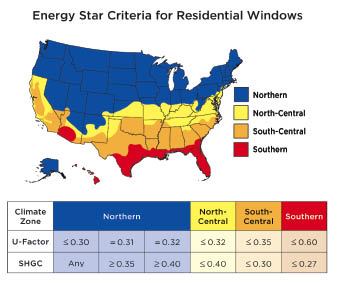
In an effort to keep its Energy Star label relevant, the Department of Energy is tightening Energy Star criteria for windows, doors, and skylights. Beginning in January 2010, these products will need to meet more stringent standards for the rate of heat loss (U-factor) and solar heat gain (solar heat-gain coefficient, or SHGC) to qualify for an Energy Star rating. For example, the maximum U-factor for qualifying windows in the northern climate zone has been lowered from 0.35 to 0.30 (see chart, below). In the southern zone, the extensive current SHGC trade-off menu for windows with different U-factors has been simplified to a one-size-fits-all maximum value of 0.27.
The Department of Energy has simplified the qualification standards for Energy Star windows across its four climate zones. Choices in the northern zone would allow building designers to balance slightly larger U-factors against increased solar heat gain, though it is not clear whether windows with the higher SHGC values will be widely available. New standards for skylights and glazed doors can be found at energystar.gov.
While Energy Star was originally intended to provide above-code guidance for choosing windows and doors, more than 28 states now have energy codes that meet or exceed its existing standards. “Energy Star barely beats the code in many states,” says Richard Karney, the program’s products manager. The new standards are designed to be more stringent than the 2009 version of the International Energy Conservation Code (IECC), the model energy code that states seeking a share of $3.4 billion in energy assistance grants under the federal stimulus package are required to adopt.
Indeed, the overhaul is meant to realign Energy Star criteria with the stimulus package’s tax credit requirements for energy-efficient windows, says Karney. But the Obama administration’s plan actually jettisons Energy Star’s four climate zones and climate-specific standards and instead requires that all windows in all zones have both a U-factor and an SHGC of 0.30 or less to qualify for the 30 percent Section 25C IRS credit. Calling the “30/30” standard “arbitrary,” Window and Door Manufacturers Association president John Stoiber says his organization is lobbying Congress to amend the law to reference the newly released Energy Star standards.
Most manufacturers will be able to meet the new requirements by offering different glass packages with inert gas fills and low-E coatings, according to the DOE. Meanwhile a more robust multiyear study and overhaul of Energy Star standards is also in the works, which the DOE expects to roll out in three or four years. Industry experts believe that those standards will require extensive product re-engineering and predict wider use of triple glazing, especially in northern climates. — Andrew Wormer
Time Running Out on Entran II Settlement
The final chapter in the long-running legal saga surrounding Entran II hydronic hose is drawing to a close. Property owners with radiant heating or snow melting systems containing the defective product have until November 19, 2009, to claim their share of $324 million in settlement funds. At stake are cash payouts of tens of thousands of dollars, or up to 50 percent of the estimated cost of fixing a failed system.
The saga began in 1989, when Heatway, one of the pioneers in the radiant heating industry, contracted with Goodyear Tire & Rubber Co. to begin manufacturing nitrile rubber hydronic heating hose. By 1994, Goodyear had produced about 25 million feet of Entran II — but problems were surfacing. Some of the hose turned brittle and cracked, allowing boiler water to leak into floors, walls, and ceilings.
The failures prompted a number of lawsuits against Heatway, which in turn filed suit against Goodyear claiming that the hose the company manufactured was defective. In its counterclaim, Goodyear said that the problems stemmed from improperly designed, installed, and maintained systems, and could have been avoided with simple annual water testing for acidic pH levels.
Goodyear won that suit in 2000 in a controversial decision that led to the bankruptcy of Heatway and its subsequent sale to Watts. But the victory was short-lived; larger class-action lawsuits filed against Goodyear on behalf of property owners — both residential and commercial, in the U.S. and Canada — were finally settled in 2004 with the establishment of the $324 million fund.
Entran II was used in an estimated 10,000 hydronic radiant and snow-melt systems, though only about 10 percent of those systems were failing as the result of defective hose when the original lawsuits were filed. The settlement applies to all owners of property where Entran II was installed, whether or not the hose failed. Award amounts vary depending on the total number of claims, the size and type of the installation, and the degree of property damage. The owners of a 2,500-square-foot in-slab system with a connection leak, for example, could receive as much as $64,022 under the terms of the settlement.
Reddish-orange in color, Entran II hose has an outside diameter of about 1 inch and is clearly marked “Heatway” or “Heatway Systems.” Other trade names may also be found on the hose, including Twintran, Nytrace, Entran II Trace, Entran II Wire, or Entran 2 (see photo). For more information or to file a claim, current and past property owners with Entran II hose can go to the claims administrator’s Web site at entraniisettlement.com. — Andrew Wormer
Offcuts
An OSHA trainer in New York City has been suspended and faces criminal charges for selling dozens of fake safety-course-completion certificates. Investigators found that the trainer had signed dozens of OSHA 30 cards — which give credit for completing mandatory 30-hour OSHA safety training — and sold them to workers who hadn’t taken the class. He charged $250 a card, half the cost of the course.
Contractors now have their own Angie’s List, where they can post complaints and warn fellow pros about problem clients. Membership on businessbeware.biz costs $5 per year; once registered, contractors can enter names and addresses of deadbeat clients into a searchable database accessible to other members. Libel rules still apply, warns attorney Susan McGreevy, a legal columnist for Contractor magazine, who advises being “very careful about posting information.”
For every eight homes that Habitat for Humanity volunteers in Saginaw, Mich., build or refurbish this year, they’ll tear two old ones down. Habitat is shifting its focus toward deconstruction, salvage, and demolition in midwestern cities like Saginaw, where shrinking populations and foreclosures have resulted in block after block of empty houses. Some chapters are reselling salvaged building materials to help cover the costs of taking down derelict homes.