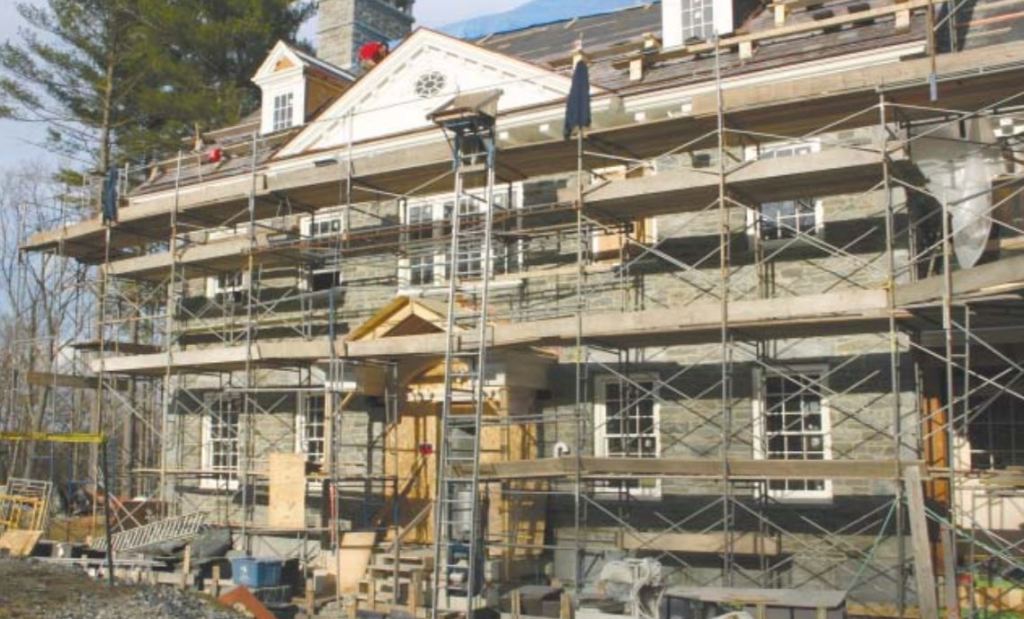
As a masonry contractor, I set up and use fabricated frame scaffolding every day. It’s an integral part of my business. Frame scaffolding — also called “pipe” or “tubular” scaffold because it’s made from welded steel tubing — provides an easily erected elevated work platform with enough area to move freely and sufficient protection to prevent missteps.
But it’s safe only if properly erected and not abused. OSHA tracks scaffold-related fatalities, 23 percent of which are incidents involving frame scaffolding. (Other types of scaffold typically used in residential construction include pump jacks, step- and extension-ladder jacks, roof brackets, and various kinds of aerial lifts. This discussion is limited to frame scaffolding.) The top five hazards are falls, unsafe access, falling objects, electrocution, and collapse.
I don’t believe in accidents. I focus on preventing injuries and property damage by providing proper training and by using tested staging components. We have worked a commercial job in safety and comfort using tubular staging that was more than 330 feet high. Once the staging is properly erected and planked in, it’s like working on a living room floor, and that’s just how I like it.
Safety Training
When it comes to staging, safety and training are of foremost concern. Staging looks simple — and, in fact, it is. But it is absolutely critical to be aware of its limits. The SAIA (Scaffold Access and Industry Association) [Editor’s note: JLC updated the name of the association and website since the original publication of this article.] offers training courses at a number of different levels through its local members. As a member, I’ve picked up reams of good information from SAIA’s newsletter and its regional conferences.
I have a little mantra: “If in doubt, shout.” I often call my local staging supplier with questions. Most suppliers have an engineer on staff or will contact the manufacturer for you. OSHA offers a great publication, too: “A Guide to Scaffold Use in the Construction Industry / OSHA 3150.” (You can download it for free at http://www.osha.gov.)
OSHA safety provisions stipulate that any work performed more than 10 feet above a lower level must be protected by guardrails or a fall-arrest system. Furthermore, employers must provide training for each employee who works on the scaffold. And, finally, a “competent person” must oversee the scaffolding’s erection and dismantling and inspect it for visible defects before each day’s use and following any occurrence of possible damage to any component.
Competency requires training, provided by a qualified person. In this article, it isn’t my intent to replace appropriate training, but to present an overview of some of the methods and equipment we use when working with pipe staging.
Setup
The fundamental key to trouble-free scaffold assembly is to begin with a firm and stable foundation. Always use proprietary steel base plates or adjustable screw jacks on all first frame sets. Screw jacks are particularly useful for leveling the first frame set on an irregular grade — and they are the only leveling system you should use. Never use stacks of wood or concrete block under the legs to level the frame, because wood blocks can slide or topple and concrete block can shatter when loaded.
The base plates or screw jacks should be placed on wood “mudsills” having a minimum 1-square-foot dimension. Typically, we use 18- to 24-inch lengths of 2×10 lumber under each plate. Whenever it’s practical, we shovel the grade level across frame ends to minimize excessive jack adjustments (no more than 12 inches), which can introduce instability.
Once we’ve leveled and squared up the first frame set, we nail the plates to the mudsills. Always use base plates and mudsills, even when setting up staging on a wood deck, concrete slab, or asphalt paving, to prevent the tubes from punching through the surface under a heavy load. And never use scaffold planks for mudsills or vice versa. It’s a good idea to clearly label mudsill planks as such to prevent their misuse.
As scaffold height increases, safety codes require you to physically secure the scaffolding to the building structure vertically at four times the narrowest base dimension. So, for a 5-foot-wide frame, you tie in at the 20-foot height, and at every 20 feet of height thereafter. According to OSHA, these vertical ties have to be repeated at horizontal intervals no greater than 30 feet starting from one end of the staging. Those are minimum specifications; we tie in at a height of 16 feet and at 16-foot intervals thereafter, and at every third frame horizontally.
Ties have to resist movement both in compression and tension, so they have to be rigid — wire alone isn’t suitable, although #9 wire is acceptable for tensioning a tie against the wall. Tie-in brackets come in various types; most clamp on to the staging and are bolted to the building. Naturally, bolt placement is important. On wood walls, we locate solid framing and bolt into that, not just into the sheathing. Masonry walls often require drilling for expansive bolt anchors; in that case, we locate the anchors in the mortar joints and repoint the holes after the scaffolding is removed.
Standard staging frames come in heights ranging from 2 feet to 6 feet 6 inches and measure 5 feet wide. Staggered frame heights are useful for setting up a level base course on steeply sloping grade and for adjusting tower height to overhead work (Figure 3). Narrower frame sections are also available in 4-foot, 3-foot, 30-inch, and 24-inch widths, for staging narrow spaces.
Erecting frames is easiest if you start with the braces on the bottom locks first, then tilt the frames up toward one another and connect the top brace locks. We immediately plumb, level, and square the first frame set, because it makes aligning and stacking successive frames much easier. After we set up a run of starter frames, we stretch a string line from one end to the other at a common attachment point — typically the bottom lock studs — then use the screw jacks to adjust all the frames to the line.
Access and Accessories
Frame ledgers may look like ladders, but they’re intended only for supporting planks and platforms, and should never be used for climbing or scaffold access. True ladders are fine for climbing three or four frames high, or from 20 to 24 feet, provided that the ladder is properly supported and secured, and that it extends at least 3 feet above the upper landing level. If your staging has multiple work levels, you need a dedicated ladder for each level. Access to any working platform higher than 24 inches above the base should be provided by a properly affixed step or ladder.
On multilevel scaffolding, we don’t bother with ladders. Instead, we install prefabricated staging stairs. Stairs are more convenient and efficient than ladders, and they’re safer. They allow you to carry small items in one hand and still grasp a handrail with the other. Stair sections and hand railings are separate components, but one should never be used without the other. Hand railings belong on both sides of every stair and surrounding stair openings at all landing points.
Lifting and loading. When it comes to loading bulk materials onto the work platform, whether block, bricks, siding, or roof shingles, a mechanical lifting system dramatically increases crew safety and efficiency. Portable hoists and platform hoists are great conveniences and are capable of lifting hundreds of pounds at time. But it’s important to remember that each grade of scaffold — light, medium, and heavy-duty — is manufactured with a specific duty rating, calculated at pounds per square foot distributed evenly over the platform. Aerial lifts, forklifts, front-end loaders, and cranes are capable of overloading a platform in a single drop. Always consider the aggregate weight of personnel and materials using the platform and never exceed the maximum safe load.
Planks and Platforms
Planks take a lot of abuse in a staging system, so it only makes sense to choose and treat them with care. Look for planks specifically grade-stamp certified for scaffold use. Common framing lumber doesn’t meet the minimum stress grade required. Large red knots, irregular or short cross-grain, and other unseen defects make framing lumber extremely dangerous to use as staging.