After baking nearly 200 loaves of bread per year, my client was finally ready to retire her 30-year-old range and remodel the kitchen where she spent so much time. Her design goals were modest: She wanted a brighter, more functional workspace with a pantry, a baking station, and an eat-in area — all within the existing footprint and with views to the backyard. And the remodel had to be “green.”
Defining that term — green — can be complicated; here in Minnesota, we’ve been working for several years to develop statewide standards for green construction. But in a relatively straightforward project like this one, meeting a client’s green goals isn’t difficult. In our case it meant choosing appliances with at least an Energy Star rating, reducing the need for artificial lighting, modestly improving the home’s energy efficiency, and using materials that don’t harm the environment.
Floor Plan
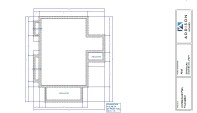
Trying to meet design expectations without adding to a home’s footprint is a basic principle of green building. In this kitchen, we removed a doorway and reconfigured a closet to improve traffic flow and gain workspace; total square footage stayed the same. We also tore out a large radiator and installed in-floor hydronic heating, which gave us room to extend the countertop and create “flex space” — an eat-in area that doubles as a work surface.
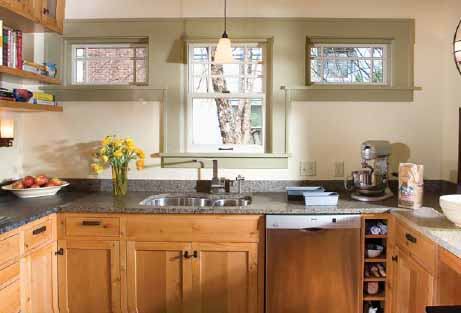
To bring in more natural light, we added a pair of windows to the kitchen’s north wall. We also replaced the existing double window overlooking the backyard with a slightly shorter insert that accommodated the flex space’s full-height countertop. As a rule we avoid any kind of vinyl product; here we chose Pella Architect Series metal-clad wood windows, which offer a good combination of looks, durability, and thermal performance. Though not triple-glazed (our preference), the double-glazed units were a significant upgrade over the home’s single-glazed originals.
Instead of tossing demolition waste in a dumpster, we reuse as much building material as we can and recycle the rest. On this project, we trimmed the new windows with material salvaged from the existing kitchen and sent the old cabinets to a local re-use center.
Improving a home’s energy efficiency is always one of our goals, whatever the project. When it makes sense, we’ll upgrade the insulation to cellulose or spray foam. Doing so for this modest remodel, however, wouldn’t have been practical, so we kept the existing fiberglass batts and carefully air-sealed the exterior wall with spray foam.
Ventilation and Lighting
Because we were concerned about backdrafting, we convinced our client to install a small, 300-cfm venting microwave rather than a high-cfm range hood. Removing cooking-produced moisture and combustion gases is important — but a 600- or 900-cfm hood sucks up way too much of a home’s conditioned air.
We refuse to install recessed can lights; in fact, we remove them from homes whenever we can. Here we used separately switched CFL (compact fluorescent) sconces and pendants for task lighting, and chose an overhead chandelier with mini-incandescent lamps controlled by a dimmer switch for general overhead lighting.
Finishes and Trim
Whenever possible, we source materials locally and avoid excessive packaging. We had this kitchen’s cabinets built at a cabinet shop located less than 15 miles from our office. The cabinet boxes were made from a prefinished maple plywood with no added formaldehyde, while the frames, doors, and drawers were built with alder, a fast-growing wood that looks like cherry.
We used low-VOC stains and finishes from Sherwin-Williams on the cabinetry, and Benjamin Moore’s Aura (a low-VOC paint) on the walls, ceiling, and trim. Exposure to VOCs — which are found in most sealers and paints, as well as in adhesives and caulks — can lead to health problems like asthma and cancer. The long-term impact of these compounds on the environment is a big concern, too — VOCs are essentially smog. Low-VOC finishes usually cost the same as traditional materials; using them is an easy way to remodel green.
We like to work with prefinished flooring because the coating process takes place in a controlled environment with appropriate measures in place for pollution control; no VOCs are added to the home. Moreover, a factory-applied finish is much more durable than a site-applied water- or oil-based polyurethane.
For this floor we used a hybrid wood called Lyptus. A rapidly renewable resource (it grows to maturity in around 12 years), Lyptus is straight, dense, and easy to work with. At the time of installation, we liked it a lot and were using it on several projects. Recently, though, we decided to install only imported woods with a full FSC (Forest Stewardship Council) chain of custody certification (www.fsc.org). Unfortunately, Weyerhaeuser — the company that co-produces Lyptus — has tried and failed to certify it, prompting us to discontinue our use of it. Sorting through the hype to find materials or systems that are indeed what they claim to be is one of the most challenging parts of the green building process.
All of the kitchen’s countertops are made from honed remnant granite — partial slabs or drops left over after the fabrication of larger projects. We work with local fabricators to keep these pieces out of their dumpsters and incorporate them into our projects.
Cost
Did it cost any more to apply green building principles to this kitchen renovation? Probably not. We’ve found that what really drives up costs are material upgrades that have some green qualities but are mostly about cosmetic appeal — bamboo flooring, recycled glass, and the like. System and efficiency upgrades, by contrast, typically add only 2 percent to 7 percent to the upfront cost of a project yet offer long-term energy savings and a reasonable payback.
The cost to the client for this project was about $540 per square foot, not including appliances.
Michael Anschel is a remodeler in Minneapolis.