Download PDF version (852.8k) Log In or Register to view the full article as a PDF document.

Image

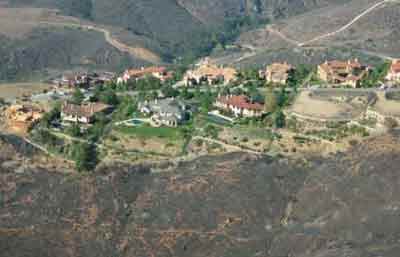
When last October's out-of-control wildfires pushed toward The Bridges, a Lennar Homes luxury development in Rancho Santa Fe, Calif., Lennar manager Key Ayers stayed put. After sending 140 employees home and seeing the community's well-heeled residents safely off, Ayers (who is also president of The Bridges' homeowners association) manned a water truck in the deserted neighborhood. For several hours, he and a handful of workers hosed down the occasional flaming bush or patch of windblown embers.

"I'm not going to tell you it was pleasant, because it wasn't," says Ayers. "The fire was 200 yards away, and it was hot and smoky. But we had good firebreaks [including the community's golf course], and the fire department was here too. And it worked out." When the flames had passed, not one of the development's multimillion-dollar houses had burned. Strict rules governing home siting, construction materials, landscape plantings, and brush clearing had done their job.

The fire district of Rancho Santa Fe lost 61 houses in the fire, and the rest of San Diego County lost hundreds more. But in the five Rancho Santa Fe developments designated "shelter-in-place" communities — including The Bridges — only one house suffered any damage. (In that case, a piece of pegboard leaning against a door caught fire and burned through the door into the garage — but sprinklers in the garage put the fire out in minutes.)

Rancho Santa Fe fire marshal Cliff Hunter says October's events were a true test of the fire-resistant concepts his district has begun to apply. The five successful developments faced the same onrushing wildfire as other areas of town where the destruction was much worse. But because homes were set back from slopes, and vegetative fuel near buildings had been thinned or removed; and because there were no vulnerable vents, windows, or lightly framed wood decks where embers could collect and ignite, fires raging up canyon slopes stopped cold at the edges of all five neighborhoods. According to a press report, a firefighter responded to thanks from residents of one community by saying, "We didn't really do anything."

Emphasis on Prevention

That anecdote contrasts sharply with the typical firefighter experience in runaway "conflagration" fires. More commonly, exhausted firefighters find themselves frustrated literally to tears by their inability to make even a dent in the raging fire as house after house is lost and crews are forced to retreat from unsafe — even deadly — conditions.

Reluctantly, the state's firefighting community has been forced to accept the reality that it will never have enough engines and crews to protect the increasing number of homes being constructed in rugged terrain subject to extreme, wind-driven wildfires. This realization has lead to greater emphasis on prevention. The California Department of Forestry and Fire Protection ("Cal Fire" for short) has resolved to build on the success of tough codes adopted at the municipal level in places like San Diego County. Although traditional efforts to fight the fires on the ground will continue, officials have adopted the toughest statewide code in the nation for ignition-resistant construction and landscaping in the "wildland urban interface" — or WUI — where so many houses have been lost over the years.

A new subchapter, Chapter 7A, in California's Title 24 ( the statewide building code) spells out strict requirements for ignition-resistant roof, wall, and deck construction in areas where wildfires are known to be likely. And rules for landscaping and site maintenance — already part of the state's fire code — have gotten tougher: Instead of a 30-foot brush-clearing requirement around homes, state law now calls for a 100-foot safety zone of "fuel modification."

Hazard zones. California is creating detailed new maps to go along with the new regs; they define the wildfire danger, dividing the whole state into zones officially labeled as having "moderate," "high," or "very high" wildfire hazard. (There is no "low" severity zone in California, says University of California, Berkeley, scientist Stephen Quarles: Aside from parts of the inner city and a few heavily managed agricultural areas, the whole state is at risk.)

As of January 1 of this year, the new Chapter 7A already applies to all three hazard severity zones throughout the State Responsibility Area, where Cal Fire has jurisdiction. Starting in June, authorities in the Local Responsibility Area, where municipal fire authorities have jurisdiction, must begin to enforce Chapter 7A, too — but only in the "very high" severity zone.

Some localities, including San Diego County, have already implemented rules as tough as — or even tougher than — the ones in Chapter 7A. Rancho Santa Fe's shelter-in-place neighborhoods may be a special case: The high-end developments, built in what Forbes magazine rates as the wealthiest zip code in America, have ample budgets to pay for the best in landscape maintenance and building details, and Cliff Hunter's office has the expert manpower to stay on the case with annual site surveys, intensive enforcement, and proactive education.

Cost of compliance. But building official Clay Westling, senior structural engineer for the San Diego County Department of Planning and Land Use, who has jurisdiction over Rancho Santa Fe as well as other, much less prosperous rural areas, says that it doesn't necessarily take a fat wallet to comply with his department's strict building rules.

"We have mobile homes in our county that comply," he notes. "If you take a simple, 1,000-square-foot slab-on-grade house, what do they need? It's not much. They need an ignition-resistant siding, such as fiber-cement board or stucco. They need a Class A roof: Asphalt composition shingles will qualify. They need dual-pane windows with tempered glazing; that adds maybe a thousand dollars. They need ignition-resistant soffit and eave materials, and they need to locate their vents on top of the roof instead of in the soffit. Overall it might come to $5,000. I don't think that's prohibitive."

The Ignition-Resistant House

Under contract to the state fire marshal, Stephen Quarles is now taking on the challenge of teaching interested parties the details of California's new statewide rules. In the last year, he has presented his comprehensive class more than 45 times to rooms filled with "everyone this code touches," he says, including "manufacturers, distributors, fire officials, building officials, contractors, architects, and designers."

For the benefit of builders, whose main responsibility is the structure, I asked Quarles in February to walk me through Chapter 7A's requirements for new homes and compare them with the additional measures required by Rancho Santa Fe's stricter rules. Here's what I learned.

Roofs

In "very high" hazard severity zones, Chapter 7A requires a Class A roof. For "high" severity zones, builders can use Class B roofing, and in "moderate" zones, Class C. All these classes are defined elsewhere in the building code — the ratings depend on national standardized fire testing protocols — but in any case, Quarles points out, most builders already apply Class A roofs on houses throughout the state (as do most builders nationwide). "Class A roofs are the popular types," he says, "asphalt composition shingles, cement tile, and clay tile. All those either are noncombustible or else they pass the Class A test."

A few roof coverings — including, surprisingly, many metal roofing products — require additional fire-resistant underlayment or cementitious sheathing to achieve a Class A rating for the assembly. But fiberglass asphalt shingles, clay tile, and cement tile create a Class A roof system when applied over ordinary plywood and felt paper.

Roof valleys require special attention under Chapter 7A. Metal valley flashing has to be underlain with "cap sheet" (fiberglass-asphalt roll roofing) because flaming brands and embers can melt through sheet aluminum and ignite the roof sheathing and framing. Woven shingle valleys, however, don't require the underlayment.

Some roofing types (clay barrel tiles, for example) leave space between the roof covering and the roof sheathing — gaps that allow birds to enter and build nests, or windblown debris to accumulate (see Figure 1). "These fine fuels are readily ignitable by embers that can blow up under there," says Quarles, "which will support flaming fire that can then ignite sheathing and roof framing."

Image

Image

Figure 1. Clay barrel-tile roofs are noncombustible and meet California's toughest standards. However, gaps under the tiles must be sealed to prevent debris accumulation and ember intrusion. Cement (top) and manufactured "bird stops" (bottom) are acceptable solutions.

So the gaps must be plugged, typically with manufactured "bird stops," but other materials — such as cement — are permissible with local approval. Cliff Hunter says cement is fine by him, and so are some types of metal mesh, though he recently denied a builder permission to use fine steel wool as a bird stop; exposed to flame and heat, the material can actually burn.

Attic Vents

Chapter 7A requires all exterior vents on the house — whether on a wall, a foundation, or a roof — to be screened with 1/4-inch wire mesh to protect against ember intrusion. But eaves and soffits are not allowed to have vents at all, unless the vents have been demonstrated to actually resist the intrusion of both flame and ember. "And that's the hook," says Quarles. "We don't have a standard accepted method to evaluate the performance of vents to resist flame and ember."

In addition to his other duties, Quarles serves as chair of an American Society for Testing and Materials (ASTM) committee that is working on devising such a test, but the group meets only twice a year. "The test isn't there yet," says Quarles. The committee has designed and built a testing apparatus, he says, and at least three manufacturers have come up with vent designs intended to resist flame and ember, and have put their prototypes through the provisional test. "So they all have data," says Quarles, "and they are walking their data around to local building departments looking for one-off approvals."

Local officials don't have to accept any vents, however — they're free to have requirements that are tougher than the state code. In San Diego County, for instance, it's a flat rule: No vents in the soffit. Because other parts of the code still require attic venting for moisture management, builders often install flat roof-mounted vents, commonly termed O'Hagan vents after one popular manufacturer's brand name (Figure 2).

Image

Image

Image

Figure 2. With soffit vents prohibited, builders adapt by installing flat-mounted rooftop vents. Models are available to blend in with synthetic slate (top) or clay tile (middle). Vents must still be screened with wire mesh, as shown here viewed from below the roof sheathing (bottom).

The whole roof venting problem "leads other places," says Steve Quarles. "Do we really need to have ventilated attics? I think this is maybe going to push the unvented roof a little faster in California. There are definitely unvented attic designs out there that have been proven, especially for certain climates."

Eaves and Soffits

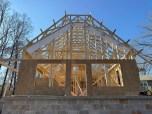
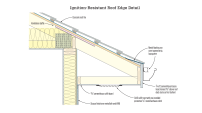
Besides restricting vents, Chapter 7A requires the eaves themselves to resist ignition (Figure 3).

Image
Image

Image

Figure 3. The photo top left shows an eave with wire reinforcement in place, ready for stucco application. The completed eave (top right) presents the appearance of solid masonry. Bottom, metal clips connect the wood structural panel sheathing to the blocking between rafters, a required seismic detail in Southern California.

There are several ways to comply, says Quarles: "You can use noncombustible material there — wrap the stucco around it, or apply a fiber-cement product such as HardieSoffit or CertainTeed WeatherBoard soffit. You can use fire-retardant-treated wood products that have met the definition for ignition-resistant material [by passing the flame tunnel test in ASTM E84], or you can pass the California state fire marshal's flame-impingement penetration test, SFM 12-7A-3." (For links to California's new wildland urban interface code and fire-marshal testing standards, visit www.jlconline.com/wildfire.)

San Diego County outlawed soffit vents years ago and provides explicit guidance for builders: Both the county building department's Web site and the Rancho Santa Fe fire prevention district's Web site supply online drawings of examples of approved soffit construction for "high" and "very high" wildfire severity zones (Figure 4).

Image

Image

Figure 4. San Diego County offers guidance on unvented, ignition-resistant eave details at the county planning department Web site ( www.co.san-diego.ca.us/dplu/bldgforms/index.html). One solution (top) uses noncombustible stucco as a fireproof backer for a foam crown-molding detail. Another (bottom) uses heavy-timber rafter-tail extensions to support solid 2-by roof decking at the roof edge. In the completed assembly, stucco must cover the wall surface up to the roof deck, between the rafter tails, as well as the rest of the wall.

Gutters

"Chapter 7A says that gutters shall prevent the accumulation of debris," says Quarles, "and it is silent otherwise." Gutter material isn't specified — builders can use either metal or vinyl. In practice, the rule leaves it up to local officials to approve specific gutter guards, screens, or other measures to keep litter out — with little to guide them in the task.

Quarles himself can't shed much light, noting, "If you go to their Web site, every gutter screen manufacturer, without exception, will tell you, ‘We are the best one ever.'"

In fact, there are probably differences, he says, but there is no state or national test to verify the screens' effectiveness — and anyway, all manufacturers admit that routine maintenance is still required to keep gutters clean. The "clean gutter" requirement may end up being more a homeowner responsibility than a builder issue, at least until someone comes up with a workable test for gutter screen systems.

Cliff Hunter says that in his experience vinyl gutters tend to melt and fall off when litter stuck in them catches fire — a possible advantage, since it removes the fire exposure to the roof edge.

Quarles agrees: "A vinyl gutter is going to fall to the ground pretty quickly; we've done tests, and we know this. And when that happens, how big a problem it is depends on the siding and the combustible material near the house. Metal gutters stay attached and expose your roof edge to fire, and everything then depends on your roof edge detailing. So it can be a risk either way, and it all comes back to debris in the gutter. That's why the language says just keep the debris out."

Walls

As with eaves, wall assemblies can satisfy Chapter 7A in multiple ways. Noncombustible claddings like stucco and fiber-cement are allowed; so is fire-retardant wood siding, if it can pass the ASTM E84 test (in a weathered condition, not just when brand new). Heavy timber and log construction also comply, by definition: "Just by being a log, you comply with this code," says Quarles.

But combustible materials — even wood clapboards and shingles — can also comply, at least in theory, he explains, if they can manage to pass the California fire marshal test for wall assemblies: "They're allowed to use underlying sheathing or other things to pass, and they do that by having their product tested at a commercial lab that is accredited by the fire marshal's office in the state of California."

Windows

One of California's new ignition-resistance tests is specifically designed to test windows; any that pass the test are allowed. But the alternative path is easier: Any window that is double-glazed — with at least one layer of the glazing (either inside or outside) being tempered glass — complies. "You can have any type of frame material you want," says Quarles. "It's all about the glass." (In practice, says Cal Fire chief of fire-prevention engineering Ernylee Chamlee, manufacturers have chosen to make both glazing layers with tempered glass: "They say it's just easier to do it that way.")

There are other ways to comply as well, Quarles notes. "You can use glass block. Or, you can use a window that passes the 20-minute test in ASTM standard E119, the vertical-furnace test that they use for fire-rated wall assemblies."

Of the four compliance methods, California's new test is clearly the toughest, according to Quarles; plenty of dual-glazed tempered window units have failed it. So far, in fact, no manufacturers have stepped up to make windows that can pass the California test — simply substituting tempered glazing in their existing models is far easier. That's okay, says Quarles, since the tempered glazing is a major upgrade, with proven benefits.

Even ordinary dual glazing — required by recent upgrades to California's energy codes — is much more resistant to wildfire than single glazing. In October, says Cliff Hunter, "we had 61 homes burned, and 57 of them had single-pane windows. That tells the story right there."

It's typical for fire investigators to find windows in which the outer pane has cracked or even fallen out but the inner pane is intact, keeping embers from entering the house and igniting it from the inside. And tests confirm that tempered glazing is much tougher even than regular glass: USDA Forest Service researcher Jack Cohen, for instance, has found that it takes more heat to fracture a tempered-glass windowpane than to ignite a wood wall.

Decks

When built using typical methods, wood decks are a critical vulnerability for houses exposed to wildfire. Wind tends to drop hot embers at the joint where the deck meets the house wall and ignite first the decking, then the siding (Figure 5). Chapter 7A requires most decking boards to pass the fire marshal's new test; redwood passes handily, and so do other woods, as well as some newly reformulated synthetic lumber products.

Image

Figure 5. Combustible deck structures are a critical vulnerability in wildfire country. Here, windblown embers collected at the intersection of a wood deck and wall during October's fire, igniting the house exterior.

There are other ways to comply: Deck surfaces can be a noncombustible material such as lightweight concrete or flagstone, or they can be fire-retardant-treated wood that passes the ASTM test for ignition resistance.

Here again, Rancho Santa Fe and San Diego County have tougher restrictions: They regulate not just the deck boards on the walking surface, but also the rest of the deck structure (Figure 6). In San Diego County, deck supports and structures have to be of heavy timber, fire-retardant wood, noncombustible material, or one-hour fire-rated construction; otherwise, the underdeck area has to be completely skirted from deck to ground with noncombustible material.

Image
Image

Image

Figure 6. This Ranch Santa Fe deck (top left) complies with ignition-resistant requirements because of its heavy timber framing, nominal 2x6 planking, and metal support posts and railing system. The deck at top right, stuccoed on the underside and topped with a proprietary noncombustible polymer waterproofing, also meets the code. Another view of that deck (bottom) shows the blackened hillside and recent green growth where the October fire swept around two sides of the house, leaving the structure undamaged.

Landscaping Issues

Tougher building details alone, however, don't explain the exceptional performance of Rancho Santa Fe's "shelter in place" neighborhoods. The siting and landscaping rules in those communities made a crucial difference — and homeowners and communities who want to push beyond basic California code requirements would be wise to focus as much on the underbrush and landscaping as on hardening their buildings.

Marrying up the concepts of wildland "vegetation management" and ignition-resistant landscaping with the techniques of ignition-resistant house construction is the key to success, says Quarles: "What Chapter 7A does — and what Rancho Santa Fe's shelter-in-place concept does in spades — is make a link between the vegetation modification around your home and the materials used to build your home and the survivability of your house. There is a direct link. You cannot address just the vegetation issue or just the building materials issue. You have to do them both in order to have a home that is survivable."

Ted Cushmanwrites about construction from his home in Great Barrington, Mass.