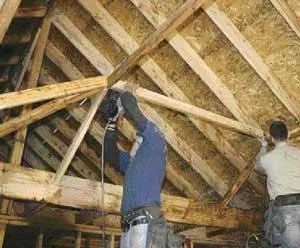
One of my favorite parts of framing a house is doing the interior-detail pickup framing — elements like arches, barrel vaults, and coffered ceilings. In this article, I’ll show a simple method for framing a hipped tray ceiling — a ceiling that looks like the underside of a hip roof except that it’s flat on top.
There’s nothing unusual about this shape, but we’ve gotten the process down to the point where we can lay it out quickly and hand most of the work off to the less experienced carpenters on the crew.
Ceiling as Roof
To help newer framers visualize the ceiling, we use roof-framing terminology to describe the pieces. The members running up from the sides of the opening are called “commons” and the ones in the corners are “hips.” These “rafters” butt against a lower rim board at the inside face of the soffit and angle up to meet the flat surface at the top of the tray. The flat area is bound by horizontal rim boards that catch the upper ends of the rafters and the tray ceiling joists that span from rim to rim.
The trays we build are small enough that all the framing members except the soffit rim can be made from 2x4s. The soffit rim should be at least as tall as the room’s ceiling joists; we often make it from 2x12s.
Sizing rule of thumb. These ceilings typically go in master bedrooms. In rooms of that size, it generally looks good if the commons are about 3 feet long. They could be longer or shorter, but we’ve found that regardless of the pitch, 3 feet is dramatic enough without overpowering the room. It’s also a nice round number to work with.
We also have to determine what slope to use for the sides of the tray. On upper floors, we try to match the pitch of the roof so that the tray rafters near outside walls won’t hit the roof rafters or come so close it’s hard to insulate.
Framing Calculations
We calculate our cuts and layout based on the 3-foot common-rafter length. The length of our tray rafters corresponds to the line length of a roof rafter — the distance between the head cut at the top and a line projected up from the plumb cut at the birdsmouth. Because the tray rafters butt to rim boards top and bottom, they don’t need birdsmouths; instead, they have plumb cuts at both ends.
The photographs in this story come from a house with an 8/12 pitch roof, so that’s the pitch we used for the tray ceiling. We knew the rafters would be 3 feet long, so the only thing we had to calculate was the length of a hip and the run of a common. The easiest way to do these calculations is with a Construction Master. I use a Construction Master Pro Trig Plus III set to round to the nearest 16th inch.
The Geometry of a Hipped Tray Ceiling
After entering the pitch (8) and the length of the common (3 feet), the calculator gives us the length of the hip (3 feet 1013/16 inches) and the run of a common (2 feet 515/16 inches). We write both numbers down and put the calculator away; that’s it for the math.
Everything else from here on out is a matter of measuring, marking, cutting, and installing.
Rise doesn’t matter. If we were framing a roof, we’d want to know the rise of the commons to know how high above the plates to support the ridge while we installed rafters. But with a tray ceiling, the rise matters only if you’re installing it in a dropped ceiling and need to fit it beneath the joists.
The ceiling shown here bumped into a large attic space, so we didn’t have to worry about its height.
Laying Out Commons
To lay out the commons, we draw a pair of lines 3 feet apart and square across the edge of a 2×4. We then use the Speed Square to mark the two parallel lines, 3 feet apart on the 2×4’s face, representing the plumb cuts at each end. We saw through the 2×4 at both lines and use this first common as a pattern to mark the others.
To save time, we stack the material for the commons, trace the plumb cuts onto the top piece, and make the cuts with a saw set deep enough to score the cut on the piece below.
We lay out the hips the same way, again with the Speed Square, but using the hip-valley scale this time.
Bevel cuts. The ends of each hip get beveled with a saw set to 45 degrees so that the top will fit between the king commons and the bottom will fit the inside corner of the opening. Using the Speed Square, we mark the hip plumb cut at one end of the hip, then make a second line parallel to the first and 11/2 inches — the thickness of the stock — away. (If the stock were 13/4 inches thick, the second line would be 13/4 inches away.)
We use these lines to guide the saw through the two bevel cuts that will produce the desired 90-degree point. With the saw set to a 45-degree bevel, we cut through the 2×4 at the line closest to the end of the board. Then, without flipping the board, we cut along the inner line (that’s 11/2 inches away), bringing the saw in from the other edge.
The two cuts cross at the center of the stock and give us the diamond-shaped point we’re looking for.
Getting the length right. We complete the hip by making a mirror image of this cut at the other end of the stock. The finished piece should be 3 feet 1013/16 inches point to point, so we measure this distance down the edge from the diamond cut we already made.
We make a mark, then use the Speed Square to draw an 8/12 plumb cut at the mark with the hip-valley scale. This new line represents the long point of the diamond cut we want to make.
Next we draw a second and third line parallel to the first and 3/4 inch to either side of it. The first line is now centered between parallel lines that are 11/2 inches apart. Our first 45-degree bevel cut is along the outer line with the blade angled back in. Our second bevel cut is along the inner line with the blade angled out. The cuts will cross to form a point at the center line, 3 feet 1013/16 inches from the cut at the other end.
The tray has four hips, so we cut three more that are exactly the same as the first. The number of commons will vary with the size of the opening, but they all must be accurately cut because the way we install them leaves no room to fudge.
Soffit Framing
While a more experienced carpenter is calculating and cutting the hips and commons, I’ll have two less-experienced carpenters frame the soffit around the opening in the ceiling. We typically bring the soffit in 24 inches from the edge of the room. We usually know in advance that we’re going to install a tray ceiling, so when we roll the joists we use pieces that run partway into the opening and stop. (We use bearing ridges on most of the houses we build, so it doesn’t matter that the joists don’t reach from plate to plate.)
If we’re framing a 24-inch soffit and using a single rim board, we snap a line across the joists 221/2 inches in from the wall and trim the joists back to that line, making sure the cuts are plumb.
Lower rim board. Although the joists are usually 2x8s, we use 2x12s for the rim because the added height allows us to install rafters several inches up from the bottom of the opening. This leaves a vertical surface below the slope large enough to install a crown with cove lighting.
If we chose to, we could make the rim the same height as the joists and install the rafters flush to the ceiling.
We start by cutting rims and nailing them (crown side up) onto the ends of the joists. We then install a second pair of rim boards perpendicular to the first, 24 inches out from the walls at the ends of the opening.
We check to make sure the entire opening is plumb, square, and straight. If it’s not, the precut hips and commons won’t fit properly and it will show in the finished ceiling.
Installing the Tray Ceiling
With the soffit framed and the hips and commons cut, it’s time to install the rafters. But first we have to mark their layout. We like to install rafters 5 to 7 inches up from the bottom of the opening, so we snap a line at the right height on all four sides.
The hips land at the inside corners and the commons are spaced 24 inches on-center along the rims. But the commons on either side of each hip (the king commons) have to be a specific distance out from the corner, equal to the run of a common — in this case, 2 feet 515/16 inches. This ensures that the hip and king commons converge at the same point.
King commons and hips. Unlike roof rafters, which need immediate support at the ridge, tray ceiling rafters can be installed by toenailing them to the lower rim. They’re so short and light that toenails will hold them until we get around to installing the upper rim.
Again, this is why we didn’t bother to calculate the rise of the commons: If our cuts are accurate and we nail the hips and king commons tight to the rim, all the rafters automatically top out at the same elevation.
We measure out from the corners of the rim and nail the king commons in place. Next, we toenail the hips in the corners. The hips and king commons will converge, and we nail them all together where they meet. (Be careful when positioning these pieces for nailing: If you hold on at the wrong spot, you could easily shoot a nail into your hand.)
Upper rims. Once all the hips are nailed to the king commons, it’s time to install the upper rim pieces. There’s no need to calculate their lengths; all we have to do is measure from corner to corner where the hips and king commons meet. We cut the pieces from 2x4s and nail them at the corners.
At this point, the upper rim goes all the way around the opening and is supported at the proper height. Next we install the commons 24 inches on-center between the king commons.
Commons and joists. The only framing left is to install 2×4 ceiling joists between the upper rims. Once more, we install these pieces 24 inches on-center. If there’s going to be a light or fan in the tray, we avoid running a joist across the center. There’s no need to install hip jacks because the drywall will be able to span from hip to king common without any added support.
Cost to Frame
A while back I timed how long it took me to frame a tray ceiling by myself. It took about two hours, but I was going all out. If I do the math and make a pattern for the hips and commons, the less experienced guys on our crew can frame a tray ceiling in about three man-hours.
Compared with the value that a tray ceiling adds to a new home, the material cost to frame one is almost negligible. The only things we have to go out of our way to get are the long 2x12s used for the lower rim. None of the 2x4s are very long, so we can usually get them from scrap.
Tim Uhler is a lead framer and exterior trim carpenter for Pioneer Builders in Port Orchard, Wash.