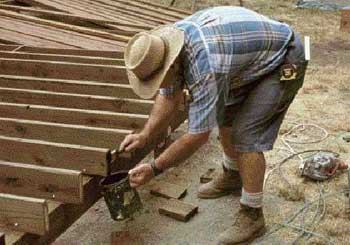
Millions of wood decks are built every year. Unfortunately, many of them will deteriorate long before they should. As a deck builder in the Pacific Northwest, I have a lot of experience demolishing and replacing rotted decks. I want what I build to last, so when I tear down a rotting deck, I try to figure out what went wrong.
Know Your Enemy
Rot is a fungus, an organism that feeds on and destroys natural materials like lumber. The spores it uses to reproduce are nearly everywhere and will grow wherever conditions are right. There are many different types of rot, but they all require food and moisture to survive. If you understand how these organisms grow, you can build decks that are less hospitable to them.
Food source. Most decks — particularly the structural framing — are made from woods that are susceptible to rot. Because the companies that treat lumber use local materials, the wood you use depends on where you work. From Denver east, builders use pressure-treated southern pine, a kind of wood easily penetrated by chemical preservatives. On the West Coast, we use pressure-treated hem-fir, a species group that does not accept chemicals very well. Frequently, only the outer surface contains preservatives, so the interior of the lumber is unprotected and susceptible to rot.
Moisture. Wood won’t deteriorate unless moisture is present. Green lumber often contains enough moisture to rot, but even materials that start out dry can become wet when they’re exposed to the weather, washed, or used as a surface for potted plants.
Some kinds of rot fungi, the wet rots, require a wood moisture content of 30 percent or more to survive. Many types of rot will do just fine as long as the wood has a moisture content of at least 20 percent, a threshold easily reached in damp climates like ours.
People often speak of “dry rot,” but if lumber is dry, it will not decay. So-called dry rot fungi are a specific type of brown rot that sends out hyphae, strands of tissue that can transport moisture from surrounding wood. But this can’t happen unless the surrounding wood is wet. If you can keep a deck below 20 percent moisture content, it won’t rot.
Collection Zones
A typical deck harbors hundreds of places where organic matter can collect and sit. I call them collection zones. Every time it rains or the wind blows, leaf litter — leaves, needles, twigs, dirt, dust, and grass clippings — finds its way into the gaps and cracks in the deck. The collected material holds moisture, so that a deck full of collection zones mimics the natural habitat of fungus — wet fallen wood on a forest floor.
A collection zone can be very small. For example, when a baluster is nailed to the face of a rim joist, the area where the two pieces meet is a collection zone. Poor deck design and building practices increase the size and number of these zones. Once the collected material becomes wet, rot will attack any unpreserved wood in the area.
The best way to prevent this is by limiting the size and number of the collection zones. If you prevent moisture and debris from getting into places they can’t get out of, you reduce the potential for rot.
Fascia detail. Some common building practices create perfect collection zones. For example, many carpenters rim the deck with a fascia board. There is usually no airflow between the fascia and the framing, so the 20 percent moisture content required for rot can be maintained over long periods of time. Water takes debris down between the fascia and the rim joist. Once organic matter gets into this collection zone, there is no way to get it out.
It’s best not to use a fascia at all, but if one is required, cantilever the deck boards one inch over it. This detail greatly decreases the likelihood of rot because it reduces the size of the areas that dirt and moisture can get into. One way to compare construction details is by looking at how many linear feet of collection zone each design creates.
Built-up beams. It’s common practice to double or triple up 2-by material to form beams. Unfortunately, the space between the pieces is a perfect collection zone. It’s better to carry loads with solid 4-by or 6-by beams.