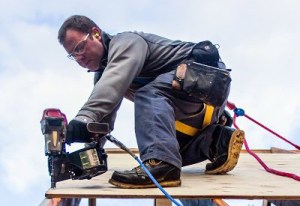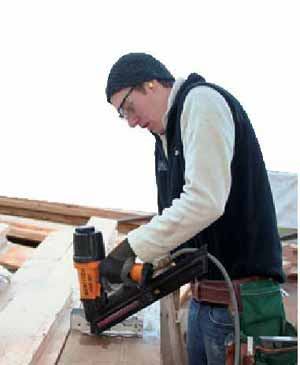
One of my first jobs as a part-time framer working after school was nailing off joist hangers. It wasn’t much fun; the work took forever and I was always smashing my fingers. Now we have nail guns to perform this task — which is fortunate, because we use a lot of framing hardware and fastening it all by hand would be a huge waste of labor.
Our crew has been using hardware guns for several years. Although we’ve tried some of the multi-blow models — which work like palm nailers — we much prefer the traditional single-blow guns because they’re faster.
For this article we tested six single-blow hardware nailers: Bostitch’s MCN150 and MCN250, Grex’s PPN65, Hitachi’s NR65AK and NR65AK(S), and Paslode’s F250S-PP. Here’s what we found out.
Locating Fasteners
Paslode pioneered this application with its Positive Placement tool, which uses a hardened metal probe to align the nail with the hole in the hardware. The other guns we tested allow the user to place the tip of the nail itself in the hanger before shooting (see Figure 1). I prefer the latter method; when your view is obstructed, it’s easier to feel your way into the hole with a nail than with a probe.
It’s important to use the correct size and type of nails for the hardware being fastened. Every gun tested except one drives 1 1/2-inch nails of up to .148 inch in diameter and 2 1/2-inch nails of up to .162 inch in diameter. Bostitch’s MCN150 drives only the 1 1/2-inch nails.
Weight and Size
Since I frame with a coil gun, you might think I wouldn’t care how much a hardware nailer weighs. But it’s one thing to use a heavy gun while holding it below the waist — which is how most framing is done — and another to use it for work overhead. Many of the joist hangers we nail off are up high and require repetitive nailing, which can get exhausting.
At 8.7 pounds, Paslode’s nailer is heavier than many framing guns. The rest of the tools we tested are close to 6 pounds, except Bostitch’s MCN150; at 4.6 pounds, this tool is so light it’s neither difficult nor tiring to use overhead.
Hardware nailers vary a lot in size (Figure 2). The Paslode model has roughly the same dimensions as a framing gun. Bostitch’s MCN250 and Hitachi’s NR65AK are almost as tall as the Paslode but narrower and a couple of inches shorter in length. The rest of the guns are noticeably smaller, in part because they have short magazines.
All of these guns will fit sideways in 16-inch on-center joist bays. But the ones that are shorter in height are easier to maneuver within the bay and elsewhere. The same goes for guns that are shorter in length. A long magazine is more likely than a short one to get in the way and force you to change position.
Power
The Paslode is more powerful than the other guns we tested; in fact, if the compressor is set too high it can overdrive the nails. This isn’t a problem unless it badly dents the hanger.
The Hitachis, too, will dent hangers if the compressor is set too high. The Grex and the Bostitch MCN250 seem to have slightly less power (at a given compressor setting) than the Hitachis, but enough to fully drive nails in sawn lumber. On occasion, all of the guns leave heads proud in LVLs, a problem easily fixed with a hammer blow. On my sites, where we did the testing, this issue was less a reflection of the nailers’ power than it was a result of the compressor’s inability to keep up with all the guns connected to it.
Features
Hardware nailers are designed for specialized use, so they’re relatively light on features. None of these guns will fire when empty, which is good because you wouldn’t want to accidentally miss any fasteners. They all have sequential trip triggers — a must for this kind of gun because double-firing greatly increases the likelihood of nails bouncing back and hitting the operator. As it is, missing the hole in heavy-gauge hardware can cause a recoil that sends the gun flying back. I’ve been hit in the head and the shins.
Every one of these guns has a comfortable padded grip, but only two have hooks: The Bostitch MCN250 has a swiveling rafter hook large enough to fit over lumber joists and rafters and 1 3/4-inch LVLs, and the Grex has a belt hook that lets you hang the gun from your tool bags — not as useful as a rafter hook, but much better than no hook at all.
Although an adjustable exhaust port is not important on a framing gun, it is helpful on a hardware nailer. If you’re nailing in tight quarters — joist bays, for example — you don’t want dust blowing into the cavity and then back at you. Every gun we reviewed has an adjustable exhaust port, so it won’t be the tool’s fault if dust gets in your eyes.
Bostitch MCN150
Because it takes only 1 1/2-inch nails, the MCN150 is considerably smaller and lighter than the others (which, as mentioned, shoot 2 1/2-inch fasteners as well). At just 4.6 pounds, it’s more than a pound lighter than the next lightest gun; at 10 1/2 inches high, it will fit between 12-inch on-center joists.
As with most hardware guns, you align the nail by placing its tip in the hole in the hardware. My one complaint about the MCN150 is that the magazine holds only one strip of fasteners, so it requires frequent reloading. Still, even though I normally don’t like having to reload so often, in this case it’s a reasonable tradeoff given the gun’s small size and weight.
The big question for tool buyers is whether they can get by with a gun that shoots only 1 1/2-inch fasteners. If they can, then this is the nailer to get. Much of the hardware we install requires 2 1/2-inch fasteners, so the MCN150 could never be our primary gun.
Bostitch MCN250
Larger and more powerful than the MCN150, the MCN250 shoots both lengths of fasteners. Like the other guns we tested, it has sufficient power to drive fasteners in most materials but occasionally leaves heads proud when putting long nails into LVLs.
Its rear-loading magazine holds 53 nails and has two nail slots: a high one for long nails and a lower one for short nails. To prevent jamming, the gun is designed in such a way that it won’t fire if you accidentally put fasteners in the wrong slot. It feels well-balanced and is the only hardware nailer with a true rafter hook.
Bostitch recently introduced a second version of this gun, the MCN250(S), which came out too late for us to test. According to the company, it’s identical to the MCN250 except it has a shorter magazine and holds fewer nails. It’s a half-pound lighter than the MCN250 and the same length as the MCN150.
Hitachi NR65AK
Available for several years now, the NR65AK works well and is comfortable to use. Based on its ability to drive fasteners home in LVLs, the tool struck me as slightly more powerful than the MCN250. My only complaint is that it doesn’t have a rafter hook.
Hitachi NR65AK(S)
The NR65AK(S) is an NR65AK with a shorter magazine. This modification makes it much easier to use, because at 11.8 inches long it will fit in hard-to-reach places. The gun holds only one strip of fasteners — again, a reasonable tradeoff given the tool’s maneuverability.
Grex PPN65
The PPN65 weighs about the same as the other guns that shoot both sizes of fasteners, but it’s slightly smaller. Although brand new to the market, its design looks somehow old — a bit generic, with a featureless housing and a thin metal trigger. The gun does have side bumpers to keep it from sliding when placed on a slope, as well as a belt-hook.
Paslode F250S-PP
At 8.7 pounds, the F250S-PP is almost half a pound lighter than its predecessor, the original Positive Placement nailer — but it’s still significantly heavier than the other guns we tested.
Its magazine can be removed without tools to clear jammed nails. The other guns don’t have this feature; if one of them jams, the nail has to be pounded back through the nosepiece. Luckily, jamming is rare with hardware nailers; it happens primarily with heavier-gauge hangers, when the fastener misses the hole and bends.
Although the F250S-PP is a reliable gun and more powerful than the other hardware nailers, it’s so heavy I find myself holding it with two hands — one on the grip and the other on the bottom of the magazine.
Favorites
All of these guns will do the job and are better than nailing by hand, but I definitely prefer some over others. If I could have only one, I’d choose the Bostitch MCN250: It shoots short and long nails, it’s well-balanced, and it has a built-in rafter hook.
I also like the NR65AK(S) — the Hitachi with the short magazine. This tool is compact and comfortable to use and it works very well. I rate it below the MCN250 because it doesn’t have a rafter hook.
The Bostitch MCN150’s small size and light weight make it the perfect gun for a framer who only needs to drive 1 1/2-inch hanger nails. If I had money in the budget for a second gun, I’d consider buying it just for driving shorter fasteners.
Tim Uhler is a lead framer for Pioneer Builders in Port Orchard, Wash., and a JLC contributing editor.