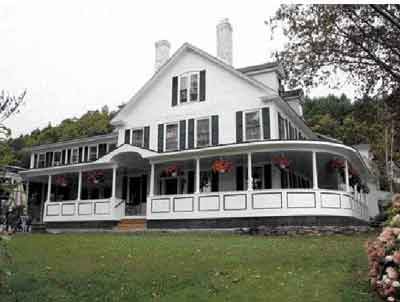
Stowe, Vt., is a classic New England town. One of its oldest and most visible structures is the historic Stowe Inn, located near the center of the village. When its owner decided to expand the dining room by adding a large wraparound porch, I was glad to get a call to discuss such a highly visible project.
Because of the building’s historic status, the town’s historic preservation commission insisted that the porch look like it had been around for a long time. Accordingly, the architect designed a porch reminiscent of those from the late 1800s. Most notably, the design included a rounded outside corner, a signature Victorian element.
Deck Framing
Other than the curved corner and a barrel vault over the inn’s front door, the porch design was conventional. We built a 2×10 pressure-treated floor system supported by 6×6 posts bearing on concrete piers spaced about 8 feet apart. To support the joists at the curved corner, we glued up a rounded girder from six layers of 1/2-inch pressure-treated plywood. The joists bear directly on this girder, and terminate in a curved band joist, which we laminated from three layers of 1/2-inch PT plywood. We also placed posts and girders near the building, so that most of the loads from the deck — which would support 100-psf commercial loads — would be carried directly to the ground, not to a ledger attached to the building.
We spent a little extra time laying out a double floor joist coming off the building’s outside corner at 45 degrees — or as close to 45 degrees as we could make it, given that the old building was not perfectly square. Since we planned to lay out the roof framing above from the same diagonal reference, we wanted it to be accurate.
To support the porch roof, we attached a ledger to the solid brick building with a combination of 3/8-inch lags and lead shields and epoxied threaded rod. At the eaves, we used three-layer built-up 2×8 beams for the straight runs and a laminated beam for the radius, all supported by fiber-reinforced synthetic columns.
Laminating a Curved Beam
While the crew worked on the straight sections of the roof, lead carpenter John Morin made the curved beam, using the same method he’d used to make the curved girder for the floor. He first did the layout on the plywood floor of our shop, using a trammel arm, then screwed 2×10 blocks to the floor, which provided the formwork for the six layers of 3/4-inch CDX plywood. Given the relatively large curve, we didn’t think we needed to compensate for spring-back, so we simply used the 9-foot design radius, figuring we could persuade the beam ends into position with clamps.
We let the glue dry for a couple of days, then delivered the beam to the job site in our stake-body truck and had a crew of four lift it into position. A plumb bob helped us line it up with the curving band joist below. Once the beam was level, we clamped it in place and marked where it would tie into the straight beams. As expected, we had to do a little prying and clamping to get the beam in its final position.
We removed the beam and Morin made stepped cuts on both ends using a circular saw, a recip saw, and a chisel; he also made corresponding cuts at the ends of the straight beams. We covered the mating surfaces with a thick layer of polyurethane glue, then pulled everything together with clamps.
Round Roof Framing
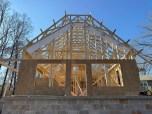
The next day John removed the clamps and went to work on framing the roof. He positioned the top end of the first rafter at the outside corner of the ledger, then used a plumb bob to line up the rafter tail with the diagonal floor joist below. This placed the first rafter in the center of the arc, where a supporting column would be located. For the rest of the rafters, John made long cheek cuts that tapered anywhere from 3/4 inch down to zero.
We spaced the eaves ends of the rafters 20 inches on-center so the segments of plywood sheathing would be the same size and shape as the standing-seam panels that would ultimately cover the roof. Matching the sheathing and the steel panels minimizes oil canning, the distortion in standing-seam panels that can be made worse by uneven substrates.
Soffits and Trim
With the roof framed, we moved on to the soffit and fascia. For the curved sections of the soffit, we used segments of 1/4-inch AC plywood, first scribing the joints in place to get a tight fit. We then used a simple site-made compass to mark a fair curve on the outside edge, and finished up by grinding and sanding to the line. We secured the soffit with polyurethane glue and finish nails.
We used cellular PVC boards for the curved fascia. We left the material in direct sunlight for a few hours, which increased its flexibility enough that we were able to make the bends.
We used similar methods to frame and trim the porch’s curving half wall. We framed the 2×6 walls with plates laminated and routed from 3/4-inch plywood. For the frame-and-panel treatment, we used 1/4-inch MDO for the panels and primed pine for the frames. A panel molding hides the gaps between the frame and panel.
Tim Meehan owns Northern New England Homes in Stowe, Vt.