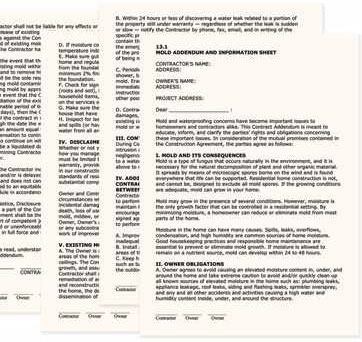
This addendum explains exactly what mold is and defines everyone’s responsibility in the event of a mold or moisture problem. To download the complete form, go to www.jlconline.com/public/legalkit.pdf.
Mold has been around for millennia, but in recent years public concern about its presence in homes and buildings has metastasized into near hysteria. This has spawned a legal atmosphere in which it’s relatively easy for unscrupulous owners to fabricate huge mold lawsuits against contractors. In fact, mold has become the new vogue for “dangerous clients,” and a growing number of law firms throughout the country specialize in — and profit from — mold litigation. The relatively short amount of time it takes to build a major case — and the ease with which it can be done — makes mold one of the pre-eminent legal threats a contractor faces today.
While it’s not possible to fully eliminate the risk of mold-related legal action, contractors can adopt certain procedures to limit that risk. Obviously, though, they have to be incorporated into the contractor’s business practice before any actual claims arise.
High Cost
Unlike most construction-defect claims — which focus solely on property damage — mold claims often involve a very costly personal injury claim as well. Why? Because even though most molds are harmless under ordinary conditions, some — most notably Stachybotrys — can pose health risks to people with weakened immune systems. These possible risks are what drive the personal injury claims, which have amounted to many millions of dollars — despite the lack of agreement in the scientific and medical community about what level of exposure can lead to health problems.
Most plaintiffs accuse the contractor of “negligence” as well, for failing to exercise “due care” to prevent the mold growth; claims also may be based on breach of contract, breach of warranty, liability for defective products, and even fraud.
Proper Paperwork
Fortunately for the contractor, the burden of proving these claims lies with the plaintiff. The key to pre-empting plaintiffs’ claims — and limiting your exposure — is having a good risk-management procedure in place. This will require some extra paperwork for you and your foremen, but it’s worth it: That paperwork could save your business someday.
A risk-management procedure requires that you do the following.
• Use construction specifications and procedures designed to prevent mold growth. Modern building materials like OSB are more mold-friendly than solid sawn lumber or plywood. Most houses are built tighter today than they were in the past; in cooling climates, many homes contain energy-efficient air conditioners that don’t dehumidify very well, along with vinyl wallpapers that trap moisture. All of this has made it harder for buildings to dry out.
• Document details. You or your field supervisor should keep a log that describes what’s been done to manage water and control moisture at every step of construction. If you want to include photos in this documentation, make absolutely sure the details have been properly executed. Otherwise, the pictures could work against you.
• Keep the homeowner informed. Owners need to understand that they bear some responsibility for limiting moisture levels inside their home. You can make this clear by educating them on the nature of mold and on what they need to do to prevent it, and by explaining what everyone’s obligations are in the event of a mold or moisture event. The Contractor’s Legal Kit — from which this article is adapted — includes a mold addendum (see previous page) that spells this out. If you’re concerned about a mold claim on a particular project, review the addendum with the clients and have them sign it before signing the contract.
• Use contract language that limits your liability, clarifies who is responsible for mold issues, and guarantees your right to respond to these problems before a claim is made. For example, all of the contracts and warranties in the Legal Kit include a mold exclusion (which, of course, should be reviewed and revised as needed by a local attorney).
Immediate Action
If a client reports a mold or moisture problem, it’s important that you respond immediately. Taking preventive steps and acting at the appropriate time is far more cost-effective than dealing with the inevitable consequences of turning a blind eye. Moreover, following an established procedure of response and notification will be considered crucial in the eyes of the court. Failure to do so could be viewed as a lack of professional conduct.
If you’re out of town, tell the homeowners to call their insurance company to submit a claim and keep all receipts for cleanup work. Otherwise, personally visit the site the same day. Ask the owners not to touch anything until you get there, but to stop water intrusion if possible.
If there’s a flood, stop the source immediately and drain any water trapped in cavities, being careful not to destroy evidence. Don’t attempt to clean up any mold; insurance companies are increasingly likely to deny coverage to contractors who try to solve mold-related problems themselves, because they can inadvertently spread contaminants. Call a remediation company.
Do just a visual inspection and record your findings — carefully. You should document, in photos and writing, the following:
• The condition of the property
• The source of the moisture
• Identification of all damaged materials and a description of all affected areas
• Evidence of material defects associated with the moisture or mold problem
• Potential sources of outside mold contamination
• Identification of all persons who provided information
Look throughout the property — especially in areas of the house that you did not work on — for other evidence of elevated moisture, and for nonconstruction sources of moisture (firewood stored indoors, houseplants, leaky faucets, and so on). Don’t make any hasty statements about causes or who is at fault. Just gather the information you need and tell the homeowners you will get back to them soon.
And be careful what you say to outside investigators. Typically they’re hired by the owner’s insurance company and are looking for a way to blame you, whether you’re at fault or not.
Notify other involved parties without delay: insurance carriers, subcontractors, architects, real estate agents, and the like.
If mold is indeed present and remediation is required, you may be able to avoid a lawsuit by entering into a settlement and release agreement, in which you agree to be responsible for getting the cleanup done and having a certification letter presented to the owner. However, you need a qualified attorney to advise you on this matter and to draw up the agreement.
Insurance Matters
Most insurance companies now exclude mold coverage from the contractor’s general liability policy, so if you’re sued you may be on your own. Costs for the legal defense and construction experts alone on a million-dollar mold claim can run well over $100,000.
If the mold claim also involves allegations of personal liability, however, you may be able to trigger insurance defense coverage and partial or total claims coverage. Again, this is a complicated area and is best discussed with your attorney.
Gary Ransone is an attorney and contractor based in Soquel, Calif. This column was adapted from his book The Contractor’s Legal Kit.