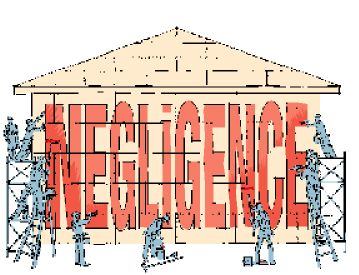
You might think that if a subcontractor gets hurt on your job site, it’s his problem. After all, he’s an independent contractor, not one of your employees. But sometimes it’s your problem.
An injured sub might be able to sue you for negligence, and if he does, he could win much more than your workers’ compcovered employee ever could. It doesn’t matter that the injured party is employed by a subcontractor, even if he’s covered by his own company’s workers’ comp policy. He can still sue you for negligence. In fact, his employer’s workers’ comp company could sue you to recover the money it pays out to him.
When your own employee is hurt on the job, the amount she can collect is usually limited to what workers’ comp will pay. But if a sub is injured on your job and if he can prove he was injured because of your negligence or the negligence of someone who works for you, there’s no legal limit on the amount of damages he can collect.
What Is Negligence?
A lawsuit for negligence is based on the premise that you had an obligation to do something (the law calls it a legal duty) and you didn’t do it or didn’t do it right. You have an obligation to keep your job site safe. That doesn’t mean that no one ever gets hurt on your site; it means no one should get hurt because of your carelessness, the carelessness of people you supervise, or some defect in the equipment you supply.
If a sub is injured because you don’t manage the site the way you’re supposed to, there are plenty of lawyers who would be happy to talk to him about suing you. If the injury is bad enough, they’ll go straight to the hospital to sign him up.
Here’s an example of what I’m talking about. In one case, the painting sub climbed up on the staging that was owned and erected by the masonry sub. But, unfortunately, the masons had removed one of the safety rails several days before; as a result, the painter fell off the staging and broke some bones.
If you think that’s the masonry contractor’s problem, think again. The painting sub sued the GC for negligence. The GC was found negligent because he knew or should have known that the masons had removed the safety rails, and he did nothing about it. The painting sub could also sue the masonry sub.
How Courts Decide
It’s important to understand that not every accident that a contractor might be liable for is caused by his own negligence. Sometimes the cause is someone else’s negligence; other times it’s just one of those things. How does a court decide whether a contractor is liable for an accident?
First it looks at safety standards. Was your job site as safe as similar job sites? Did your company have a safety policy in place? Did you do things like hold safety meetings and train people how to use nail guns? Being able to answer yes to these sorts of questions can help your case. You’re more likely to be found liable if your policies or past performance are found wanting.
Courts will also look at the OSHA and state safety standards for the activity that caused the injury. The attorney for the plaintiff subcontractor could use those standards as evidence of what you were supposed to do and could bring in witnesses to testify that you didn’t do it. But actual witnesses are not even necessary. In some cases, the mere fact that someone got hurt in a particular manner will be considered evidence of negligence. That’s the “trout in the milk bottle” legal principle. You don’t need to know how the fish got in there to know that something is screwy.
This is why your insurance company keeps urging you to make sure that your employees and your subs use safety equipment and follow all safety standards.
The Inadequacy of Insurance
Speaking of insurance, you might be thinking that you pay premiums for liability insurance so it will be there to pay claims by injured subs. Isn’t that what liability insurance is for? In theory, yes, but you might be sued for more than the amount of your coverage. Say you have a million-dollar policy and the plaintiff wins a judgment for two million. You get to pay that second million yourself.
Even if you win the case, you could find yourself paying higher premiums or looking for a new insurance carrier because your current carrier decides to cancel your policy. Insurance companies have access to vast databases of information, so your carrier is going to know about it if an accident happens on your site. If a sub’s employee files a comp claim against his own company’s insurance company for an injury that happened on your job, you could be affected by the fact that someone paid a claim on an accident that occurred on your site, even though there were no allegations of negligence on your site.
Here’s another potential problem with liability insurance. If you read your policy carefully, you may find exclusions for cases in which you were “grossly” negligent or failed to meet certain safety standards. Clauses such as those are subject to some interpretation, but you’re not the one who gets to do the interpreting.
As a contractor, your first and best line of defense is to put effective safety policies and procedures in place. There is no downside to safety. Make those safety procedures a part of your contract with your subs. Then you or your construction superintendent needs to get out there on the job site and see that those procedures are followed.
Quenda Behler Storyhas practiced and taught law for over 25 years and is the author ofThe Contractor’s Plain-English Legal Guide(www.craftsman-book.com).